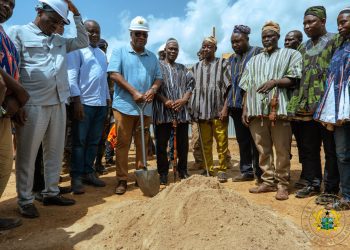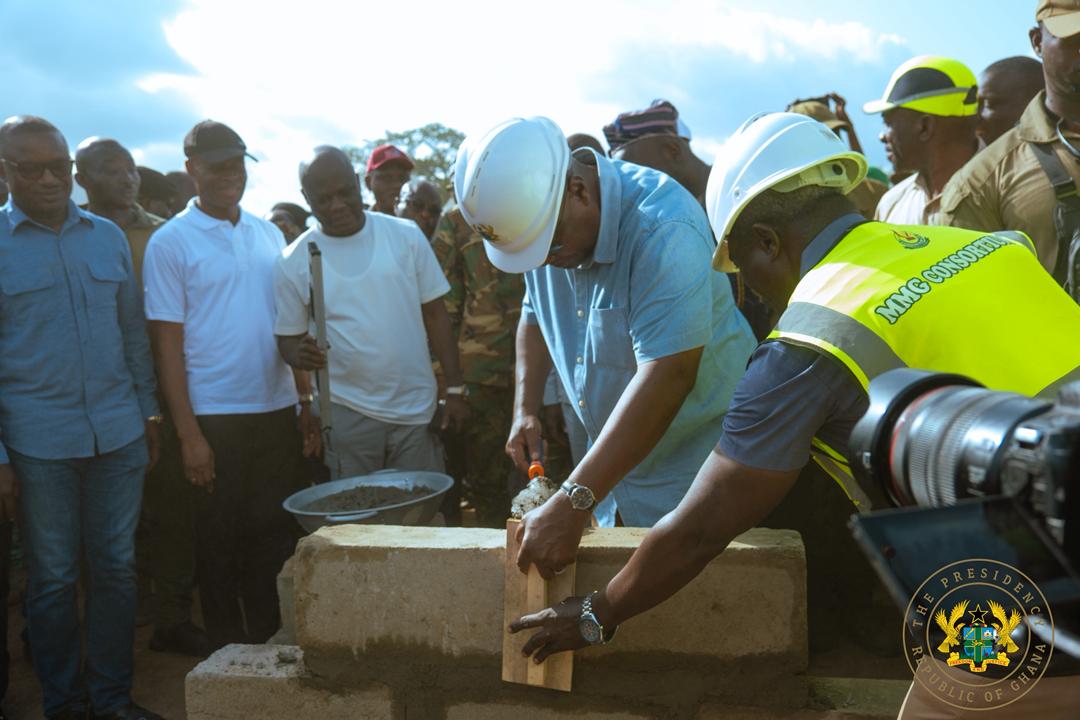
President John Dramani Mahama has cut sod for the construction of the Tenga STEM Secondary School, describing the project as a transformational investment that will prepare young people in the area for the future through science, technology and innovation-driven education.
Addressing residents during the ceremony, President Mahama reflected on the remarkable growth of Tenga over the years, noting that the once small community had become one of the largest towns in the area after Bole.
“When I was a Member of Parliament, Tenga was a small town. But over the years, Tenga has grown significantly and today stands as one of the major communities in this area, second only to Bole,” he said. “That growth reflects the determination and hard work of the people of this community.”
The President used the occasion to emphasize the importance of patience and perseverance, saying the people of Tenga had waited many years for a secondary school of their own.
“For a long time, there was a desire to establish a secondary school here,” he said. “The people of Tenga demonstrated patience and never lost hope.”
He recalled that under the Community Day Senior High School programme, discussions had initially led to the establishment of schools in Bamboi and New Longoro to serve surrounding communities, while Tenga’s own efforts to establish a school with Assembly support had faced setbacks.
“But today is different,” President Mahama declared. “Today is a happy day because what we are beginning is bigger and more transformational than what we imagined years ago.”
According to him, the Tenga STEM Secondary School will not be an ordinary institution but a modern centre for science, technology, engineering and mathematics education.
“It will have modern science and technology laboratories, boarding facilities, teachers’ bungalows, and all the infrastructure needed to deliver quality education,” he stated.
He added that once completed, the school would resemble a university campus and create opportunities for generations of young people in the area.
President Mahama assured residents that funding had already been secured through the Ghana Education Trust Fund (GETFund), stressing that the project would not be abandoned midway.
“Let me assure the people of Tenga that this is not one of those contracts that will begin and stall. GETFund has made resources available for this project,” he said.
Although construction was originally expected to begin in 2025, he explained that unforeseen circumstances delayed the start of the project.
“We are beginning now, and once work starts, we intend to move quickly to completion,” he added.
The President expressed confidence that the school would be completed and commissioned before the end of his tenure.
“I strongly believe that before I leave office, this school will be completed and commissioned,” he said. “When that happens, children in Tenga will no longer have to leave home in search of quality secondary education.”
He outlined a vision of a complete educational pathway within the community, where children can progress from primary school through junior high and secondary school before proceeding to university. “That is the educational ladder we want to build,” he emphasized.
President Mahama also announced plans to improve infrastructure at the Bamboi school by adding boarding facilities to increase enrollment and improve access to education.
Beyond education, the President highlighted major healthcare interventions planned for the area.
He announced that Banda Nkwanta would receive a clinic, while the existing Tenga Health Centre would be upgraded into a polyclinic to meet the needs of the growing population.
“Tenga itself was among the first communities to benefit from a health centre, but with population growth and increasing demand, that facility is no longer adequate,” he said.
He further disclosed that the Bole Hospital would be upgraded into a 160-bed District Hospital to strengthen referral services across the area.
“This is how development should work,” President Mahama stated. “Strong communities supported by strong educational and health infrastructure.”
Story: Patrick Asford Boadu