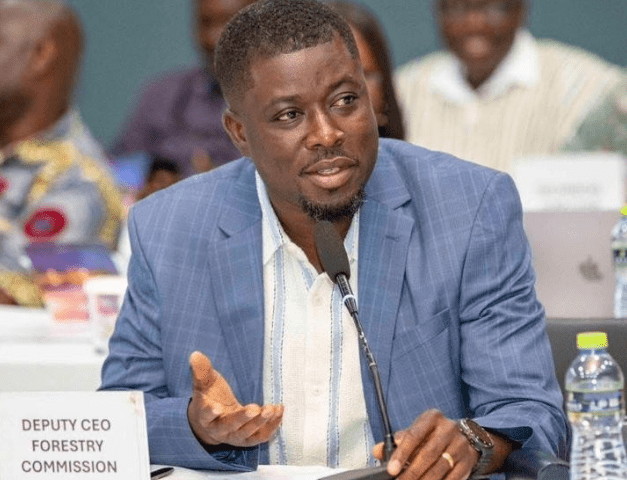
The Deputy Chief Executive Officer of the Forestry Commission, Elikem Kotoko, has raised serious concerns over increasing attacks on Ghana’s forest reserves, warning that illegal mining, logging, and poaching continue to pose major threats to the country’s environmental security and natural resources.
Speaking on efforts being intensified to protect forest reserves across the country, Mr Kotoko revealed that large portions of Ghana’s forests have come under severe pressure over the past decade, particularly following the passage of Legislative Instrument (L.I.) 2462, which he said opened the floodgates for illegal activities to thrive within forest zones.
“Our forests were under so much stress and breached,” he stated, describing the situation as a national emergency requiring urgent and coordinated intervention.
As part of efforts to strengthen forest protection, the Forestry Commission has established specialized protection camps within vulnerable forest reserves to improve rapid response and surveillance against encroachers.
According to Mr Kotoko, the initiative has received support from the United Kingdom government, which has so far provided ten protection camps equipped with communication gadgets and rifles for forest guards operating in high-risk areas.

The camps are expected to house teams of officers working in shifts to monitor and secure forests against illegal miners, illegal loggers, and poachers.
He explained that although illegal mining has dominated national attention, illegal logging and poaching remain equally dangerous threats to Ghana’s forests and biodiversity.
Mr Kotoko underscored the critical importance of forests to Ghana’s survival, noting that forests serve as vital sources of clean drinking water, environmental protection, and climate regulation.
“If nothing at all, we have all learned and heard of the old dictum that when the last tree dies, the last man dies,” he said.
He argued that the Forestry Commission deserves stronger institutional support because forest reserves play a direct role in protecting water bodies and maintaining ecological balance.
The Deputy CEO further suggested that agencies such as the Ghana Water Company should contribute financially towards forest protection efforts because many of the country’s water sources originate from protected forest areas.
In a striking remark, Mr Kotoko stated that he would personally support the deployment of military personnel to fully take over forest protection operations if government deemed it necessary.
“The forest is a national asset that must be protected so well,” he declared.
According to him, the Forestry Commission currently lacks adequate manpower and logistical capacity to effectively police the country’s over 280 forest reserves.
He disclosed that the Commission faces a staffing deficit of more than 2,200 forest guards needed to properly monitor and secure the reserves.
“It’s not enough at all,” he admitted when questioned about the current number of protection camps and personnel.
Mr Kotoko revealed that forest protection officers undergo rigorous military training before deployment, but noted that financial constraints and delays in recruitment clearances continue to hinder efforts to scale up operations.
He, however, expressed optimism that government support, coupled with increased assistance from corporate Ghana and international partners, could significantly improve forest protection efforts in the coming years.
The Deputy CEO used the occasion to appeal to private companies and development partners to support the Forestry Commission with vehicles, logistics, equipment, and other operational resources.
“The same support given to other security agencies should apply to the Forestry Commission,” he appealed.
Mr Kotoko maintained that protecting Ghana’s forests is not only an environmental necessity but also a matter of national security and economic survival.