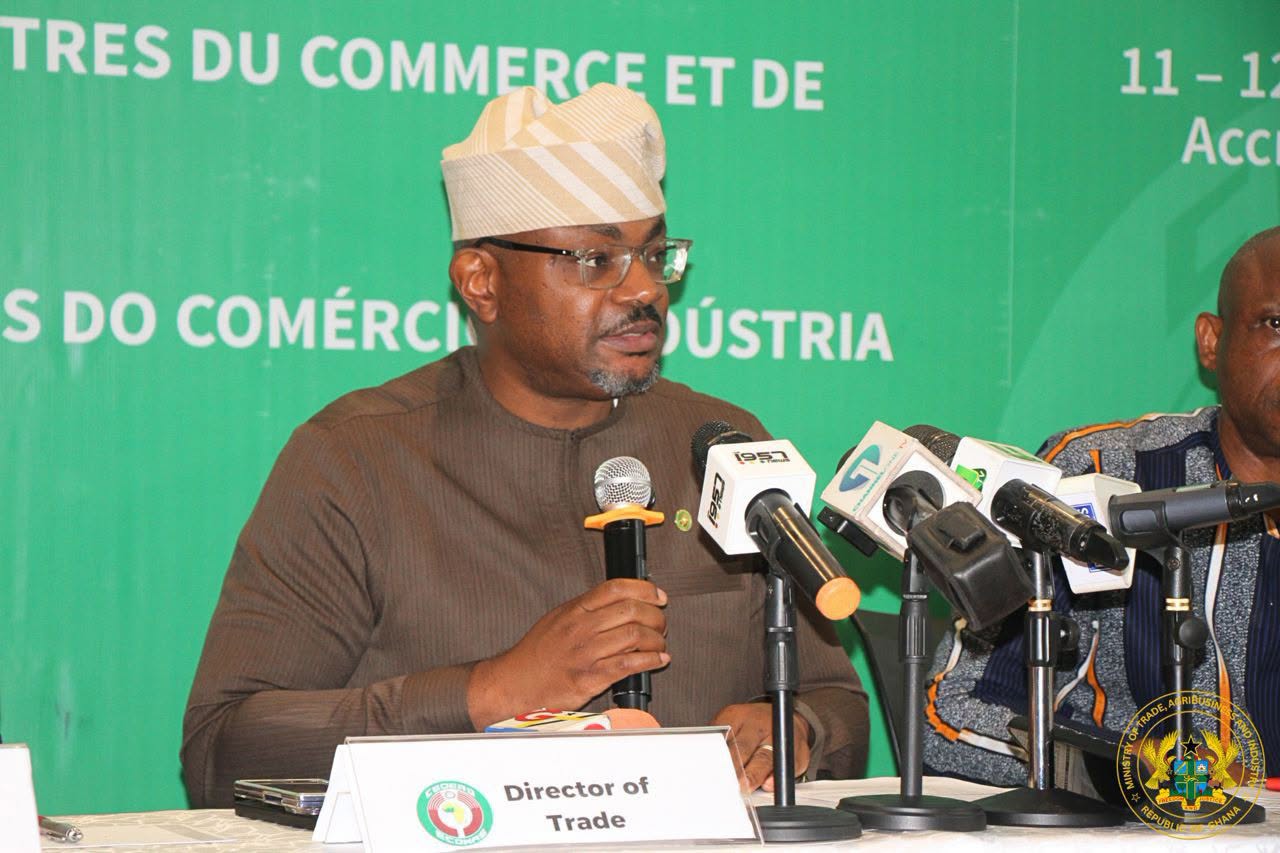
The ECOWAS Commission has launched a high-level ministerial media briefing ahead of a crucial three-day regional summit, outlining a unified strategy to accelerate economic integration, harmonize investment policies, and protect consumers across West Africa.
Addressing the press, executive leadership from the Commission emphasized that the meeting of regional ministers is designed to establish a coordinated approach to navigating the current economic environment. Over the course of the summit, ministers will evaluate critical reports and frameworks submitted by technical committees across four primary pillars: trade, industry, investment, and competition.
Kolawole Sofola, the Executive Director of Trade at the ECOWAS Commission, highlighted the host nation’s pivotal position in driving the sub-region’s economic agenda. Sofola noted that Ghana not only occupies a central place in the regional integration framework but also hosts the African Continental Free Trade Area (AfCFTA) Secretariat.
Acknowledging the host country’s active preparation, Sofola extended gratitude to the local ministry, specifically commending the Deputy Minister of Trade, Agribusiness, and Industry for delivering the host country’s opening remarks at the Senior Trade Officials’ meeting on June 8.
Harmonizing Industrial Policy and Bridging Regional Gaps
The summit will heavily focus on addressing structural disparities in West African industrialization. Ogonye Peter, the Acting Director for Industry and Private Sector Promotion, revealed that while the West African Common Industrial Policy was adopted in 2018, a subsequent 2023 review exposed a fragmented landscape.
”One of the gaps is that there’s a divergent approach to industrialization among member states. Most member states do not even have an industrial policy, and the ECOWAS policy existing since 2018 has only inspired a shallow level of adoption.”
To rectify this, a newly validated implementation strategy has been submitted to the ministers. This framework provides targeted technical assistance to help member states either develop their first industrial policies or align existing ones with the broader regional vision. Additionally, the committee presented harmonized quality standards for processing six key agricultural commodities, alongside standardized regulations for infant complementary food products to safeguard market access and product quality.
Aligning Investment Codes and Addressing Policy Breaches
The economic convergence strategy further extends to the ECOWAS Common Investment Market, a framework designed to foster a predictable, attractive cross-border investment climate. Ogonye Peter noted that the regional framework aligns smoothly with the continental AfCFTA investment protocol, meaning West Africa requires minimal structural adjustment and can focus instead on fast-tracking execution.
However, serious concerns were raised regarding member states bypassing regional protocols to sign independent bilateral trade agreements.
”Each of these instruments says that member states can no longer have bilateral investment treaties. But today we are seeing member states pushing to sign bilateral investment treaties among themselves, pointing to the fact that either there is a lack of understanding… or that member states are deliberately ignoring them.”
The upcoming ministerial sessions are expected to yield an official pronouncement addressing these compliance gaps. Furthermore, the Commission will update ministers on the rollout of the ECOWAS Business Council, an apex body designed to ensure the private sector is fully mainstreamed into cross-border value chains and project financing.
A New Frontier for Cross-Border Consumer Protection
Addressing the growing realities of digital trade and expanded community markets, Dr. Siméon Koffi, the Executive Director of the ECOWAS Regional Competition Authority (ERCA), announced the submission of a pioneering draft regional regulation on cross-border consumer protection.
While intra-regional trade currently accounts for less than 15% of West Africa’s total external trade, Dr. Koffi pointed out that expanding digital platforms have brought new vulnerabilities. The proposed regulation serves as a coordinated defense against misleading commercial practices, unsafe products, and unfair digital manipulation.
”This initiative is not about restricting trade. Rather, it’s about building trust in our markets. A trusted marketplace attracts investment.”
The proposed framework establishes clear rights to product safety, accurate information, privacy, and effective redress, while introducing robust consumer compensation structures and legal enforcement mechanisms through the ECOWAS Court of Justice.
Following ministerial review and guidance, Dr. Koffi stated that the draft regulation will progress to the ECOWAS Parliament and the Council of Ministers for final legal adoption, signaling a historic step toward a secure, integrated regional economy.
Story By: Eugenia Ewoenam Osei