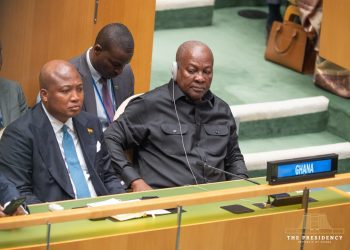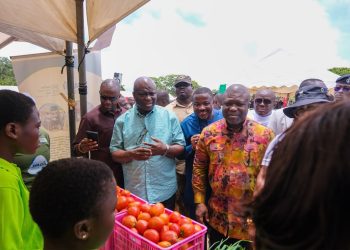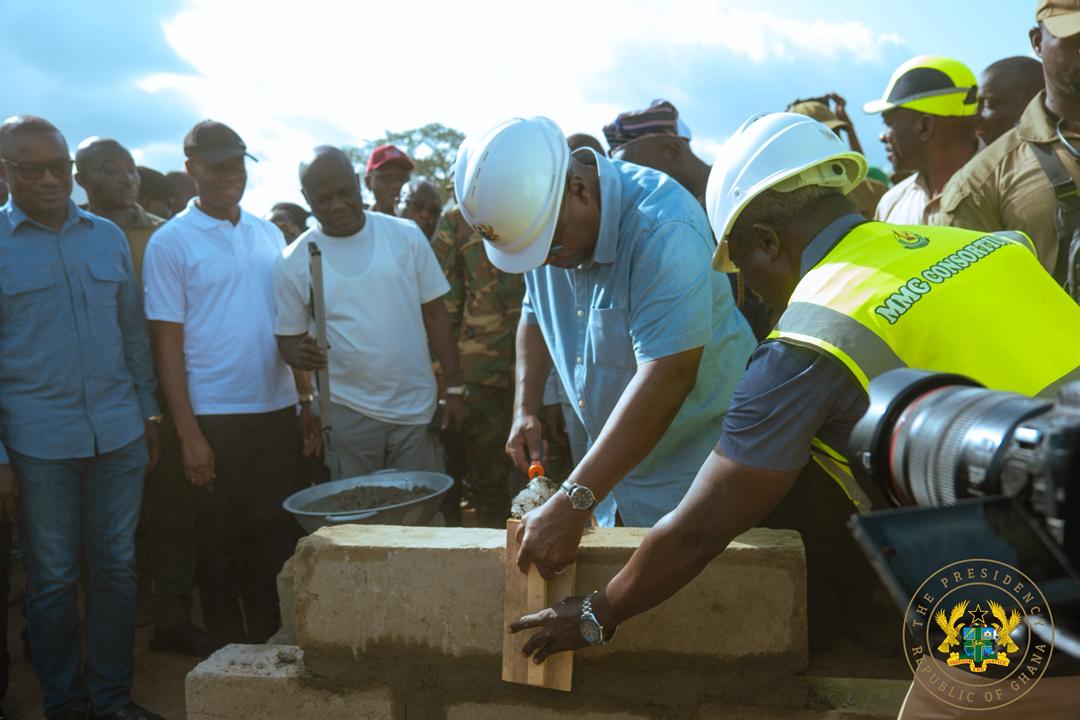
President John Dramani Mahama has cut sod for the construction of the Busunu STEM Girls’ Senior High School, describing the project as a major step toward expanding access to science and technology education for girls across Ghana.
Addressing chiefs, residents and stakeholders at the ceremony in Busunu, the President said the project forms part of government’s broader strategy to democratize STEM education and ensure that children in all parts of the country have equal opportunities to pursue careers in science and engineering.
He noted that the ceremony marked an important milestone for education and the future of young people in the area. “We are here to mark an important milestone in education and in the future of our young people,” he stated.
President Mahama explained that STEM, which stands for Science, Technology, Engineering and Mathematics, was introduced as a response to concerns about declining student interest in science-related subjects.
“As I mentioned yesterday, in the past, the way these subjects were taught often discouraged many of our children from pursuing science-related programmes,” he said.
“As a result, many students gravitated toward arts, humanities and business courses instead of becoming doctors, agricultural scientists, civil engineers and other professionals our country urgently needs.”
The President revealed that in 2012, his administration commissioned a study to examine why students were struggling to engage effectively with science and mathematics education.
“From that study emerged the idea of integrating STEM education directly into the secondary school curriculum,” he explained. According to him, the initiative first began with STEM vacation classes aimed at encouraging girls to participate in science education before later expanding to include boys.
“At the beginning, we introduced STEM vacation classes. Initially, these were targeted at girls and later expanded to include both boys and girls,” he said.
President Mahama noted that although the policy framework was developed during his previous administration, implementation only began after his government left office.
“The report was completed, although we were unable to fully implement it before leaving office. The government that succeeded us started implementation,” he stated.
However, he argued that the implementation was limited to selected schools and did not sufficiently benefit students in underserved communities.
“Our view is different. We want to democratize STEM education so that every child, regardless of where they live, has access to these opportunities,” he stressed.
He explained that government’s strategy now involves both constructing dedicated STEM schools and upgrading existing secondary schools with STEM laboratories and facilities.
“That is why, while we continue to build purpose-designed STEM secondary schools, we are also equipping existing secondary schools with STEM laboratories and facilities so they can equally deliver science and technology education,” he said.
President Mahama emphasized that the Busunu project was specifically designed to empower girls and encourage greater female participation in science and engineering careers. “Today, we are not only cutting sod for a STEM school, we are cutting sod for a STEM Girls’ School,” he declared.
“This school will create opportunities for young women to study Science, Technology, Engineering and Mathematics and pursue careers in areas that have traditionally seen fewer women represented.”
He expressed confidence that the school would nurture future female professionals and national leaders.
“I believe this school will produce generations of capable women who will become doctors, midwives, civil engineers, technicians, electrical engineers and leaders who will contribute significantly to the development of Ghana,” he added.
The ceremony also took an emotional turn when President Mahama spoke about the decision by the Busunuwura to name the school after his late mother.
“I also want to express my heartfelt appreciation to my father, the Busunuwura, for surprising me with the announcement that this school will be named after my mother,” he said.
The President recounted how his mother grew up in Busunu and how his parents’ relationship began in the community.
“This is deeply meaningful because my mother grew up here in Busunu. It was here that my father met her,” he noted.
“I have often heard the story from my uncles about how my father would travel here, sometimes at night, to visit her.”
“One day, as the story goes, he arrived on his motorcycle, took my mother with him, and rode with her to Damongo. That became part of our family story and, in time, led to the family we became,” he added to applause from the crowd.
President Mahama assured residents that funding for the project had already been secured and that construction work was expected to proceed without delays.
“As our traditional leader indicated earlier, funding for the project has already been allocated and secured,” he said. “Therefore, there should be no delays caused by lack of financing.”
He disclosed that the project had an 18-month completion timeline and expressed optimism that the school would be ready by the end of 2027.
“The contract period is expected to be 18 months, and so, if all goes according to plan, we will gather here again by the end of 2027 to commission this school,” he stated.
The President further assured contractors that payments would be made promptly as work progressed. “As work progresses and certificates are submitted, payments will be processed promptly to ensure steady progress. Money should not become the reason for slowing down construction,” he said.
President Mahama officially declared construction work commenced and encouraged young girls to pursue ambitious dreams. “To the young girls who will one day study here, I want you to dream boldly,” he said.
“One day, many of you will become doctors, nurses, midwives, engineers, scientists and innovators who will transform our nation.”
He concluded with a message of hope for the future of the institution. “May this school become a place of excellence and opportunity for generations to come,” he said.
Story: Patrick Asford Boadu