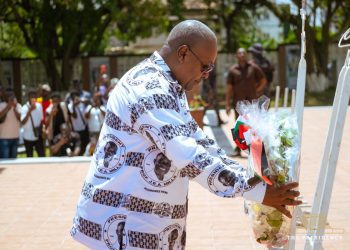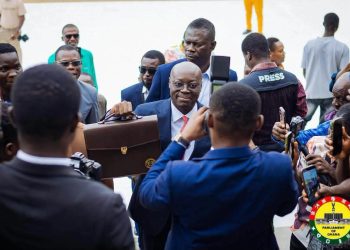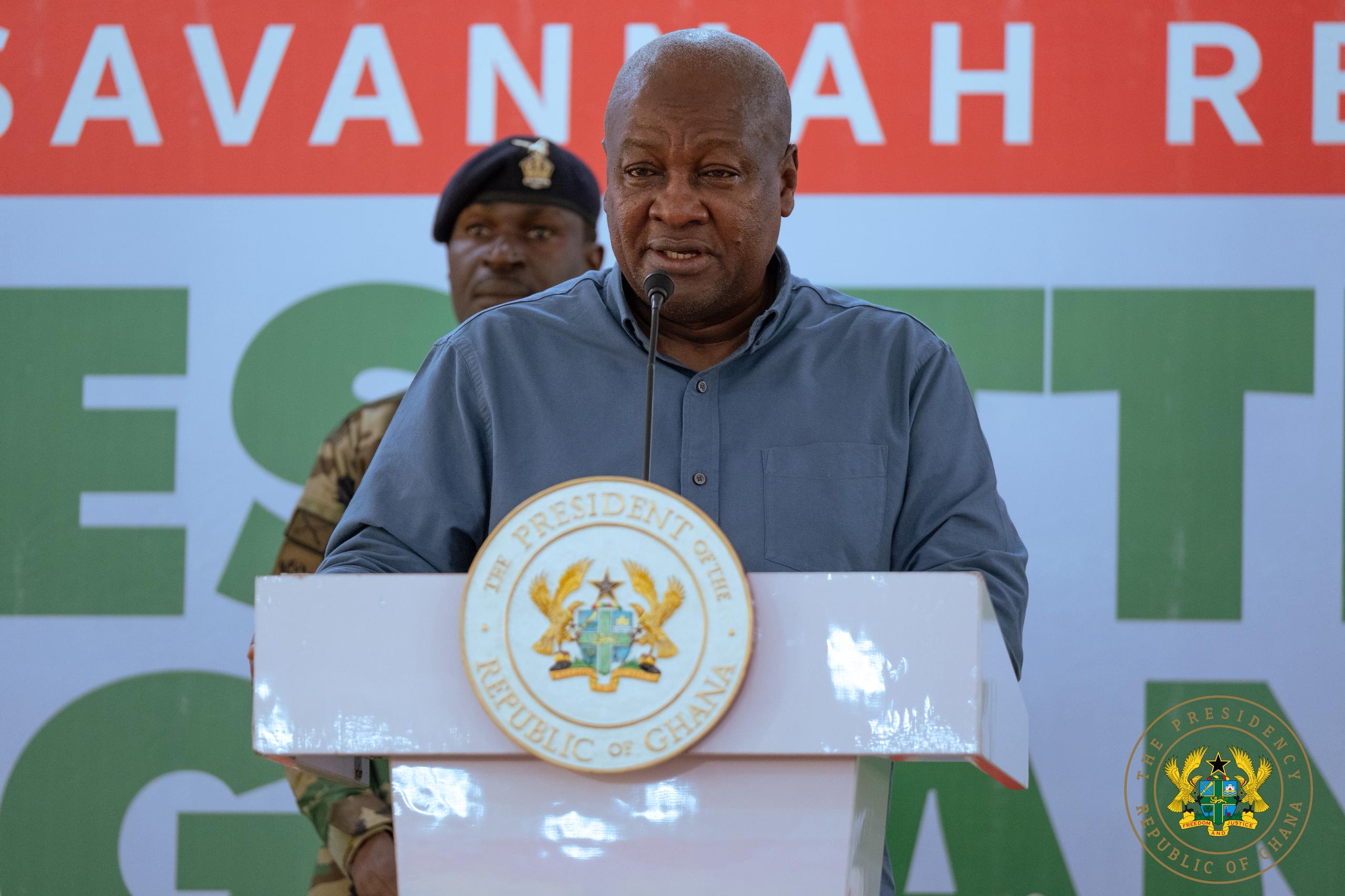
President John Dramani Mahama has outlined what he described as significant gains in Ghana’s economic recovery while announcing a series of major development projects for the Savannah Region during a community engagement in Damango.
Addressing residents, traditional leaders and local officials, President Mahama said Ghana’s economy had become more resilient despite global economic uncertainties.
“We have achieved macroeconomic stability. Inflation came down to 3.2%, but has risen marginally to 3.4% due to external factors,” he said.
“That is a clear sign of a resilient economy. In the past, whenever there was an external shock, inflation would rise sharply and the currency would depreciate rapidly.”
According to the President, the country’s key economic indicators now point to improved stability and stronger financial management.
“Today, however, the indicators point to greater stability. The currency remains stable, interest rates have declined, and our reserve position continues to strengthen,” he stated.
President Mahama disclosed that Ghana’s foreign reserves currently stand at $13.9 billion, with government targeting a substantial increase to strengthen the country’s capacity to withstand future shocks.
“We have come up with a new policy to build the reserves even higher to be able to cover 15 months of imports so that in the event of any external shock Ghana’s economy will be resilient and will not be affected,” he said.
The President also announced that Ghana had reached the final stages of its International Monetary Fund programme, which he said his administration inherited under difficult conditions.
“We inherited the IMF programme from the previous government. At the time we took over, all performance indicators were off track. It meant that the programme was in danger of derailment,” he explained.
He said government implemented difficult corrective measures during its first quarter in office to restore confidence in the programme.
“The first review mission approved the programme, the second mission also endorsed our progress, and the final mission concluded its work in Ghana just last week. Their assessment of our performance was positive and satisfactory,” he revealed.
President Mahama noted that the programme would now proceed to the IMF Board for approval of the final $380 million tranche. Despite the progress, he cautioned against complacency.
“We are not going to celebrate prematurely or declare victory too early because we recognise that the work is not yet finished,” he stressed.
The President further disclosed that government had agreed with the IMF to transition from the Extended Credit Facility to a Policy Coordination Instrument.
“It means that every six months, I would sit with the IMF to look at how our reforms are going and see whether we are still maintaining the kind of discipline with which we started,” he said.
“It is my hope that this is the last time that Ghana will go to the IMF for a bailout. We must be able to manage our affairs in such a way that we don’t go begging anybody to come and bail us out.”
President Mahama also highlighted what he described as rapid economic expansion under his administration.
“At the time we took over, the total gross domestic product, the size of our economy, was just about $80 billion. Within one year and a few months, we have increased that size of the economy to $114 billion,” he said.
“Today as I speak with you, Ghana has moved from number 11 biggest economy in Africa to number 8 biggest economy in Africa.”
He said non-traditional exports had also seen significant growth. “When we came into office, the total value of non-traditional exports was $3.83 billion. In just about one year, we have moved the total value of non-traditional exports from $3.83 billion to about $5 billion,” he stated.
President Mahama linked the economic growth to increased investments in infrastructure, education, agriculture and healthcare.
“One of the first things we did was to pass a policy that said that 80% of the District Assemblies Common Fund should be transferred directly to the districts,” he noted.
“Today, as I speak, all the DCEs will testify that 80% of their money is received and it is received in a timely manner.”
According to him, the policy has accelerated local development projects across the country.
“CHPS compounds are being built, schools are being built, 24-hour markets are being built,” he said.
The President emphasized the need for balanced national development, noting that poverty indicators still show the northern regions lagging behind.
“Even though the constitution says that we must be fair in distribution of development, it also says that we must be balanced in terms of distribution,” he explained.
“That is why every country tries to achieve balanced development and Savannah is one of them.”
As part of government’s intervention plans for the region, President Mahama announced the establishment of a new Science and Technology University in the Savannah Region.
“Already the Chinese government have given us a grant of $30 million to start this university,” he disclosed.
“In addition, we have applied to BADEA, which is the development bank of the Arab nations, to give us another $100 million to enable us build a good campus.”
The President also announced plans for a new 300-bed Savannah Regional Hospital at Swalipi.
“This will be a 300-bed hospital with all the modern facilities, x-rays, CT scan, MRI and everything you need to have a quality outcome in terms of healthcare,” he said. He explained that the hospital would serve as the referral centre for all district hospitals in the region.
President Mahama further revealed that government was advancing procurement processes for the long-awaited Damango Water Project. “This project is going to draw water all the way from Yapei,” he said. “Damango will receive water, extended to Larabanga and Mole Game Reserve.”
On roads and sports infrastructure, the President assured residents that the Savannah Region would benefit from ongoing national projects. “Some of the roads that have not been captured yet will be captured under phase two of the Big Push,” he said.
He also announced that Savannah Region would receive a regional sports stadium after progress is made on the regional hospital project.
Touching on rural electrification, President Mahama disclosed that 172 communities had been captured under the first phase of a new electricity expansion programme.
“The contract has been signed, the contractors are moving to sites, and so 172 communities that didn’t have lights before will have lights,” he said. He noted that Savannah Region currently has one of the lowest electricity coverage rates in Ghana.
“Our intention now is to move it from 68% as close to the national average of 90% as possible,” he stated. “We are looking at solar solutions for those who are not closer to the grid because the grid is too far to be able to extend to their communities.”
Story: Patrick Asford Boadu