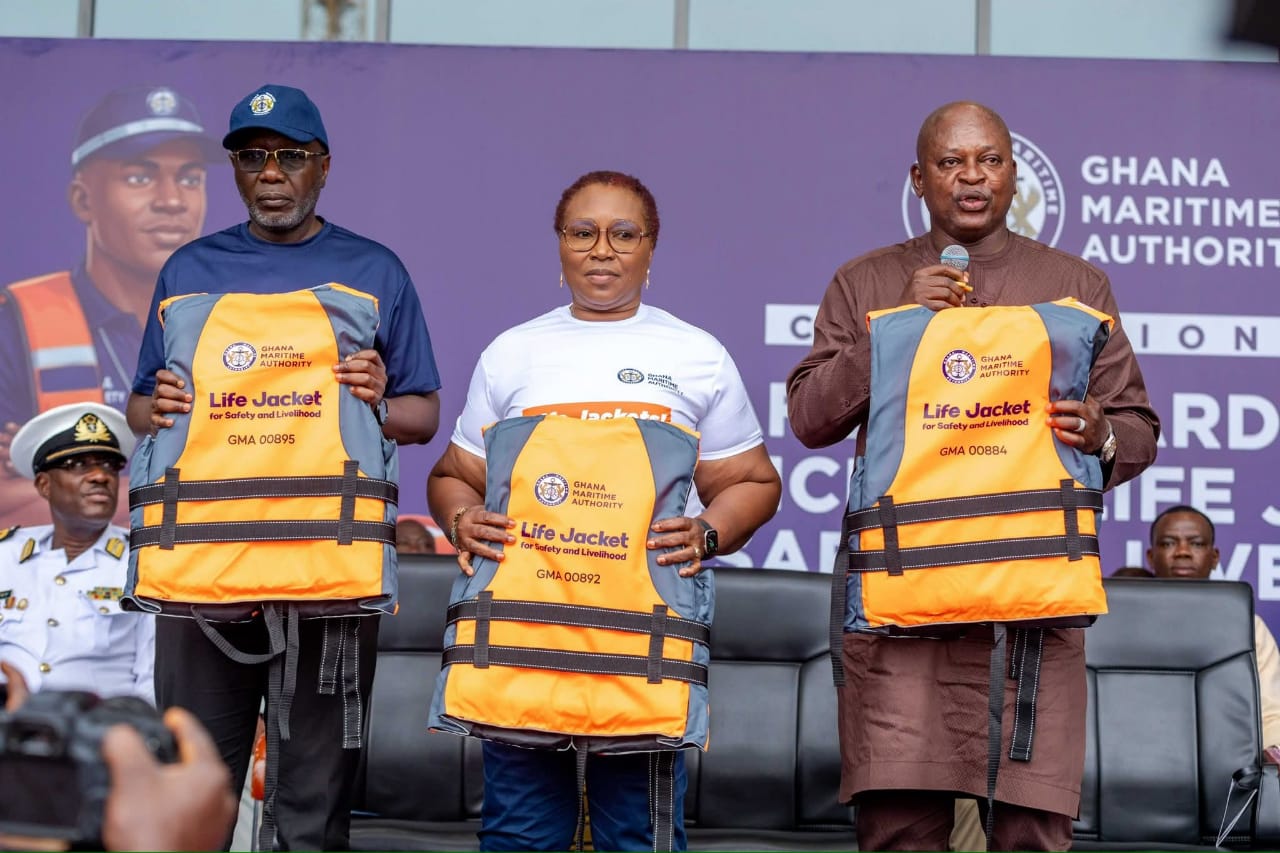
The Director-General of the Ghana Maritime Authority (GMA), Dr. Kamal-Deen Ali, has launched the “No Life Jacket, No Crossing of Ghana’s Inland Waters” initiative, a nationwide campaign aimed at reducing preventable accidents and improving safety on the country’s inland waterways.
Speaking at the launch, Dr. Ali described the initiative as a life-saving movement designed to protect the thousands of Ghanaians who rely on rivers, lakes and other inland waterways for transportation and economic activities.
“We are not just launching a program; we are initiating a life-saving movement aimed at sustaining livelihoods and protecting families and persons who depend on our waterways,” he said.
According to him, the initiative marks a shift from merely acknowledging tragedies on Ghana’s waterways to taking concrete action to prevent them.
“For far too long, our inland waterways have been a source of anxiety, with accidents that are largely preventable,” Dr. Ali noted.
As part of efforts to strengthen maritime safety regulation, the GMA has significantly expanded its operational presence across the country. Dr. Ali revealed that the Authority has increased its coverage by nearly 70 percent since last year, opening new offices in Akosombo, Kete Krachi, Bamboi, Saboba, Wa, Agona, Jewab, Ngaliche and Shama, among others.
He said the expansion demonstrates the Authority’s commitment to the government’s resetting agenda by bringing maritime safety services closer to communities.
A key component of the initiative is the Life Jackets for Safety and Livelihood Programme, which seeks to make life jackets more accessible and affordable for passengers and boat operators.
Dr. Ali announced that life jackets would be sold at subsidized prices to encourage individuals who regularly travel on water bodies such as the Volta Lake, White Volta and Black Volta to own personal safety equipment. He added that life jackets would also be available for rent at affordable rates for occasional travellers.
“We intend to have life jackets available at discount prices so individuals can purchase them. But we will also make them available for rental so that no passenger has an excuse for not wearing one,” he explained.
The Director-General also introduced a newly trained team of Safety Guards who will be stationed at landing sites and waterways to enforce safety regulations.
Their primary responsibility, he said, will be to ensure that no boat departs without every passenger wearing a life jacket.
“Their mission is to ensure that no boat leaves the shore without all passengers wearing life jackets,” he stressed.
Dr. Ali praised the Safety Guards for their dedication and rigorous training and expressed confidence in their ability to promote a culture of safety on Ghana’s waterways.
He also acknowledged the support of the Minister for Transport, the Governing Board of the GMA, the Ghana Navy and Vacances Limited for their contributions toward the successful implementation of the programme.
Appealing to boat operators, Dr. Ali urged them to view the Safety Guards as partners rather than adversaries.
“A safe boat is a trusted business platform. These Safety Guards are helping us achieve that,” he said.
He further called on passengers, traditional leaders, Members of Parliament, Metropolitan, Municipal and District Assemblies, and local communities to support the initiative and help make Ghana’s waterways safer for all.
The “No Life Jacket, No Crossing” initiative forms part of broader efforts by the Ghana Maritime Authority to strengthen safety standards, reduce fatalities and promote responsible use of inland waterways across the country.
Story: Patrick Asford Boadu