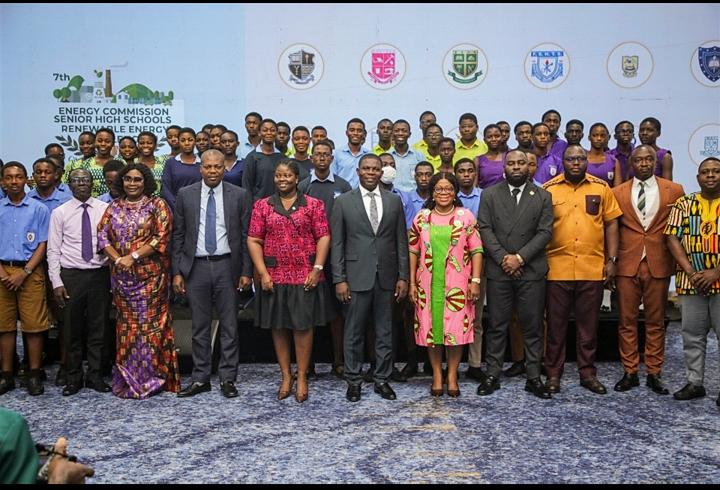
The Deputy Minister for Energy and Green Transition, Richard Gyan-Mensah, has officially launched the 7th edition of the Energy Commission’s Senior High School (SHS) Renewable Energy Challenge, urging students to move beyond academic theory and develop practical, market-ready solutions for the country.
Speaking on behalf of the Minister for Energy and Green Transition, John Abdulai Jinapor, the Deputy Minister emphasized that the ministry places immense premium on youth-led innovation. He noted that the initiative has experienced remarkable growth over the past six years, evolving from a localized competition of six schools in the Greater Accra region into a highly recognized national platform for creativity and clean energy education.
This year’s event, dubbed the “Champions of Champions” edition, brings together past winning schools and top-performing institutions to compete on long-term sustainability and real-world relevance. The event is running under the theme, “Harnessing Renewable Energy to Power Ghana’s 24-Hour Green Economy.”
The Deputy Minister stated that while Ghana has achieved nearly 90% electricity access, several remote and underserved communities still lack reliable power due to the high financial costs associated with extending the national grid. He pointed to solar systems, mini-grids, off-grid systems, and biomass technologies as essential, practical alternatives to bridge the rural-urban energy gap while driving economic growth.
Addressing the participating students, he stressed that their task extended far beyond a classroom exercise. He challenged them to think concurrently as engineers, entrepreneurs, and policymakers to design solutions that are technically sound, financially practical, and socially impactful.
He urged the competitors to create projects that have a direct, tangible impact on the daily lives of everyday citizens across various sectors of the Ghanaian economy.
”Let the project you develop today speak for the farmer,” Gyan-Mensah noted. “Let a project speak for the fisherman in my hometown, Apam. Let a project speak for the trader in Kasoa market. Let a project also look at the manufacturer in Tema.”
He also extended this charge to the health sector, asking students to develop energy solutions capable of easing the challenges faced by rural nurses.
The Deputy Minister commended the Energy Commission for conducting a six-year impact assessment of the program, stating that this demonstrated a clear commitment to measuring true transformation in Science, Technology, Engineering, and Mathematics (STEM) education and community development.
He assured stakeholders that the ministry, alongside the Energy Commission and corporate partners like the Bui Power Authority and GIZ, is fully prepared to mentor, train, and nurture the young innovators to help drive Ghana’s broader climate agenda and energy transition.
In his concluding remarks, the Deputy Minister lauded the dedication of teachers, mentors, parents, and sponsors. Motivated by the high caliber of the competing schools, he pledged to establish a localized version of the competition within his own constituency, Gomoa West, to prepare local schools for future national editions.
To further incentivize the competition, he announced a personal cash prize of 10,000 Ghana Cedis for the ultimate winning school before declaring the 7th edition of the challenge officially launched.
Story By: Eugenia Ewoenam Osei