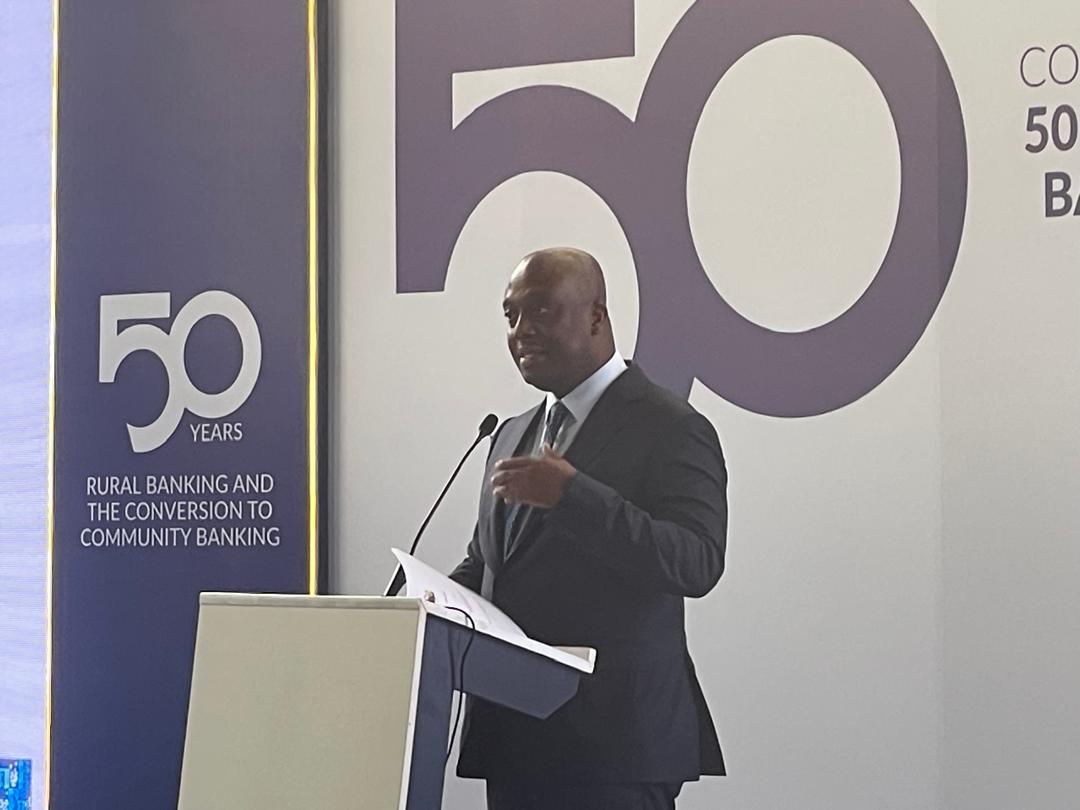
The Deputy Minister for Finance, Thomas Nyarko Ampem, has described Ghana’s Rural Banking sector as one of the country’s greatest yet least celebrated development success stories, saying Community Banks have transformed millions of lives by bringing banking services to people who were once excluded from the formal financial system.
Delivering the keynote address on behalf of Finance Minister Dr. Cassiel Ato Forson at the commemoration of 50 years of Rural Banking in Ghana, Mr. Ampem said the transition from Rural Banks to Community Banks marks the beginning of a new chapter in Ghana’s financial inclusion agenda, one that seeks to expand access to finance, strengthen local enterprise and drive inclusive economic growth.
Drawing inspiration from Adam Smith’s landmark economic work, The Wealth of Nations, published exactly 250 years ago in 1776, Mr. Ampem said Ghana gave practical expression to that philosophy two centuries later by recognising that national prosperity depends on empowering ordinary people to produce, trade and invest.

He recalled that before the introduction of Rural Banks in 1976, banking services remained largely inaccessible to farmers, traders and artisans, leaving many communities dependent on informal lenders and limiting opportunities for economic advancement.
“So Ghana made a bold decision,” he said, explaining that government deliberately took banking to the people because financial inclusion was recognised as a powerful engine for productivity, investment and national development.
According to the Deputy Minister, that decision has exceeded expectations.
Today, the sector comprises 147 licensed institutions, operating through nearly 1,000 branches and serving more than eight million customers across the country.
He described the achievement as one of Ghana’s most remarkable development successes, noting that few sectors can claim to have transformed lives as quietly, consistently and profoundly as community banking.
Mr. Ampem stressed that the transition to Community Banking is far more than a change of name, describing it as a renewed vision designed to prepare the sector for a rapidly changing economy.
He explained that while Rural Banks successfully expanded financial access over the past five decades, the next phase must embrace digital innovation, stronger governance and broader access to financial services.
“Community Banking is to carry that vision into the digital age,” he stated, adding that future Community Banks must become trusted development partners, digital financial service providers, champions of financial literacy, catalysts for agricultural development and financiers of innovation.
Mr. Ampem said the transition comes at a time when Ghana’s macroeconomic fundamentals are steadily improving through stronger coordination between the Ministry of Finance and the Bank of Ghana.
He noted that disciplined fiscal management and complementary monetary policies are restoring macroeconomic stability and creating a stronger environment for Community Banks to mobilise savings, expand credit and support farmers, traders and small businesses.
As part of efforts to strengthen the financial system, the Deputy Minister disclosed that Government issued a GH¢5 billion bond in March 2026 to recapitalise the Bank of Ghana, describing it as the first phase of a broader strategy to restore the Central Bank’s financial strength by 2032.
He announced that additional allocations would be made in future national budgets to reinforce the Bank of Ghana’s institutional independence, preserve monetary policy credibility and safeguard price and financial stability.
Mr. Ampem reaffirmed the Ministry of Finance’s commitment to working closely with the Bank of Ghana, ARB Apex Bank and other stakeholders to build resilient, innovative and sustainable Community Banks capable of driving inclusive economic development.
He urged stakeholders to view the sector’s 50th anniversary not merely as a celebration of past achievements but as an opportunity to define a more ambitious future where every Ghanaian, regardless of geographical location, can access quality financial services.
“The pioneers of 1976 built institutions that expanded access to finance. The responsibility of our generation is to build institutions that expand prosperity,” he stated.
He concluded that Ghana’s continued economic transformation will depend on strong Community Banks that remain rooted in local communities while supporting enterprise, innovation and shared national prosperity.