The Bui Power Authority (BPA) exceeded its electricity generation target in 2025, expanded its solar power capacity to a record 105 megawatts peak (MWp), and posted a net profit of US$66.2 million, underscoring what Chief Executive Officer Ing. Kow Eduakwa Sam describes as a year of operational resilience and strategic progress despite significant leadership transitions across Ghana’s energy sector.
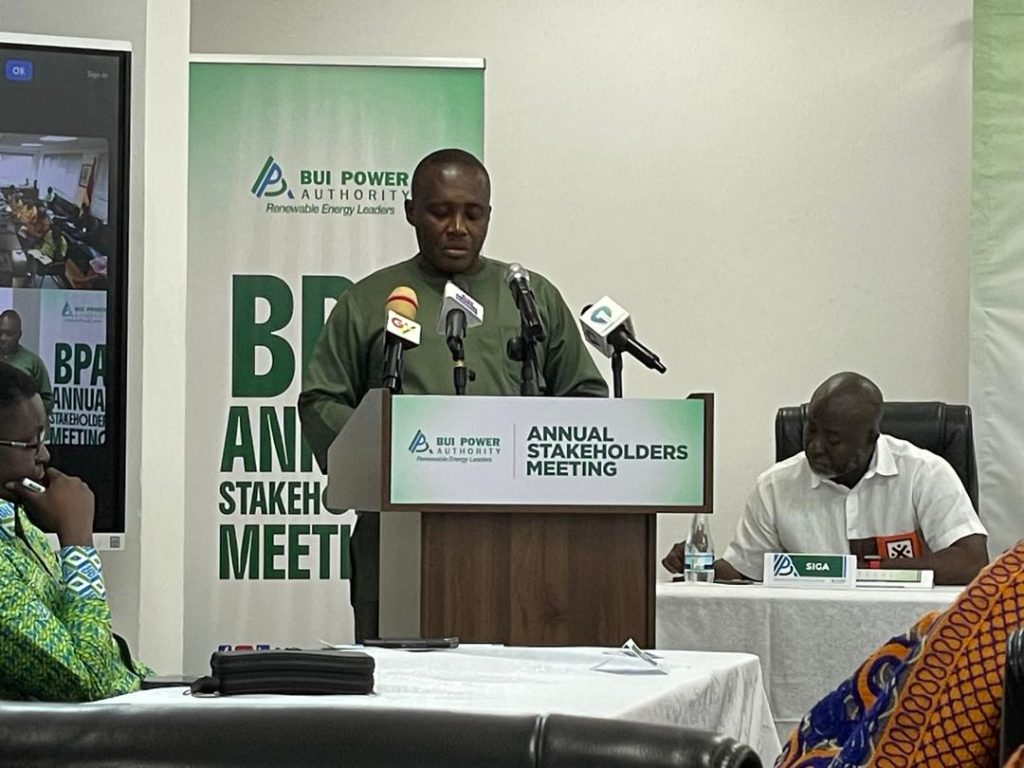
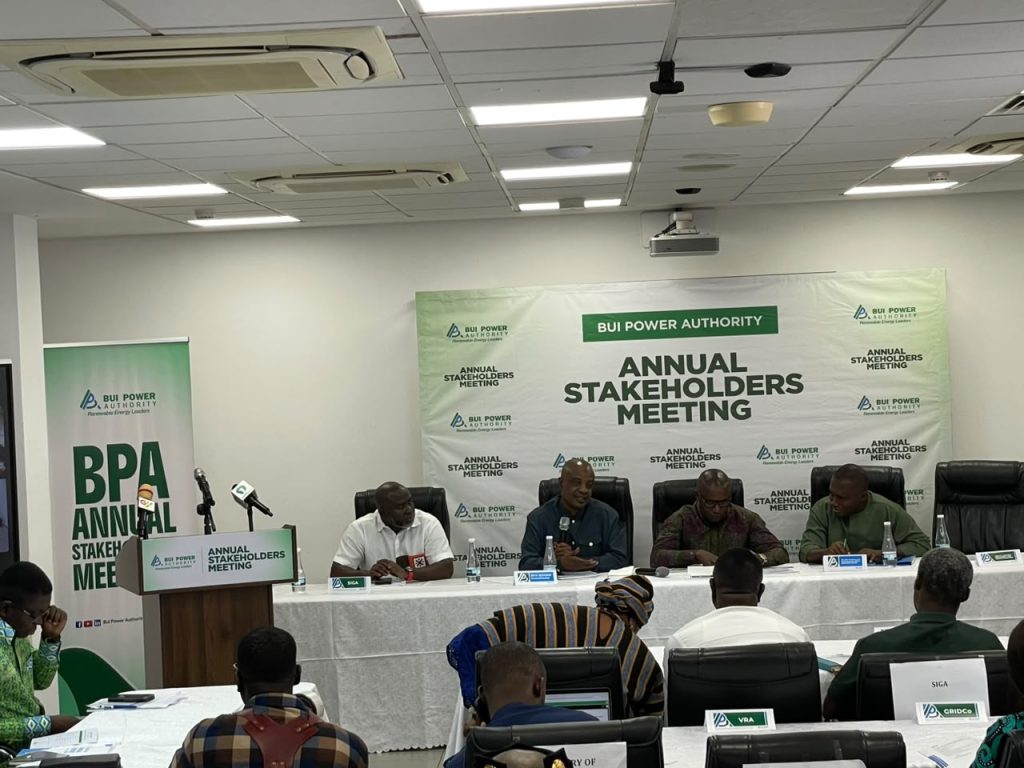
Addressing the Authority’s 2026 Annual Stakeholder Meeting in Accra, Ing. Sam said the year under review was marked by changes in leadership at the Ministry of Energy, the BPA Board of Directors and Executive Management, alongside broader policy shifts within the energy sector.
Despite the transitions, he said the Authority maintained operational stability, adapted to the evolving policy environment and continued to deliver on its mandate of providing reliable renewable energy to the national grid.
According to the Chief Executive Officer, BPA generated a total of 1,438 gigawatt-hours (GWh) of electricity from its hydro and solar plants in 2025, surpassing its projected output of 1,350GWh by 6.5 per cent. The figure also represents a 6.7 per cent increase over the 1,348GWh generated in 2024.
He attributed the improved performance to efficient plant operations, favourable hydrological conditions and effective system dispatch.
The Bui Hydroelectric Plant remained the Authority’s principal source of electricity, producing 1,339GWh during the year, an increase of five per cent over the previous year’s output.
Ing. Sam further disclosed that the main hydro plant maintained an average operational availability of 95 per cent, ensuring dependable electricity supply throughout the year.
A major highlight of the Authority’s performance, according to the CEO, was the accelerated expansion of its renewable energy portfolio.
He announced that BPA commissioned the first 50MWp phase of its ongoing 100MWp Solar Photovoltaic (PV) Project, increasing the Authority’s operational land-based solar capacity to 100MWp.
Combined with its 5MWp floating solar facility, BPA’s installed solar generation capacity now stands at 105MWp, nearly doubling the 55MWp operational capacity recorded previously.
To strengthen grid reliability and support the growing integration of renewable energy, the Authority also commissioned a 28-megawatt-hour Battery Energy Storage System (BESS).
Ing. Sam explained that the battery storage facility would improve grid stability and enhance the reliability of solar generation, adding that its capacity would be expanded over time to meet future operational requirements.
The Authority’s solar installations generated 102GWh of electricity in 2025, compared with 76GWh the previous year, reflecting the impact of the expanded infrastructure.
The BPA Chief Executive said work is progressing steadily on several renewable energy projects expected to be completed in 2026.
These include the remaining 50MWp phase of the ongoing 100MWp Solar PV Project, the 50MWp Yendi Solar Project, a 25MWp Floating Solar Project, and the renegotiated 20MWp Land-Based Solar Project at the Bui Generating Station.
Looking beyond these developments, he disclosed that the Authority has initiated processes to develop additional solar projects ranging between 50MWp and 250MWp, supported by battery energy storage systems, across strategic locations in northern Ghana.
He said the projects form part of BPA’s medium-term development strategy aimed at strengthening Ghana’s renewable energy mix while improving electricity reliability.
Beyond electricity generation, Ing. Sam announced progress on government’s broader hydropower expansion programme. He said feasibility studies for proposed hydropower projects on the Tano, Pra and Ankobra rivers, as well as Wli Falls, had reached 35 per cent completion by the close of 2025.
The studies are being undertaken by Tractebel Engineering S.A. and SRC Consulting Engineering. According to him, the projects are expected to substantially expand the Authority’s renewable energy capacity while improving the complementarity between hydropower and solar generation.
The Chief Executive also reported solid financial results for the year. BPA generated US$145.9 million in revenue from electricity generation and recorded a net profit of US$66.2 million. He said the Authority maintained a strong asset base and improved several operational efficiency indicators during the year.
Ing. Sam noted that although sector-wide challenges relating to outstanding payments by key customers persist, there has been gradual improvement in receivables, which is strengthening the Authority’s long-term financial sustainability.
On occupational health and safety, the BPA Chief Executive said protecting employees, contractors and host communities remained one of the Authority’s highest priorities. He disclosed that the Authority sustained a strong safety culture throughout 2025, resulting in zero lost-time injuries for the entire year.
According to him, BPA will continue investing in safe operational practices while pursuing innovation, renewable energy expansion and operational excellence to support Ghana’s energy security and sustainable development.
He expressed confidence that the Authority’s ongoing investments in hydropower, solar energy and battery storage technologies would position BPA as a leading driver of Ghana’s transition to a cleaner, more resilient and diversified energy sector.