You have heard me talk about MahamaCares. You have heard the policy language, catastrophic illness coverage, high-cost conditions, financial risk protection. It all makes sense in the abstract. But I want to tell you what it looks like when it arrives at someone’s door, because the abstract never quite captures what this fund has done in its first year. How it has changed real lives.
Let me tell you about Rebecca.
Rebecca
Rebecca Odarquaye is a midwife. For years she has been the person who shows up for other people in their most vulnerable moments, the steady hands in the room when a baby enters the world, the calm voice when a mother is afraid. She has spent her career in the business of keeping people alive.
Then one day the person who needed saving was her.
Rebecca was diagnosed with a brain aneurysm. Not the kind of diagnosis you manage quietly at home, the kind that requires urgent, specialised neurosurgery, the kind that does not wait and does not negotiate. The surgery that could save her life came with a bill of GH¢210,840.
Her family did not have it. Not even close.
This is the moment that has played out in Ghanaian households for generations, the moment a medical crisis becomes a financial one, when families sit around a table doing maths that will never add up, calculating what to sell, who to call, which relative might have something to contribute. The illness is terrifying. The bill is a second blow entirely.
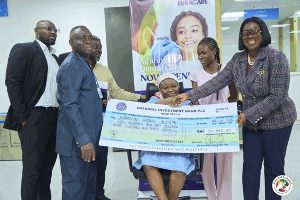
Rebecca’s story found its way into the public through the media. And MahamaCares stepped in.
The Ghana Medical Trust Fund covered the full GH¢210,840. Professor Benjamin Sarkodie and his neurosurgical team at Euracare performed the procedure. It was successful. Rebecca survived. And the woman who has spent her life helping other people bring new life into the world is back doing exactly that.
I need you to sit with that for a moment. Not the number. The woman.
And then there was Elsa
Around the same time, in the Volta Region, a four-year-old girl named Elsa Klabi from Kpando was diagnosed with Wilms’ Tumour, kidney cancer. She was four years old.
MahamaCares paid GH¢46,000 for her treatment and surgery at the Ho Teaching Hospital. Elsa got her chance.
In that same pilot phase, seven cancer patients in the Volta Region received treatment under the fund. Brain surgeries, heart surgeries, oncological treatments, GH¢4.8 million deployed across fifty patients, each one a family that did not have to choose between saving their person and keeping everything else from falling apart.
What this is really about
MahamaCares is not an NHIS programme. I want to be clear about that, because this story does not belong to us. It belongs to the Ghana Medical Trust Fund, to its Administrator Obuobia Darko-Opoku and her team who have built something real from the ground up, and to President John Dramani Mahama, who committed his own salary to it before asking anyone else for anything.
The NHIA’s role is a supporting one. We are a funding body, and we have contributed human resource to help build the Fund’s capacity. We are part of the architecture, not the centre of it. I say that not out of false modesty but because it is simply true, and because the people who deserve the credit for Rebecca’s survival and Elsa’s surgery are the ones who built and run this fund.
What I will say is this. The reason MahamaCares matters to me, and why I speak about it often, is that it completes something. Free Primary Healthcare catches Ghanaians at the community level before illness becomes serious. The NHIS carries them through hospitals and specialist wards. And MahamaCares stands at the end of the line, in the place where costs have always been impossible, and says: you do not have to face this alone.
Rebecca faced a GH¢210,840 bill with nothing in her hands. She did not have to face it alone.
Elsa was four years old and had kidney cancer. She did not have to face it alone.
That is what one year of MahamaCares looks like in practice. Not a policy document. Not a press conference. Two lives, and fifty more in that pilot phase alone, that were not lost because someone decided no Ghanaian should ever have to choose between their health and everything else they have.
The work continues
One year in, the foundation is strong. But there are thousands of Rebeccas and thousands of Elsas across this country who do not yet know this fund exists, or who do not know how to access it. That is the next chapter, making sure the people who need it can find it.
If you or someone you know is facing a catastrophic medical bill for conditions like cancer, kidney disease, cardiovascular disease or stroke, the Ghana Medical Trust Fund is there. Register. Ask your facility. Tell your family.
No Ghanaian should face that bill alone.
Author: Dr. Victor Asare Bampoe, CEO, National Health Insurance Authority