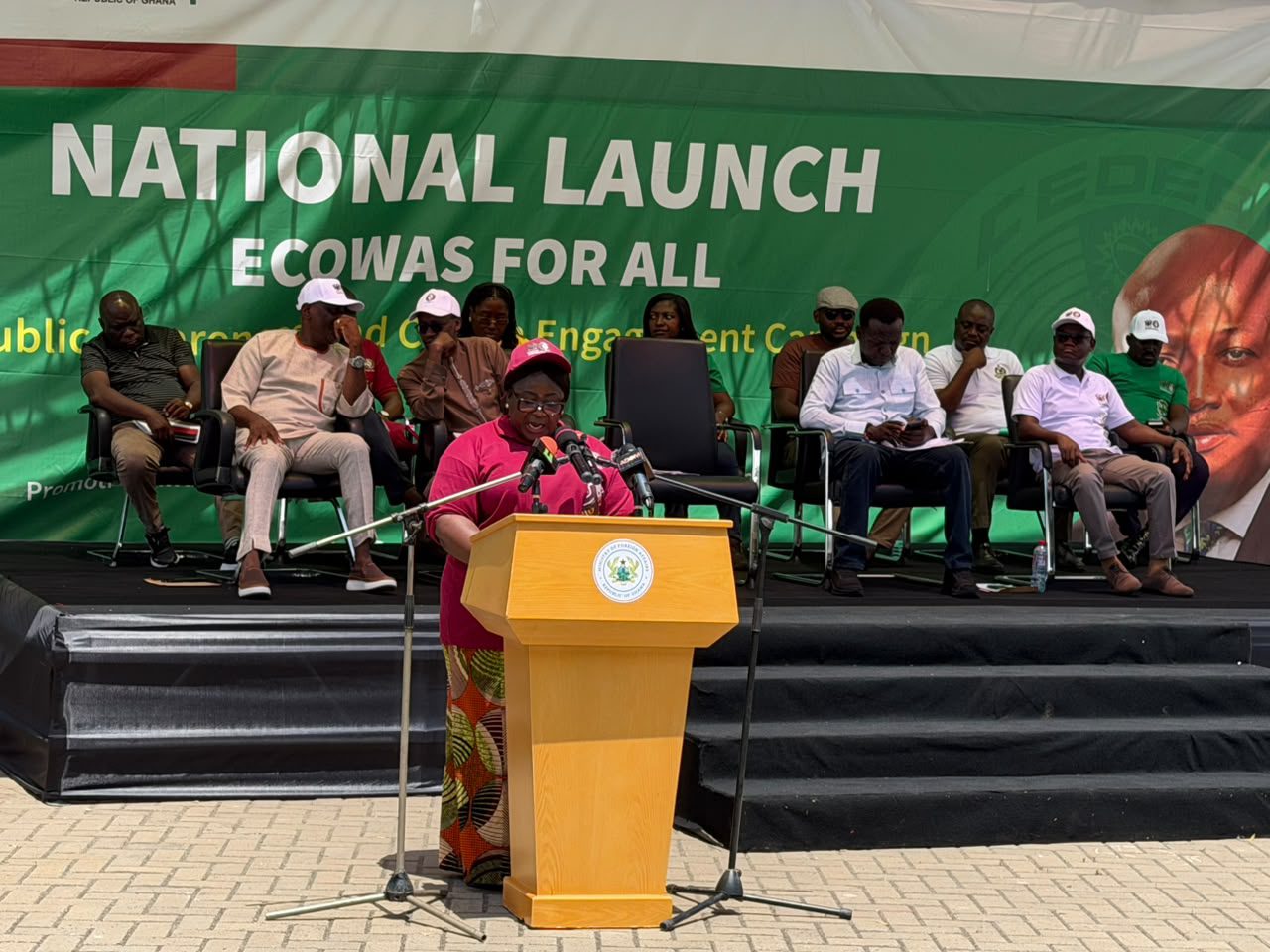
In a departure from traditional bureaucratic settings, the Ministry of Foreign Affairs has brought its regional integration awareness campaign directly to the bustling commercial hub of Makola Market.
Addressing traders, importers, and exporters, the Chief Director at the Ministry, Khadijah Iddrisu, emphasized that the government is committed to eliminating trade bottlenecks and empowering local business owners to leverage the full benefits of the Economic Community of West African States (ECOWAS).
Explaining the rationale behind meeting traders at their place of business rather than in a distant conference hall, Khadijah Iddrisu stated, “Today, instead of inviting you to this program in a conference hall far from you, we have come to deliver this important information to you right here in Makola, the heart of commercial activity in Accra.”
She acknowledged the persistent operational hurdles business owners encounter during regional transit, noting that trade facilitation remains a top priority for the government.
”We are also aware of some of the challenges you face when you embark on your business trips,” she noted. “Too often, we hear of goods being held up at borders for days with demands for documents traders are not familiar with, and for payments that should not be made, and so on. This campaign exists because we want to empower you to address these systemic issues.”
Highlighting the economic scale of the subregion, she pointed out that ECOWAS unites a population exceeding 300 million people and over 400 million when considering the broader demographic context. She paid special tribute to women traders, who form the backbone of grassroots commerce.
”As you may be aware, women carry out about 74% of informal cross-border trade along the Abidjan-Lagos Corridor. When we talk about regional trade, we are talking about you,” Iddrisu emphasized, adding that intra-ECOWAS trade reached $786.8 million, with Togo serving as a leading trading partner.
During her keynote address, the Chief Director broke down critical policy frameworks designed to ease cross-border commerce:
ECOWAS Trade Liberalization Scheme (ETLS): Khadijah Iddrisu explained that goods originating from ECOWAS member states and properly registered can cross borders duty-free. Manufacturers were urged to acquire the ECOWAS Certificate of Origin to benefit from tax-free sales across the subregion.
Protocol on Free Movement: Citizens are legally permitted to travel to any ECOWAS member state with valid travel documents and stay for up to 90 days without a visa. Travelers were advised to carry valid passports and national identification cards to ensure unhindered movement.
ECOWAS Brown Card Insurance: Motorists traveling across borders in their own vehicles were strongly encouraged to enroll in the scheme, which guarantees fair and prompt compensation to victims of road accidents involving non-resident motorists.
Axle Load Policy and Small-Scale Trade: Transport operators were reminded of harmonized axle load limits for heavy-duty vehicles, while women traders were informed about targeted legal and structural reforms intended to safely transition informal cross-border trade into the formal sector.
Opening the floor to an interactive question-and-answer session with technical experts from various stakeholder ministries, agencies, and departments, Iddrisu assured participants that the Ministry’s support extends far beyond a single event.
”Our commitment does not end today,” she affirmed. “The Ministry of Foreign Affairs, through the ECOWAS National Office, will continue to work with all our people to follow up on all the outcomes that will come out of this campaign. In the coming weeks, we will take this campaign to other major markets.”
She encouraged traders to utilize the ECOWAS National Office located at the Ministry of Foreign Affairs in the Airport Residential Area to report grievances, share experiences, and seek institutional intervention.
”Please don’t hesitate to contact us at the Ministry of Foreign Affairs with all your challenges, contributions, and the experiences that you have to share with us, and those that need our intervention with the ECOWAS Commission to resolve,” she urged.
Concluding her address, she reiterated that the ultimate measure of successful regional integration is the ease with which citizens conduct their livelihoods.
“The manifestation that regional integration is working is when traders are able to move freely and at ease, without any threat or hindrance. ECOWAS belongs to you.
Eugenia Ewoenam Osei