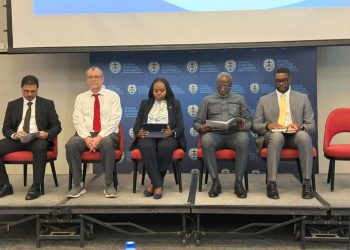
The Bank of Ghana has identified reserve accumulation, banking sector credit transmission and rising geopolitical risk as central issues for deliberation at its 129th Monetary Policy Committee meeting, as policy makers consider how to protect recent macroeconomic gains in a more fragile global environment.
Opening the meeting in Accra, Governor Dr. Johnson Pandit Asiama said one of the committee’s major concerns would be the interaction between domestic success and a shifting external landscape.
He noted that while inflation, reserves and confidence indicators had all improved, the policy decision now required more than simply acknowledging good news. Instead, he said, the committee had to examine how the current policy stance fits an economy where activity is recovering but external risks are rising.
A major issue highlighted by the Governor was the Ghana Accelerated National Reserve Accumulation Programme, described in his remarks as an ambitious initiative intended to raise international reserves to 50 months of import cover by 2028, from current levels of around 5.8 months.
Dr. Asiama said building stronger external buffers was important for macroeconomic resilience but cautioned that a reserve-accumulation strategy of that scale raises important monetary policy questions.
He said the committee would need to consider the implications for liquidity conditions, the central bank’s balance sheet and the interaction between reserve build-up and monetary operations.
“Strengthening external buffers in general is an important element of macroeconomic resilience,” he said, but added that initiatives of this magnitude must be assessed carefully within the broader policy mix.
The Governor also turned attention to the role of the banking sector in transmitting monetary policy to the wider economy. He said the sector remains sound, profitable and well capitalised, with asset quality improving meaningfully over the past year. Yet he noted that credit growth remains subdued, despite the easing in inflation and better macroeconomic conditions.
According to Dr. Asiama, the committee would need to determine whether the restraint in lending reflects supply-side caution among banks or weaker demand from borrowers. He said possible explanations include banks’ risk appetite, capital buffer requirements and still-elevated non-performing loan ratios, as well as weak appetite for borrowing among households and firms.
“The banking sector remains sound, it remains profitable, it remains well capitalized,” he said, but stressed that the effectiveness of monetary policy ultimately depends on whether rate changes translate into actual credit conditions for businesses and households.
The Governor said the external shock now confronting Ghana is materially different from the one the committee faced in January. Back then, he said, the main risk was complacency in the face of improving conditions.
Now, the task is to preserve gains while confronting a live inflation risk from abroad. “We must make our decision at the intersection of domestic success and external uncertainty,” he told the meeting.
He reminded the committee members that central banking is not only about managing crises, but also about managing success in a way that endures. He said the decision reached this week must be robust enough to hold under more than one possible global scenario in the months ahead.