Ghana has taken a significant leap forward in its digital transformation journey, becoming only the second nation in Africa to host a cabinet-level Artificial Intelligence (AI) bootcamp. This landmark initiative, launched today by the Chief of Staff, Julius Debrah on behalf of President John Dramani Mahama, highlights the government’s proactive commitment to leveraging emerging technologies for enhanced governance and socioeconomic development.
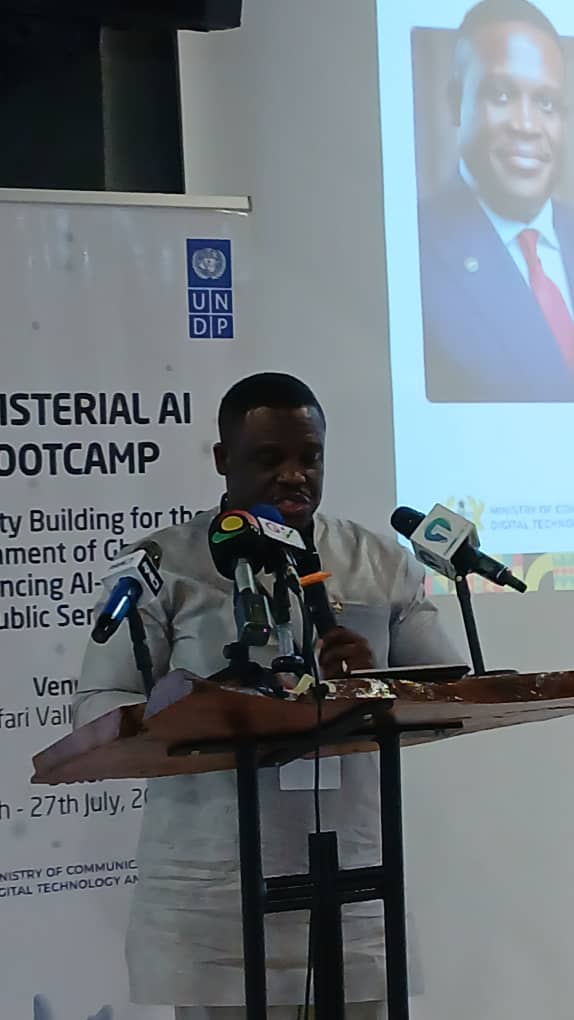
Addressing a distinguished gathering that included the Secretary to Cabinet, Ministers of State, UN Resident Coordinator, UNDP Resident Representative, senior government officials and AI focal persons from all ministries, the Minister for Communication, Digital Innovation and Technology, Samuel Nartey George emphasized the urgency and strategic importance of the bootcamp.
“Our meeting here today is a testament to leadership by example,” Sam George asserted , “demonstrating to our citizenry that we prioritize their interests by promoting emerging technologies within the National Reset Agenda. This will enhance our governance architecture for efficient and accessible public service delivery.”
The bootcamp, designed as “more than just a training session a moment of national leadership,” will span three days. With the assistance of expert resource persons, participants will deliberate, learn, and co-create a bold vision for AI’s role in Ghana’s governance and socioeconomic transformation.
“We stand at the dawn of an era defined by AI, a powerful technological force shaping not just economies and industries, but also governance, national security, education, health, and human development itself,” the Minister remarked, acknowledging the pervasive nature of AI.
“The world and nations are racing to understand, regulate, and harness AI to create inclusive prosperity, mitigate risk, and sustain democratic values. In this unfolding global AI landscape, Ghana cannot afford to be a bystander. Ghana must be an informed, strategic actor, responsive to both the opportunities and responsibilities that AI presents.”
He clarified that the bootcamp’s objective is to prepare ministers to govern wisely in an era of AI-enabled governance, equipping them with the tools to ask better questions, design more innovative policies, and align innovation with Ghana’s developmental agenda.
AI, the Minister noted, has the potential to enhance outcomes across sectors like health, agriculture, education, finance, and infrastructure by automating routine tasks, generating predictive insights, and facilitating superior decision-making.
According to the Minister, the four-fold aim of the meeting is:
To demystify AI; clarifying its essence, limitations, and implications within Ghana’s governance context.
To explore global and regional trends, thus including best practices in responsible AI development and deployment, and developing real-world use cases for each ministry.
To examine ethical and institutional challenges, which entails addressing concerns such as bias, data sovereignty, and algorithmic transparency for comprehensive understanding.
To align on Ghana’s strategic pathway; particularly the proposed National AI Strategy, which has undergone a highly consultative, multi-sectoral development process and is slated for an upcoming public launch.
The Minister highlighted that the bootcamp would allow participants to reflect on how the eight pillars of Ghana’s AI strategy intersect with each ministry’s mandate, fostering high-level ownership and collective action. This initiative, he says is anchored in President Mahama’s vision, enshrined in the Reset Agenda, to transform Ghana’s economy through technology, requiring “informed, ethical, and visionary leadership in all our ministries.”
These efforts, according to Sam George are intrinsically linked to Ghana’s ambitious goal of becoming the premier African AI hub by 2028, a vision further cemented by a recent $1 billion agreement signed with the government of UAE in May this year to build the first AI hub on the continent.
“That vision, however, cannot be realized by technologists alone and geeks,” he stressed. “It requires committed institutional leadership—leaders like yourselves in this room who can think critically, govern boldly, and act with strategic intent.”
Sam George urged participants to be active rather than passive recipients of information, encouraging them to interrogate, imagine, question, and co-create the future.
“AI is not for Sam George and the technical geeks in government, but for every one of us, and AI must not happen to us, but it must happen with us and for us.”
Concluding, the Minister expressed hope that the bootcamp would signify a “shared political commitment across the cabinet to build the AI fluency needed to lead confidently in a rapidly changing world.”
“One can never be ready until you decide to try or start the journey,” the Minister reflected. “We are embarking on that journey of AI adoption across the entire government today.”
Story By: Eugenia Ewoenam Osei