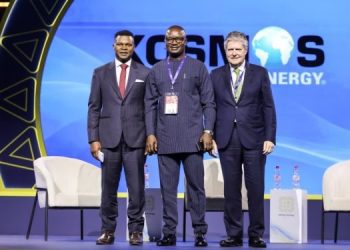
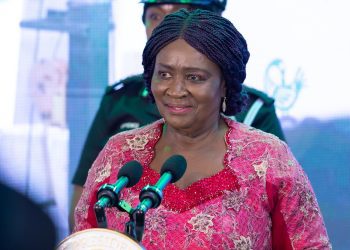
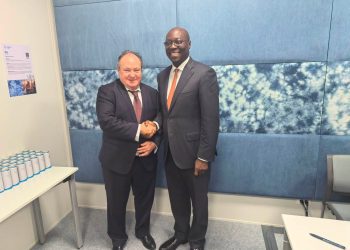
The Government has taken a significant step toward accelerating its renewable energy ambitions with the official launch of the Scaling Up Renewable Energy Programme (SREP-Ghana) Website and the Net Metering Web Application Portal. The launch marks the activation of key components under a broader $30.4 billion investment agenda for the sector.
Delivering the keynote address on behalf of the Minister for Energy and Green Transition, Dr. John Abdulai Jinapor, the Deputy Minister, Richard Gyan-Mensah, hailed the launch as the “threshold of triumph” for the nation’s renewable energy journey, which began with the passage of the Renewable Energy Act (Act 832) in 2011.
The new user-friendly web portal is designed to streamline the adoption of distributed renewable energy (DRE) by allowing homes, businesses, industrial owners, and public facilities to apply for smart net metering under the SREP.
“Distributed Renewable Energy now serves as Ghana’s fastest-growing sector,” Gyan-Mensah stated, attributing this surge to falling technology prices, the global demand for green goods and services, and the nation’s high ambition to meet Environmental, Social, and Governance (ESG) goals and international climate commitments.
The platform will enable seamless applications for both existing and new captive renewable energy installations, help users optimise their investments, and allow the Ministry to track every renewable energy system installed nationwide, providing critical data for planning.
The SREP, backed by the Government of Ghana, the African Development Bank (ADB), Climate Investment Funds (CIF), and the Swiss Government through SECO, is the cornerstone of Ghana’s move toward a sustainable and resilient energy landscape.
He highlighted SREP’s crucial role in diversifying the national energy mix, reducing carbon emissions, increasing energy access in remote, off-grid areas, and fuelling inclusive growth. The programme is a direct contributor to achieving the national target of 10% renewable energy penetration in the electricity generation mix by 2030.
The launch also served to announce the activation of a crucial subsidy scheme for the SREP net metering component.
Referring to a recent announcement made by the Minister John Jinapor at the 7th African Committee Meeting of the International Solar Alliance (ISA), the Deputy Minister confirmed that the DRE sector is projected to receive nearly 20% of a major $30.4 billion investment programme announced for renewables. This investment is also targeted at utility-scale plants, solar irrigation, and hybrid solar-wind-hydrogen systems.
Ghana’s current non-hydro-renewable capacity stands at 280 MW, representing about 5% of the national mix. Through the strategic rollout of SREP, the government is optimistic about achieving 7% by 2027.
SREP is spearheading this goal by delivering 12,000 net metering installations. This includes 1,089 installations reserved for key public entities like secondary schools, hospitals, and Metropolitan, Municipal, and District Assemblies (MMDAs)—with the remaining 10,911 designated for deployment in homes, SMEs, and the private sector.
“I am confident that we will achieve the 70 MW net metering target upon completion of this programme,”Mr. Gyan-Mensah affirmed.
He commended the SREP Programme Implementation Unit (PRU) for the intuitive web platform and called on key stakeholders—ECG, GRIDCo (formerly NETCO), the Energy Commission, VRA, and PURC to link the application portal to their respective websites for seamless access by emerging prosumers (producers and consumers of energy).
The Deputy Minister issued a call for strict adherence to the new framework, noting that the national electricity system is anchored on energy exchange, not cash. He cautioned applicants against oversizing their systems, stating, “you must avoid oversizing the system to prevent delays in processing your applications or cancellation.”
He concluded by expressing gratitude to the Minister for Finance for providing the counterpart fund of GH₵48 million, of which GH₵38 million has been allocated as of the third quarter of 2025, ensuring the programme’s robust financial backing.
Story By: Eugenia Ewoenam Osei