Abidjan, Côte d’Ivoire – May 14, 2025 —
Ghana’s President, John Dramani Mahama, has declared that the West African nation is “open for business again” and on a firm path to economic recovery following years of fiscal turbulence.
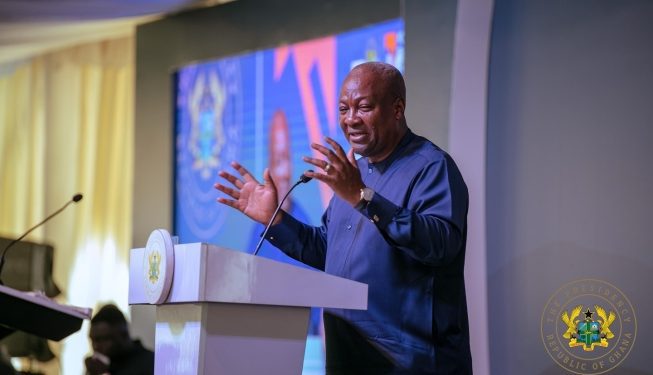
Speaking at the 2025 Africa CEO Summit in Abidjan, President Mahama outlined the government’s efforts to stabilize the economy, restructure debt, and create a more investor-friendly environment, reaffirming Ghana’s commitment to sustainable growth and private sector development.
“When I was inaugurated, I said Ghana is open for business again and I truly meant it,” he told a high-profile gathering of regional and international CEOs.
“We have a natural resource base, and all we need is to create the right environment for the private sector to thrive. That is where our focus lies.”
Mahama revealed that upon assuming office in January 2025, the government discovered that the economic challenges were deeper than anticipated.
He noted that swift measures were introduced to stabilize the macroeconomy, aided by Ghana’s ongoing program with the International Monetary Fund (IMF).
“We’ve corrected a lot of the slippages. We’ve completed the fourth review and are on track to complete the program by April next year,” he said.
One of the major hurdles, he added, was Ghana’s debt overhang.
The country had defaulted on its external obligations and sought relief under the G20 Common Framework for debt restructuring. So far, agreements have been reached with all creditors except a small group of commercial bondholders.
To ensure sustainability, Mahama said his administration has reactivated the national Sinking Fund and is adopting innovative borrowing strategies to reduce reliance on public debt while investing in critical infrastructure.
As part of this strategy, the government has launched the Big Push Program, aiming to inject $2 billion annually into roads, bridges, hospitals, schools, and security infrastructure.
Mahama also highlighted Ghana’s flagship 24-Hour Economy Policy, designed to enhance productivity, increase employment, and attract foreign direct investment by ensuring round-the-clock business operations, supported by stable power supply and investment incentives.
In a bid to modernize the workforce, the President cited the launch of the Million Coders Program and other youth-targeted initiatives focused on digital skills and entrepreneurship.
Mahama assured investors that Ghana’s oil and gas sector is rebounding after a period of declining output, with renewed interest from international firms and additional offshore blocks available for exploration.
He emphasized agribusiness and agro-processing as key growth areas, pointing to Ghana’s fertile land, abundant water, and proximity to a combined market of 400 million people in West Africa—and 1.4 billion under the African Continental Free Trade Area (AfCFTA), which is headquartered in Accra.
“Ghana is a natural platform for regional production and trade.
We’re expanding infrastructure, building railways, roads, ports, and airports to make it even easier to do business,” Mahama stated.
With robust air connectivity and a growing logistics network, the President positioned Ghana as a gateway for regional commerce.
“Every major airline flies into Accra,” he added. “Where they don’t, Ethiopian Airlines will take you there.”
Ending his address on a confident note, Mahama said, “We’ve been through the worst. As the pilot of the plane, I can tell you, it’s going to be a smooth ride from now till 2028.”
He concluded by encouraging attendees to visit Ghana and explore investment opportunities firsthand, promising a “typical Ghanaian welcome and red carpet treatment.”