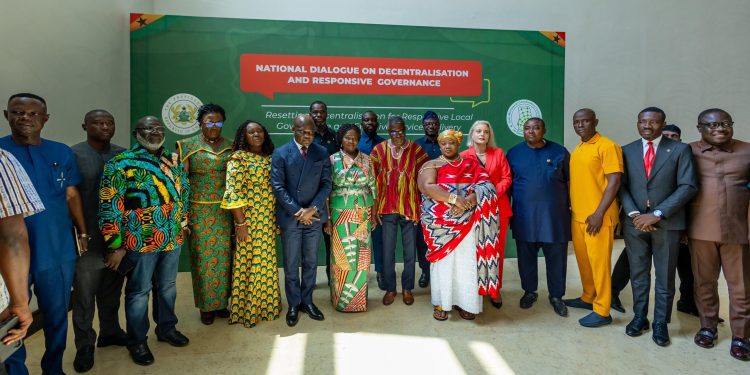
Ghana has opened a historic chapter in its governance journey with the launch of the first National Dialogue on Decentralisation and Responsive Governance, a two-day event aimed at reshaping how power, resources, and responsibilities are shared between central government and local authorities.
Speaking at the opening ceremony, Vice President Prof. Jane Naana Opoku Agyeman described the dialogue as an opportunity for Ghana to renew its commitment to bringing government closer to the people. She reminded the gathering that more than three decades ago, Ghana boldly embraced decentralisation as a strategy to make governance relevant at the local level.
“Development is most meaningful when decisions are taken closest to the people they affect. This dialogue must move us beyond abstract aspirations. It must result in policies and programmes that change how citizens experience government in their daily lives,” she said.
The Vice President highlighted that the ongoing National Decentralisation Policy and Strategy (2026–2030) is expected to provide a clear framework for the next phase of reforms. The new policy, she noted, will help transfer real power and authority to local governments, ensuring that district assemblies are better equipped to respond to community needs.
The dialogue will tackle long-standing challenges such as weak fiscal transfers, low citizen engagement, and uneven service delivery across the country. It will also provide a platform for discussing broader issues like climate resilience, gender equality, and youth participation in governance.
Participants are divided into breakout sessions covering administrative, political, and fiscal decentralisation, planning, and local economic development. Other sessions are dedicated to ethics, mindsets, and inclusivity. At the end of the dialogue, organisers expect to issue a communiqué, a roadmap with timelines, and a clear set of recommendations to guide the policy’s adoption and implementation.
The Vice President emphasised that the dialogue must not be reduced to another talk shop. “The outcomes of this dialogue will redefine how we govern and perceive ourselves as a nation. Government is keen to ensure that the lessons and insights here translate into tangible improvements in service delivery that citizens can see and measure,” she assured.
The event, which has brought together ministers, MPs, traditional authorities, civil society organisations, development partners, and the media, is also expected to strengthen consensus around electing MMDCEs and building stronger partnerships between government and local communities.
With the dialogue now underway, the Vice President called for courage, clarity, and unity of purpose to ensure that Ghana emerges with a decentralisation framework that is inclusive, accountable, and responsive to the needs of its people.