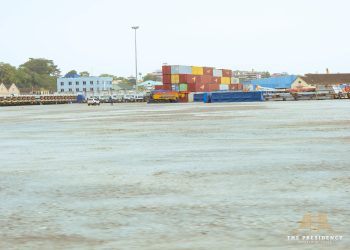
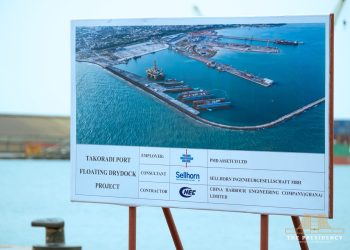
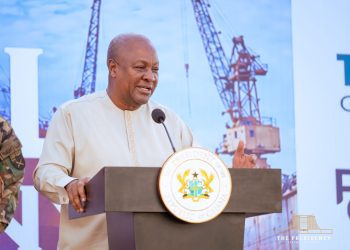
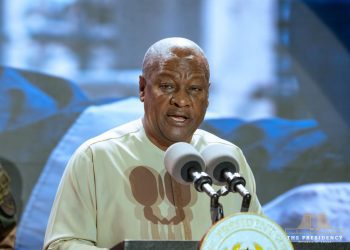
President John Dramani Mahama has broken ground for the construction of a $137 million floating dry dock facility at the Takoradi Port, describing the project as a major step towards strengthening Ghana’s maritime industry, expanding regional ship repair services and creating employment opportunities for young people.
The project, being undertaken under a 25-year concession agreement, is expected to be completed within 18 months and will create approximately 430 jobs, with 30 per cent of the positions reserved for women.
President Mahama performed the groundbreaking ceremony alongside the commencement of works on Berth 19, a separate $98 million expansion project by the Ghana Ports and Harbours Authority (GPHA) aimed at increasing the port’s dry bulk handling capacity.
Addressing the ceremony, the President expressed satisfaction that the floating dry dock project, which was announced five months ago as the first project under the Ghana-United Kingdom Growth Partnership, had finally moved into the implementation stage.
“It is unfortunate that it has taken 14 long years, but there is a better late than never. And so we are happy that today we are able to break ground for this ship and dry dock facility,” he said.
President Mahama said the facility would address a significant gap in ship repair and maintenance services along the West African coast and the Gulf of Guinea.
He recalled that, during his previous tenure as President, Ghana had to send some of its ageing naval vessels to the Damen Shipyard in the Netherlands for servicing and maintenance because of the absence of a major ship repair facility in the sub-region.
“I know how important this is because as President and as Commander-in-Chief of the Armed Forces, I remember when I came to office and we had to service some of our ageing naval fleets, we had to send them to Damen Shipyard in Netherlands to go and service and maintain them,” he stated.
According to him, vessels operating along the Gulf of Guinea, including oil rigs and ships from neighbouring countries such as Nigeria, would benefit from the facility instead of travelling to Europe or Durban in South Africa for maintenance.
“There is a lot of traffic.
There are a lot of vessels working on the Gulf Coast, and they either have to go to Europe for maintenance or they have to go to Durban in South Africa for maintenance. So, this fills a very good vacuum,” he said.
The President said beyond its economic benefits, the project would provide opportunities for technology transfer and skills development among Ghanaian youth, making them competitive in the international maritime industry.
“What pleases me the most is that it will create 430 jobs for our young people. This is all part of the Big Push and the reset agenda to create jobs for our young people, and indeed, the icing on the cake is that 30 per cent of the jobs are reserved for females, for our young girls,” he added.
He expressed confidence that the facility would be efficiently managed under private-sector participation and become an important maritime infrastructure asset for Ghana and the wider West African region.
Accra Reset and infrastructure development
President Mahama also used the occasion to reiterate his government’s commitment to the Accra Reset agenda, which he said was designed to address Africa’s dependency on external support and strengthen the continent’s capacity to finance and develop its own economies.
He explained that although the initiative initially focused on health sovereignty following the abrupt cancellation of a $174 million USAID funding facility that affected critical health interventions, its scope had expanded to address broader challenges arising from the changing global economic order.
“We have been talking about a reset agenda, and to do a projection of it, we talk about the Accra Reset. The Accra Reset is about cutting the dependency syndrome, and being able to build more resilient economies, and be able to stand on our own,” he said.
The President noted that African countries and other nations in the Global South continued to borrow at significantly higher interest rates than developed economies, largely because of the risk premiums attached to their investments.
He said the situation increased the cost of financing critical infrastructure projects and called for reforms to the international financial architecture to ensure developing countries had access to affordable, long-term financing.
“One of our advocacies under the Accra Reset is to change the global financial architecture,” he stated.
He emphasised the importance of patient capital, particularly pension funds and other long-term financing arrangements, in supporting infrastructure projects that require extended periods to generate returns.
President Mahama commended the financial institutions and private-sector partners involved in the Takoradi projects, including Petra, for mobilising the necessary resources.
Berth 19 expansion to boost Takoradi Port
On the GPHA Berth 19 project, President Mahama said the approximately $98 million investment would address capacity constraints at the port’s existing dry bulk terminal and enable it to handle increased volumes of mineral exports and imported bulk commodities.
He noted that Takoradi Port had undergone significant transformation since he cut the sod for its expansion in 2012, evolving from a predominantly export-oriented port during the colonial era into a major facility handling both imports and exports.
The port currently serves several sectors, including mining, oil and gas, container shipping and the cement industry.
President Mahama said the expansion of the dry bulk terminal was necessary to accommodate growing demand for the export of mineral ores and the importation of clinker for cement production.
He also highlighted improvements in the port’s draft through dredging, which had increased its capacity to accommodate larger vessels.
The Berth 19 project is expected to be completed within 26 months, with the President expressing the hope of returning to commission the facility after construction.
Western Railway Line to be prioritised
President Mahama further announced that the Western Railway Line would be prioritised under the government’s new economy plan, with the first phase expected to extend the railway network to Nyinahini to facilitate the exploitation and transportation of bauxite deposits in the area.
The second phase will extend the line along the Western Corridor to Hamile in the Upper West Region, creating a potential freight transportation link between Ghana’s northern border and the Takoradi Port.
He said the railway project would be particularly important for transporting minerals such as manganese, bauxite and lithium, while also facilitating the movement of containers and other cargo.
“The Western Line is the most profitable because of the manganese, the bauxite, and all that. So even if you take containers up, you can bring bauxite or manganese or lithium ore down to the ports,” he said.
The President indicated that the Finance Minister would announce the prioritisation of the first phase in the 2027 Budget.
He also disclosed that the International Finance Corporation (IFC) had agreed to finance the proposed Volta Corridor, which includes the development of a private-sector port at Esikuma in the Western Region, led by LMI.
Another port is planned for Debre in the Savannah Region, with an inland terminal expected to facilitate cargo movement and provide landlocked Burkina Faso with an alternative route for its imports and exports.
President Mahama said the arrangement would reduce the distance Burkina Faso’s traders and transport operators currently travel to access cargo through the Tema Port.
Further expansion of Tema Port
The President also outlined plans to increase the capacity of Tema Port through further expansion of the Meridian Port Services (MPS) facilities and the old Tema Port.
He said discussions were ongoing towards an agreement on MPS Berth 5, while dredging works at the old port had already increased its depth to 14 metres, allowing larger vessels to access the facility.
He acknowledged the growing congestion at MPS, despite its position as one of the leading container terminals in West Africa.
To address the challenge, he said the GPHA was developing a terminal at Kpone to accommodate empty containers and other cargo, with plans to extend the railway line to the facility to support the movement of containers away from the main port.
President Mahama said the investments in ports, railways and roads were essential to building a resilient economy and strengthening Ghana’s competitiveness in regional and international trade.
“If you want to build a resilient economy and a community that progresses, you must put down the economic infrastructure and the social infrastructure. You must do the roads, you must do the railways, you must do the ports,” he stressed.
He expressed appreciation to all the partners, financiers and institutions involved in the two Takoradi projects and expressed optimism that the investments would significantly enhance Ghana’s maritime and logistics capacity.
Story: Patrick Asford Boadu