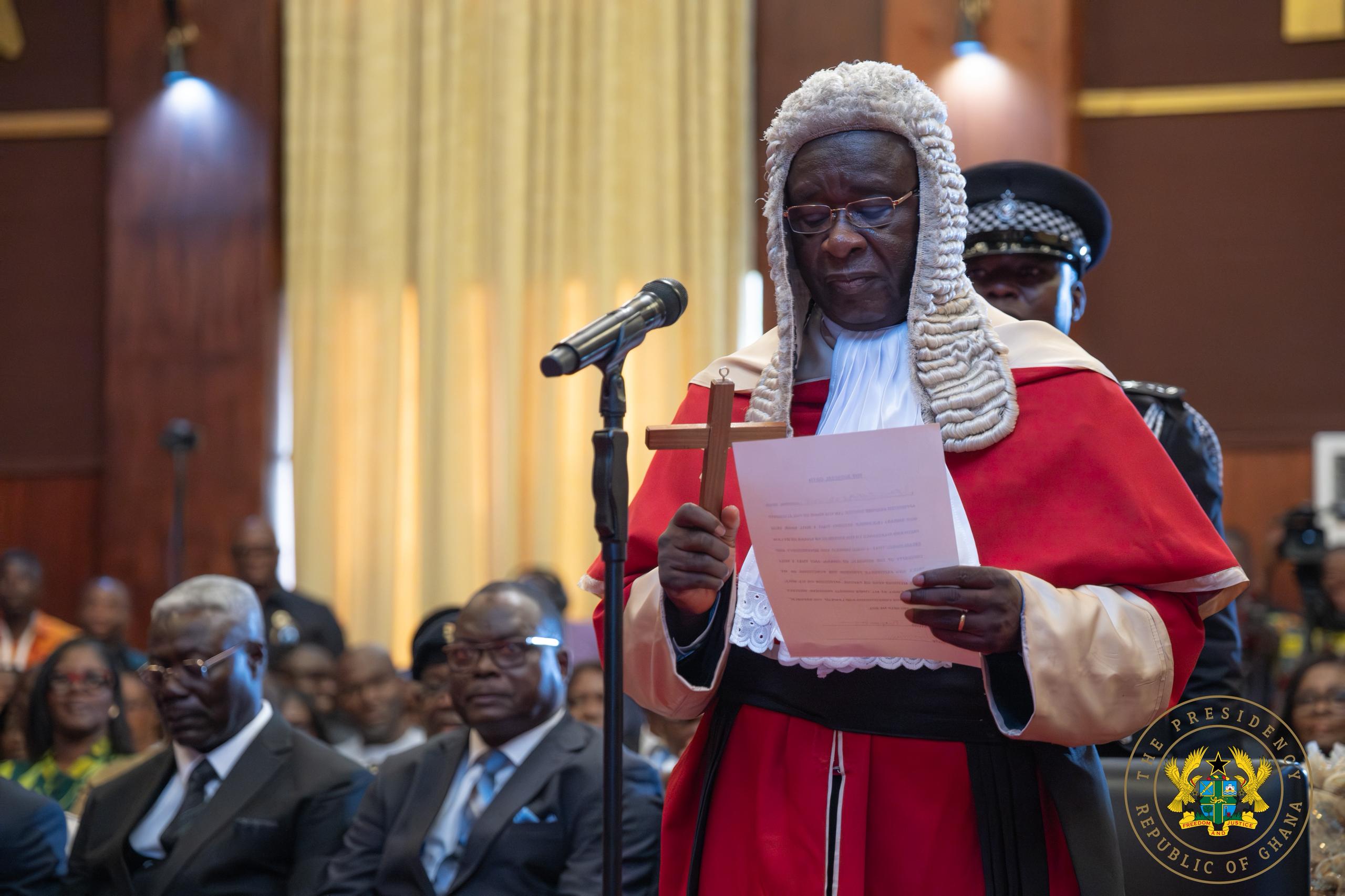
Newly sworn-in Chief Justice of the Republic of Ghana, Justice Paul Baffoe Bonnie, has pledged to lead a judiciary that is fair, independent, accessible, and anchored in integrity, as he outlined an ambitious vision for judicial reform during his investiture ceremony at the Jubilee House.
Speaking with emotion and conviction, Justice Baffoe Bonnie said he was humbled by the national responsibility entrusted to him.
“It is with a deep sense of humility, gratitude and solemn responsibility that I stand before you today on this historic occasion of my investiture as Chief Justice of the Republic of Ghana,” he said.
He thanked President John Dramani Mahama for the confidence reposed in him, and expressed appreciation to the Council of State, Parliament, his mentors, family, and colleagues.
“I wish to express my deep gratitude to His Excellency the President for appointing me to this high office… I thank my wife and children for their love, patience and understanding,” he added.
“The Judiciary Must Be Independent, Impartial and Accessible”
Justice Baffoe Bonnie emphasized that the judiciary must remain a steadfast guardian of the Constitution and the rights of citizens.
“Every court in our land holds a sacred duty to ensure that the rights, liberties and human dignity of Ghanaians are respected and protected,” he said.
“It is not the law alone that matters, but how the law is applied and how courts earn the confidence of the people.”
He acknowledged concerns among the public regarding fairness and access to justice.
“The judiciary must not only be seen to be fair, but must be fair,” the Chief Justice stressed. “Clearing backlogs, reforming processes, promoting alternative dispute resolution, and harnessing technology are not optional they are imperatives.”
Vision of a Service-Oriented Judiciary
Outlining his priorities, the new Chief Justice said he envisions a judicial system that is efficient, transparent, and rooted in ethical conduct.
“My vision for the judiciary is that of a service-oriented institution—courts that are efficient, transparent and respectful of all persons,” he noted.
“I envision a Ghana where justice is not delayed or denied; where the cost, distance and complexity of going to court are no longer barriers to fairness.”
He called for continuous training of judges and court staff, expansion of digital tools, and improved court infrastructure to enhance public trust.
“We will strive together to raise the brand of the judiciary in the minds of the people not as an institution they must fear, but one that belongs to them and works for them,” he stated.
Commitment to Rule of Law and Judicial Accountability
Justice Baffoe Bonnie promised to uphold the Constitution and protect judicial independence.
“In accepting this office, I give my solemn word that I will uphold the rule of law, respect the separation of powers and protect the Constitution,” he declared.
“I will insist on accountability because independence without responsibility brings entitlement and erodes public trust.”
He reminded judicial officers that their authority is a public trust:
“Every litigant who enters a courtroom brings not only a case but hope—hoping that justice will be done. I accept the responsibility of protecting that hope.”
Call for Legal Education Reform
The Chief Justice highlighted the need for transformation in legal education, promising a more inclusive and competence-based system.
“We must move from exclusion to inclusion, from rote learning to critical thinking, and from credentialism to competence,” he said.
“Our goal is not merely to produce more lawyers, but better lawyers who are disciplined, ethical and devoted to the cause of justice.”
A Judiciary That Belongs to the People
Reflecting on his seven months in acting capacity, Justice Baffoe Bonnie praised the resilience of judicial staff and the enduring trust citizens continue to place in the courts.
“Today, I humbly accept the sacred mandate to serve as Chief Justice… I accept this charge not for honour, but for service to the Constitution, the law and the people of Ghana,” he affirmed.
He ended with a call for national support:
“Let us together ensure that the judiciary remains not a citadel of privilege but a sanctuary of hope, where the poor and the powerful alike find refuge in the impartial majesty of the law.”
Story: Patrick Asford Boadu