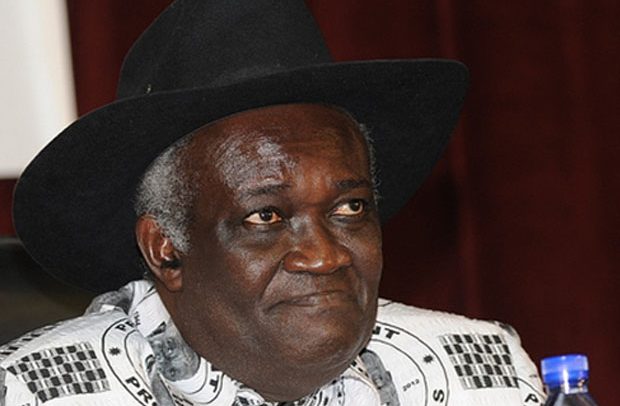
At the third session of the National Dialogue on Decentralisation and Responsive Governance, Professor Kwamena Ahwoi delivered pointed reflections on how to reset decentralisation in Ghana. The session, themed “Using the Past to Inform the Future: Resetting Decentralisation for Responsive Local Government and Effective Service Delivery”, drew a strong line on political and financial autonomy at the local level.
Prof. Ahwoi, often hailed as one of Ghana’s leading voices on local governance, said that debates about federalism and decentralisation often overlook the fragile balance between local independence and national unity. “Perhaps we haven’t quite found that balance yet,” he remarked, calling for a clear empirical audit to see how far Ghana has come.
He argued that political autonomy (the power districts wield) and fiscal autonomy (the resources they control) must go hand in hand. “It’s not enough to give districts decision-making power if they lack the financial clout to act,” he said.
On the controversial issue of diverting part of the District Assemblies Common Fund (DACF) for MPs’ monitoring, Prof. Ahwoi said he has long opposed it. He argued that the 5 % of national revenue allocated to the common fund was supposed to be used entirely by district assemblies for local development. “If MPs need resources to monitor, let them have it in the central budget, not from that 5% meant for districts,” he stated.
He argued that the central government still controls 95 % of national revenue, a pool that can accommodate oversight costs without eating into the funds reserved for local development. “If we divert from that 5 %, we erode the very purpose of that fund,” he said.
Prof. Ahwoi’s standing in Ghana’s decentralisation architecture adds weight to his critique. He served as Minister of Local Government and Rural Development from 1993 to 2000 under the Rawlings era, and briefly as Foreign Affairs Minister in 1997. He has also long been active in academia, currently lecturing at GIMPA and advising on governance matters.
In April 2025, he was appointed Chairman of the IMCC Legislative Review Committee, a body tasked with refining the legal architecture underpinning decentralisation and local governance.
His arguments resonated loudly in a room filled with ministers, local government officials, civil society representatives, and traditional and religious leaders, many of whom are central to the reforms under discussion.
What remains to be seen is whether the upcoming communiqué and roadmap from the dialogue will reflect his call: that autonomy must be paired with clear fiscal justice, and that local assemblies must not be shortchanged by poorly designed national policies.