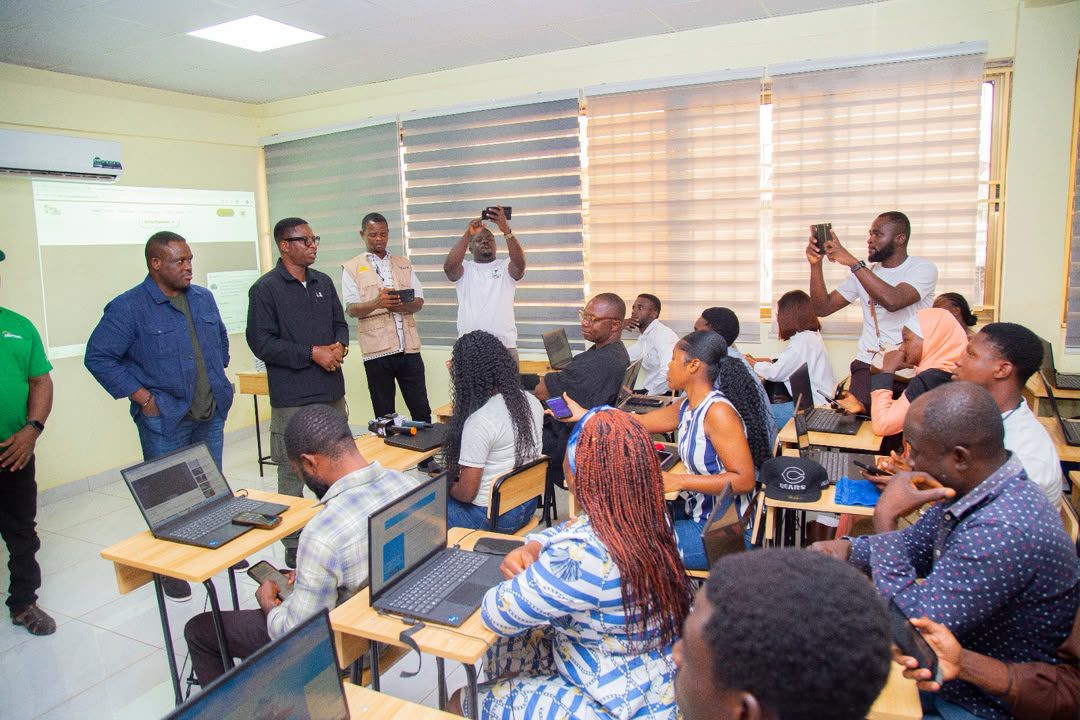
The Ministry for Communications, Digital Innovation and Technology is taking its work directly to the grassroots. In an interview during his nationwide monitoring tour, the sector Minister Samuel Nartey George, shared insights into the government’s digital agenda.
From tracking infrastructure expansion in partnership with telecom giants to pivoting the flagship One Million Coders program toward job creation, the Minister detailed how the ministry is adapting its strategies to ensure tangible benefits for everyday Ghanaians.
Spanning the Ashanti, Volta, Oti and Savannah regions, the Minister’s current tour is designed to evaluate agency performance and agency-led projects firsthand. “You’ve put something out. You must get a response and a feedback mechanism to ensure that the entire communication loop is complete.” He added,
“Yes, we’re getting the reports from our field officers, but it’s important that we come to meet the beneficiaries of the work we’ve done to then be able to identify what we’re doing right, where there are gaps, and what we need to evolve and adapt to.” This on-the-ground approach has already yielded critical course corrections, bringing low-patronage areas under the One Million Coders program to light, issues that likely would have slipped past standard desk reports.
Reflecting on the past two years of foundational policy frameworks, the Minister outlined the ministry’s focus for the next two years, rigorous implementation, monitoring, and optimization. A prime example is the ongoing collaboration with MTN and Telesol to deploy about 800 new sites on MTN and about 1,960 on Telecel
Highlighting his hands-on approach, the Minister shared, “And I’ve been on my phone, I’ve been trying to see how easy it is to make calls as we go into various communities, how easy it is to browse. And I’m taking note of that and I’m sending reports back to the various technical teams at the NCA.”
Addressing concerns regarding low community-center turnout in certain districts, the Minister outlined a pragmatic strategy to maximize government resources without abandoning existing facilities.
“We’re not taking the laptops away from the community. We’re only repurposing them,” he explained, noting that the program is expanding into structured educational ecosystems like TVET institutions, technical universities, and universities such as scaling up laptop allocations at KNUST from 500 to 2,500 units.
Furthermore, in communities where standalone ICT center patronage is low, underutilized laptops are being strategically redistributed to equip secondary and junior high school labs within the same locality, ensuring that “that’s not a responsible use of government resources” is actively corrected.
Meeting the administration’s manifesto target of training one million Ghanaians is only the first phase. According to Sam George, President John Mahama’s immediate follow-up question is always, “What happens after the training, which means find jobs.”
To answer this, the ministry is actively bridging the gap between talent acquisition and employment by partnering with industry bodies like the Business Outsourcing Association of Ghana (BOSAG) to create a verified database of skilled graduates, such as data annotators, to attract Business Process Outsourcing and Knowledge Process Outsourcing firms into the country.
Concluding on the future of the initiative, the Minister stated, “Basically, we are pivoting now away from the training into the job creation model,” expressing full confidence in a bold target to generate 100,000 digitally enabled jobs over the next two years.
Eugenia Ewoenam Osei