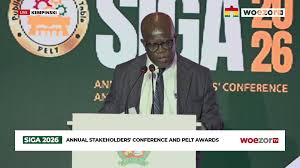
Vice President Prof. Jane Naana Opoku-Agyemang has issued a call for a fundamental shift in the management of Ghana’s public enterprises, asserting that legacy operational challenges can no longer justify persistent underperformance.
Speaking at the 2026 SIGA Annual Stakeholder Conference and Public Enterprises Leadership (PELT) Awards, the Vice President emphasized that the nation’s 170 specified entities must move beyond being “fiscal burdens” to become self-sufficient drivers of national development.
”Legacy issues and past operational challenges should no longer serve as a justification for persistent underperformance. These entities must deliver a value proposition that is attractive to Ghanaians, who are, after all, the ultimate shareholders.” She stated.
Delivering a keynote address on behalf of President John Mahama, Prof. Opoku-Agyemang described the state’s vast portfolio of power utilities, infrastructure authorities, and institutions as essential national assets. She noted that while these entities represent one of the largest concentrations of economic wealth in the country, their success is currently hampered by a culture of financial indiscipline that puts undue pressure on public finances.
The Vice President highlighted that a comprehensive reform agenda is already in motion to address these systemic issues. This includes a rigorous review of the state’s equity portfolio initiated in 2025 by the State Interests and Governance Authority (SIGA) in collaboration with the Ministry of Finance.
The review aims to determine the strategic significance of each entity, with the government considering options such as listing sustainably profitable enterprises on the stock exchange or increasing its stake to maximize public value.
Central to this new era of oversight is the introduction of a performance-linked remuneration framework. Prof. Opoku-Agyemang explained that this system will ensure that management and board compensation are tied directly to measurable outcomes, fostering a performance-oriented culture across the public sector.
She added that Ghana is aligning its reforms with successful models seen in Rwanda, Kenya, and South Africa, where improved governance has directly translated into national prosperity.
Concluding her address, the Vice President reiterated that the government’s commitment to corporate governance, financial sustainability, and strategic private-sector partnerships is unwavering. She noted that the Ministry of Finance’s recent introduction of “commitment authority” has already brought much-needed clarity to public procurement.
Prof. Jane Naana Opoku-Agyemang maintained that the success of these institutions is inextricably linked to the success of the nation, stating that when public ownership reflects the highest standards of accountability, every Ghanaian benefits.
“Our nation’s public enterprises are central to our national development story. If they succeed, and they must succeed, then Ghana succeeds.”
Source: Eugenia Ewoenam Osei