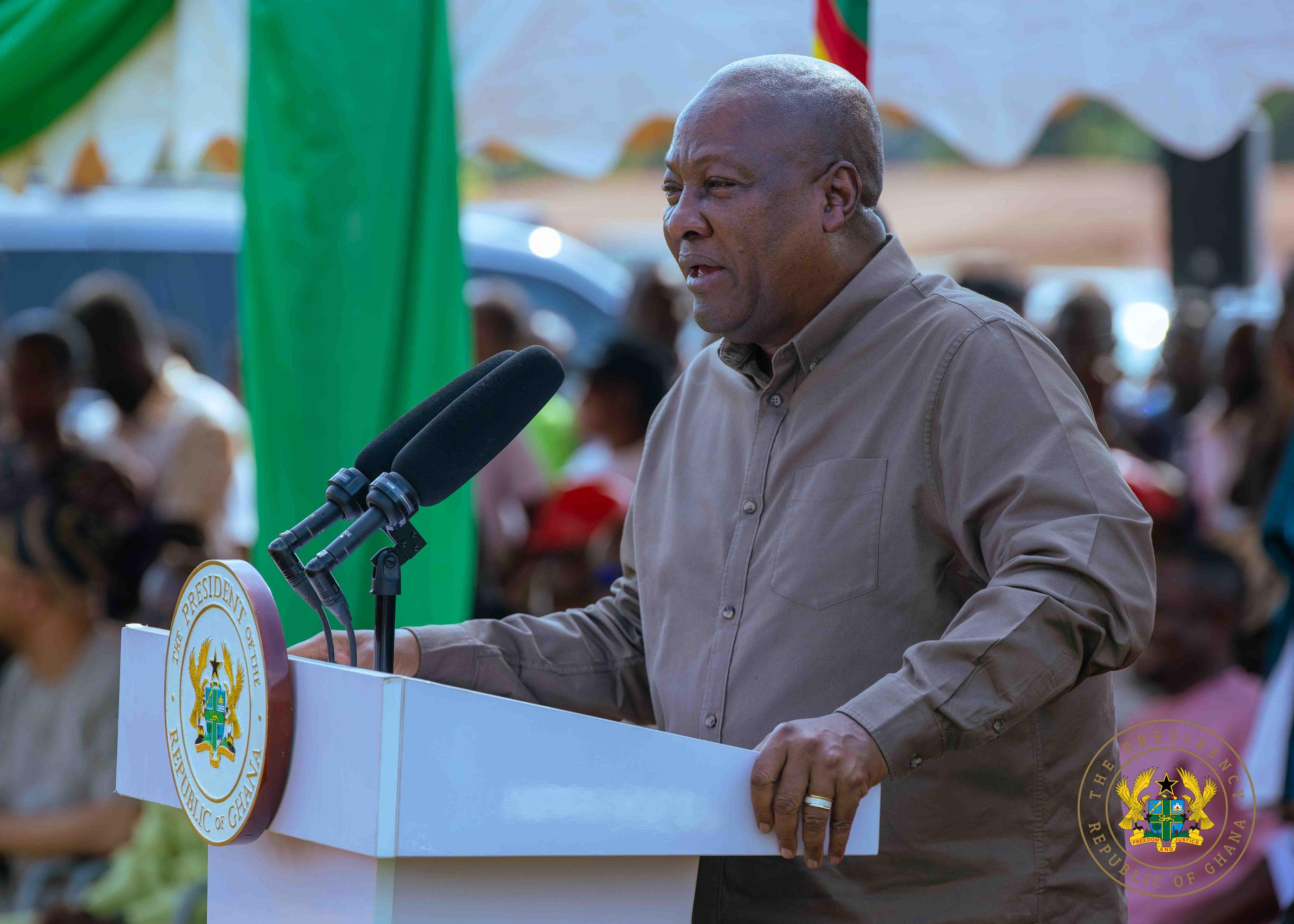
President John Dramani Mahama has cut the sod for the construction of a modern 24-hour economy market in Dormaa as part of his ongoing working tour of the Bono Region, reaffirming his government’s commitment to inclusive development and economic transformation.
The sod-cutting ceremony marks the beginning of what the President described as a nationwide “Accountability Series,” aimed at keeping citizens informed about government performance and ensuring equitable development across all regions.
“The purpose of this exercise is simply to account to the people of Ghana and to ensure that development reaches every region,” President Mahama stated.
Economic Recovery on Track
Addressing the gathering, the President highlighted significant improvements in Ghana’s economic indicators within one year of his administration.
“After one year in office, we have taken deliberate steps to ensure that public funds are used responsibly and directed into projects that improve the lives of our people. I am happy to report that Ghana’s economy is showing strong signs of recovery,” he said.
He noted that inflation has dropped considerably from 23.4 percent, while the Ghanaian cedi has strengthened from GH₵17 to approximately GH₵10.7 against the US dollar.
“These gains did not happen by chance—they are the result of discipline, careful management, and a clear focus on restoring confidence in the economy,” he added.
On public debt, President Mahama revealed that Ghana has made notable progress through collaboration with international partners, including the International Monetary Fund.
“We have reduced the debt-to-GDP ratio from 66 percent to the target of 45 percent within a year. This progress strengthens our ability to withstand external shocks and positions our economy for sustained growth,” he explained.
24-Hour Market Initiative to Boost Local Economies
The President emphasized that the Dormaa market project is part of a broader national initiative to stimulate economic activity and create jobs.
“Markets remain the backbone of our local economies. They support livelihoods, encourage trade, and serve as centres of community life,” he noted.
He disclosed that government plans to construct 261 modern markets nationwide under the 24-hour economy initiative.
“This is about expanding economic activity beyond traditional hours and creating more opportunities for traders and young people,” he said.
The Dormaa market will feature modern infrastructure, including administrative offices, a daycare centre, restaurant spaces, a police station, a fire service post, a clinic, cold storage facilities, banking services including a women’s development bank and a transport terminal.
President Mahama also assured displaced traders of priority access upon completion.
“Let me assure all traders who were affected by the redevelopment that they will be given priority in the allocation of shops,” he said.
Inspection of Key Projects
As part of his regional tour, President Mahama is expected to inspect and commission several key infrastructure projects.
These include the commissioning of the National Signals Bureau building and a visit to the proposed Sunyani Airport site, where land has been secured for construction.
He will also visit Sunyani Secondary School to assess projects funded by GETFund.
Regional Trade Concerns Raised
The President also addressed concerns raised by the Dormaahene regarding the confiscation of goods belonging to Ghanaian traders in Burkina Faso.
“I will engage the President of Burkina Faso to address recent concerns regarding the confiscation of goods belonging to Ghanaian traders and to find a lasting solution,” he assured.
Commitment to National Development
Reaffirming his administration’s long-term vision, President Mahama pledged continued investment in infrastructure, particularly road networks.
“By the time I leave office, our goal is clear: to ensure that Ghana’s road network stands among the best in West Africa,” he stated.
He concluded by expressing gratitude to the chiefs and people of Dormaa for their support.
“Together, we will continue to build a stronger, more inclusive economy that works for all.”
Story: Patrick Asford Boadu