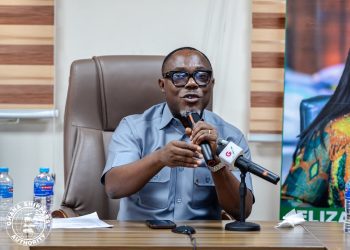
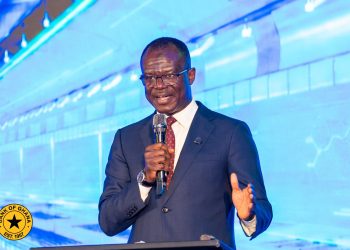
Chief Executive Officer of the Ghana Gold Board (GOLDBOD), Sammy Gyamfi, has outlined a bold new strategy aimed at reasserting national control over Ghana’s gold trade, describing the establishment of the Gold Board as a “product of foresight” and a critical tool for transforming the country’s economic trajectory.
He noted that the GOLDBOD was born out of President John Mahama’s long-standing vision to leverage Ghana’s abundant gold resources to support foreign exchange reserves and strengthen the national currency.
“President Mahama couldn’t understand why, as a country so richly endowed with gold, we continued to struggle with our reserves and were forced to borrow on the Eurobond market,” Mr. Gyamfi said.
He revealed that the previous legal regime allowed individuals, including foreigners, to acquire licences to buy, sell, and export gold. This led to the domination of the export space by foreign nationals, notably Indian companies, who often failed to repatriate required foreign exchange earnings.
According to Mr. Gyamfi, many of these foreign operators also abused their licences to smuggle gold, undermining the state’s ability to accurately track production and export volumes, particularly in the small-scale sector.
“You went to India or Dubai and saw massive figures for Ghana’s gold exports, but our records locally showed little, because no one was properly monitoring the system,” he lamented.
To correct this, President Mahama directed the fast-tracking of new legislation, resulting in the swift passage of the Ghana Gold Board Act, which was assented to on April 2 this year.
“People thought it would take years to establish the Gold Board, but I knew my marching orders,” Sammy Gyamfi stated, crediting stakeholders like Steve Manteaw, Senyo Hosi, and the Ghana National Association of Small-Scale Miners for their roles.
The new legal framework, Mr. Gyamfi explained, centralises gold trading under one authority, GOLDBOD. “From now, no individual, foreign or Ghanaian, can buy or export gold unless licensed by the Gold Board. You can be jailed for up to 15 years if you flout this,” he warned.
The policy also shuts out foreigners from small-scale gold trading. “Why should foreigners take over every sector of our economy? Government has capitalised GOLDBOD, and our own citizens will now handle gold purchases for the state,” he said.
Asserting further control, GOLDBOD has introduced a new tiered licensing regime. Tier 1 licenses are for small-scale “petty buyers” who work in the field, often on motorbikes, while Tier 2 licenses are for structured businesses with offices. Both categories, Gyamfi noted, are subject to anti-money laundering and counter-terrorism checks.
The agency has already started accumulating gold reserves for the Bank of Ghana. “So far, we’ve purchased over 120 kilograms of gold from large-scale firms, which have been added to our reserves at the Bank of England,” he revealed.
Mr. Gyamfi echoed his agency’s mission: “We are asserting our national sovereignty. We are saying that Ghana’s gold must work for Ghanaians.”