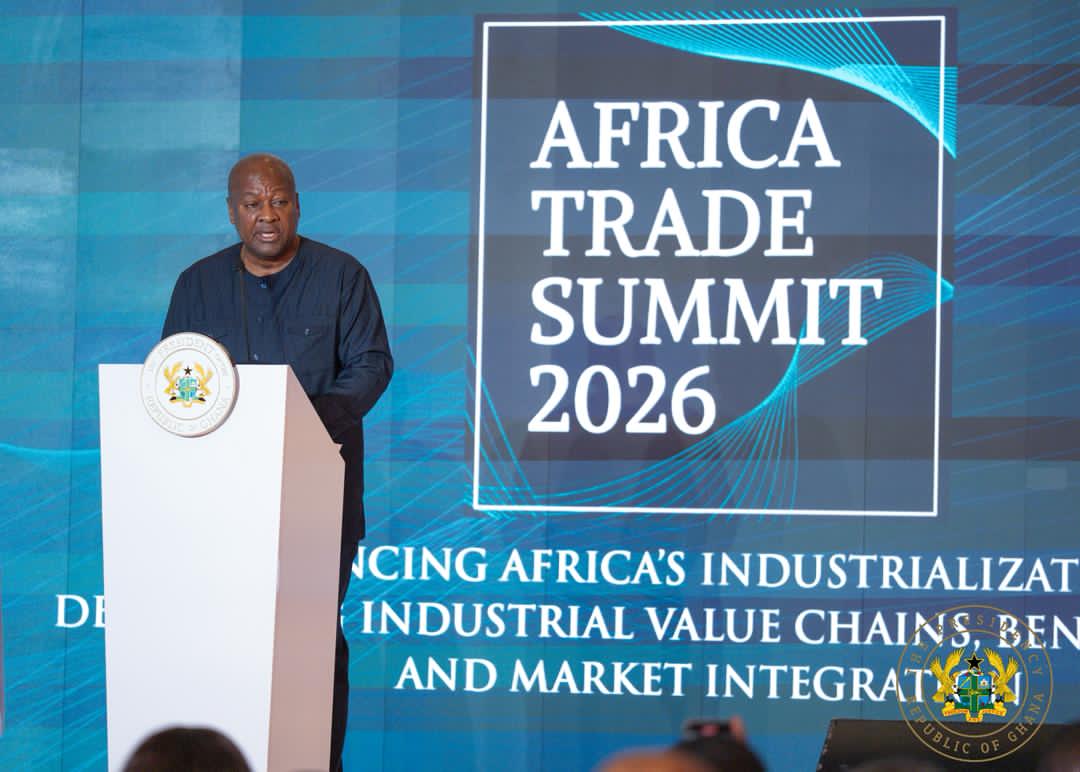
President John Dramani Mahama has called for urgent, bold and coordinated action to finance Africa’s industrialisation, insisting that political independence without economic transformation remains incomplete.
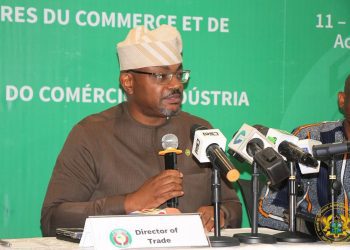
Delivering the keynote address at the Africa Trade Summit 2026 held today at the Kempinski Hotel in Accra, President Mahama said Africa could no longer sustain an economic model that exports raw materials while importing finished goods.
“Our generation must define itself by economic independence. Political freedom without economic transformation is incomplete,” the President stated.
He described Africa as standing at a historic turning point and urged leaders, investors and development partners to commit to a new industrial paradigm built on value addition, beneficiation and regional integration.
Financing Africa’s Industrial Future
President Mahama identified access to long-term, affordable finance as the single most critical constraint to Africa’s industrialisation, particularly for small and medium-sized enterprises.
“Industrialisation is capital-intensive, yet access to long-term affordable finance remains constrained by shallow financial markets, high interest rates and debt pressures,” he noted.
He outlined four key pillars to finance Africa’s industrial transformation: effective domestic resource mobilisation, unlocking institutional capital, crowding in private sector investment, and stronger support from development partners and multilateral institutions.
According to him, Africa’s pension funds, insurance companies and sovereign wealth funds manage hundreds of billions of dollars which, with the right financial instruments, could be channelled into industrial and infrastructure development.
Value Addition and Resource Sovereignty
President Mahama stressed that Africa must move decisively from primary production to value addition, noting that the continent captures only a fraction of the value of global supply chains despite producing most of the raw materials.
Citing cocoa as an example, he said Africa produces the bulk of the world’s cocoa yet benefits minimally from the global chocolate industry.
“This model has deprived our economies of jobs, technology and revenue. Beneficiation changes this equation,” he said.
Highlighting Ghana’s experience, the President said his government is deliberately shifting from a commodity-export model to a value-added economy, prioritising agro-processing, manufacturing and industrial clusters aligned with Ghana’s comparative advantages.
He also underscored the importance of resource sovereignty, pointing to reforms in Ghana’s gold sector.
“Since the establishment of the Ghana Gold Board in April 2025, gold exports from the small-scale mining sector have increased to 104 tonnes, with 100 per cent foreign exchange repatriation,” President Mahama disclosed.
Regional Value Chains and AfCFTA
President Mahama emphasised that Africa’s industrialisation cannot succeed within fragmented national markets, arguing that the continent’s future lies in regional value chains.
“Not every country can produce everything, but together we can build competitive industries across our borders,” he said.
He described the African Continental Free Trade Area (AfCFTA) as the most ambitious integration project in Africa’s history, capable of transforming the continent into a viable manufacturing and investment destination.
Ghana, he noted, remains proud to host the AfCFTA Secretariat and continues to be a leading adopter of its trade preferences.
However, the President cautioned that AfCFTA alone would not industrialise Africa unless it is deliberately aligned with infrastructure development, enterprise support and investment in logistics, energy and industrial infrastructure.
Call for Collective Action
President Mahama concluded by stressing that Africa’s industrial transformation cannot be achieved by governments alone.
“Governments must provide leadership and stability. The private sector must invest and innovate.
Financial institutions must design long-term financing solutions, and development partners must align with Africa’s priorities,” he said.
He urged participants to move from declarations to delivery and from commitments to implementation.
“Let this Africa Trade Summit be remembered as the moment when ambition was matched with action and partnerships were forged to power Africa’s industrial future,” the President concluded.
Story: Patrick Asford Boadu