The Minister for Works, Housing and Water Resources, Hon. Kenneth Gilbert Adjei, has outlined significant progress made in the Works, Housing and Water Resources Sector, reaffirming government’s commitment to infrastructure development, housing delivery and sustainable water management despite prevailing economic constraints.
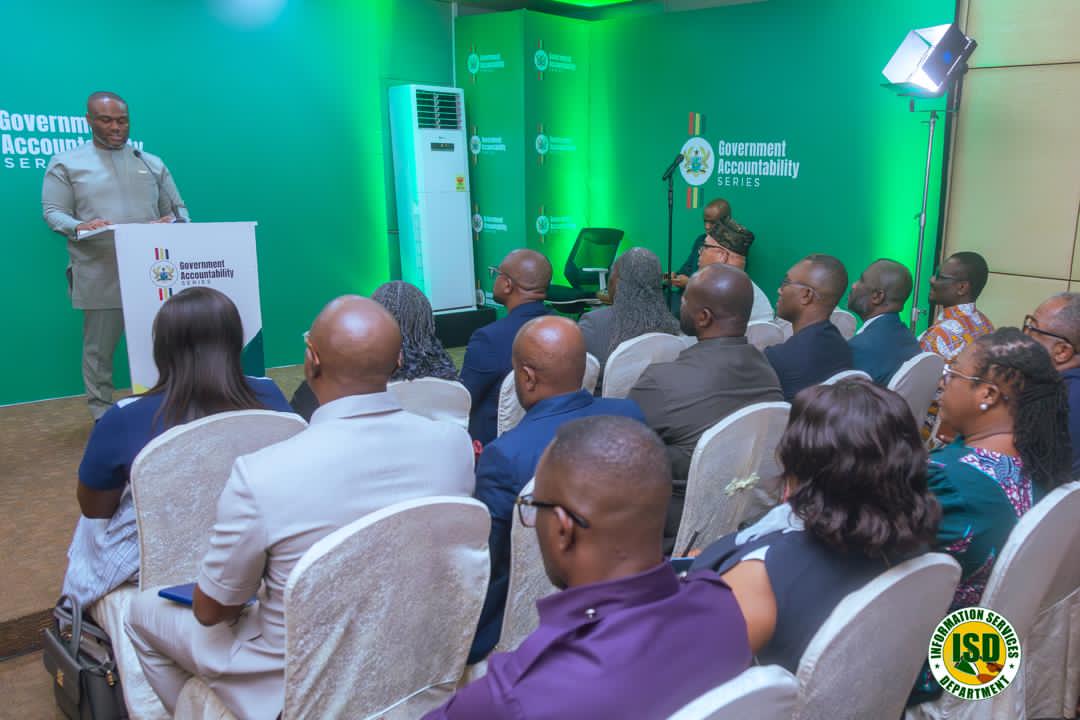
Delivering his first official address at the Government Accountability Series, the Minister said transparency, public engagement and accountability remain central to the administration’s resetting agenda.
“Open, transparent engagement remains central to good governance and national development,” he stated, adding that the Ministry’s work is aligned with government’s vision of equity, sustainability and national transformation.
Coastal Protection and Flood Control
Hon. Adjei announced the successful completion of major coastal protection projects at Komenda, Ningo–Prampram and Elmina, collectively safeguarding about 15 kilometres of Ghana’s coastline.
“At Komenda, the final phase of the coastal protection works, including a critical bridge, has been completed, improving connectivity and livelihoods in fishing communities,” he said.
He noted that dredging works at the Djale Lagoon in Ningo–Prampram had restored beach front access and protected nearby homes, while Phase Three of the New Takoradi Sea Defence Project at Elmina had also been completed.
Several other coastal projects are at various stages of completion, including Dansoman, Dixcove, Anomabu, Cape Coast, Aboadze and Axim.
The Minister further disclosed that Phase Two of the Blekusu Coastal Protection Project had commenced following President John Dramani Mahama’s visit to tidal wave-hit communities in Ketu South.
“True to the President’s promise, the contract has been awarded, the project is 25 per cent complete, and calm has already been restored along the coastline,” he noted.
Drainage and Flood Mitigation
Addressing flooding, Hon. Adjei said government has made it a top priority, leading to the establishment of a Presidential Task Force on Flooding to coordinate nationwide interventions.
Under the National Flood Control Programme, the Ministry has constructed and rehabilitated drainage systems across the country, resulting in the construction of about 1.76 kilometres of storm drains during the review period.
He highlighted ongoing works under the Greater Accra Resilient and Integrated Development (GARID) Project, including the dredging of over 90,936 cubic metres of sediment from the Odaw Channel and drainage upgrades in Alajo, Akweteyman and Nima.
The Minister also announced progress on the Flood Early Warning System (FEWS) for Accra, stating that servers had been installed at the Ghana Hydrological Authority, NADMO and the Ghana Meteorological Authority.
“Operational testing and user training have been completed, significantly strengthening flood preparedness in Accra,” he said.
Similar flood risk assessments are underway in Kumasi, targeting the Sisa, Wiwi and Aboabo drainage basins.
Housing Delivery and Urban Renewal
Turning to housing, Hon. Adjei acknowledged Ghana’s housing deficit of over 1.8 million units, worsened by rapid urbanisation and affordability challenges.
To address this, he said government is completing stalled affordable housing projects, including 800 units at the Kpone Affordable Housing Project and advancing the Oxygen City Housing Project in the Volta Region.
“This is the first TDC Ghana Ltd housing project outside the Tema Acquisition Area and will deliver 800 modern apartments with full social amenities,” he explained, adding that completion is expected by June 2027.
Progress has also been made on the Saglemi Affordable Housing Project, with joint venture arrangements concluded and documentation undergoing final review by the Attorney-General.
Additionally, the State Housing Company is advancing the Surge Homes at Amrahia and SHC Gardens, both expected to be completed by the end of 2025.
Under the Government Redevelopment Programme, 68 housing units for public servants have been completed, with 422 more under construction across prime locations in Accra.
Resettlement and Decentralised Housing
The Minister said government is reconstructing 2,225 housing units for communities displaced by the Akosombo Dam spillage, with Phase One involving 1,010 units across North, Central and South Tongu.
He also announced the Greenville District Housing Programme, targeting low- to middle-income earners in eight pilot districts using cost-effective and sustainable building methods.
“This programme marks a significant step towards decentralising housing delivery and promoting social equity,” he stated.
Water Resources and Supply
On water resources management, Hon. Adjei warned that Ghana is already experiencing water stress, with per capita water availability falling below the UN threshold.
He cited climate change, illegal mining, deforestation and weak enforcement as major threats to water sustainability, adding that the Water Resources Commission has intensified buffer zone restoration and community-based water governance.
To support flood forecasting, telemetry systems have been installed on the Black and White Volta Rivers, alongside the rehabilitation of several hydrological gauging stations nationwide.
In terms of water supply, the Minister revealed that while 88 per cent of Ghanaians have access to basic water services, only 44 per cent enjoy safely managed water.
He said major urban water projects at Keta, Wenchi and Sekondi-Takoradi are nearing completion, with plans to commence expansion projects in Damango and Sunyani.
In conclusion, Hon. Adjei reaffirmed government’s resolve to deliver impactful infrastructure despite fiscal constraints.
“We remain dedicated to creating infrastructure that meets today’s needs while laying a solid foundation for future generations,” he said, calling on citizens and institutions to uphold planning regulations and responsible environmental practices.
Story: Patrick Asford Boadu