President John Dramani Mahama has described the expansion of KEDA (Ghana) Ceramics Company Limited in Shama as a transformative milestone in Ghana’s industrialisation drive, declaring that the country is no longer content to remain an import-dependent economy.
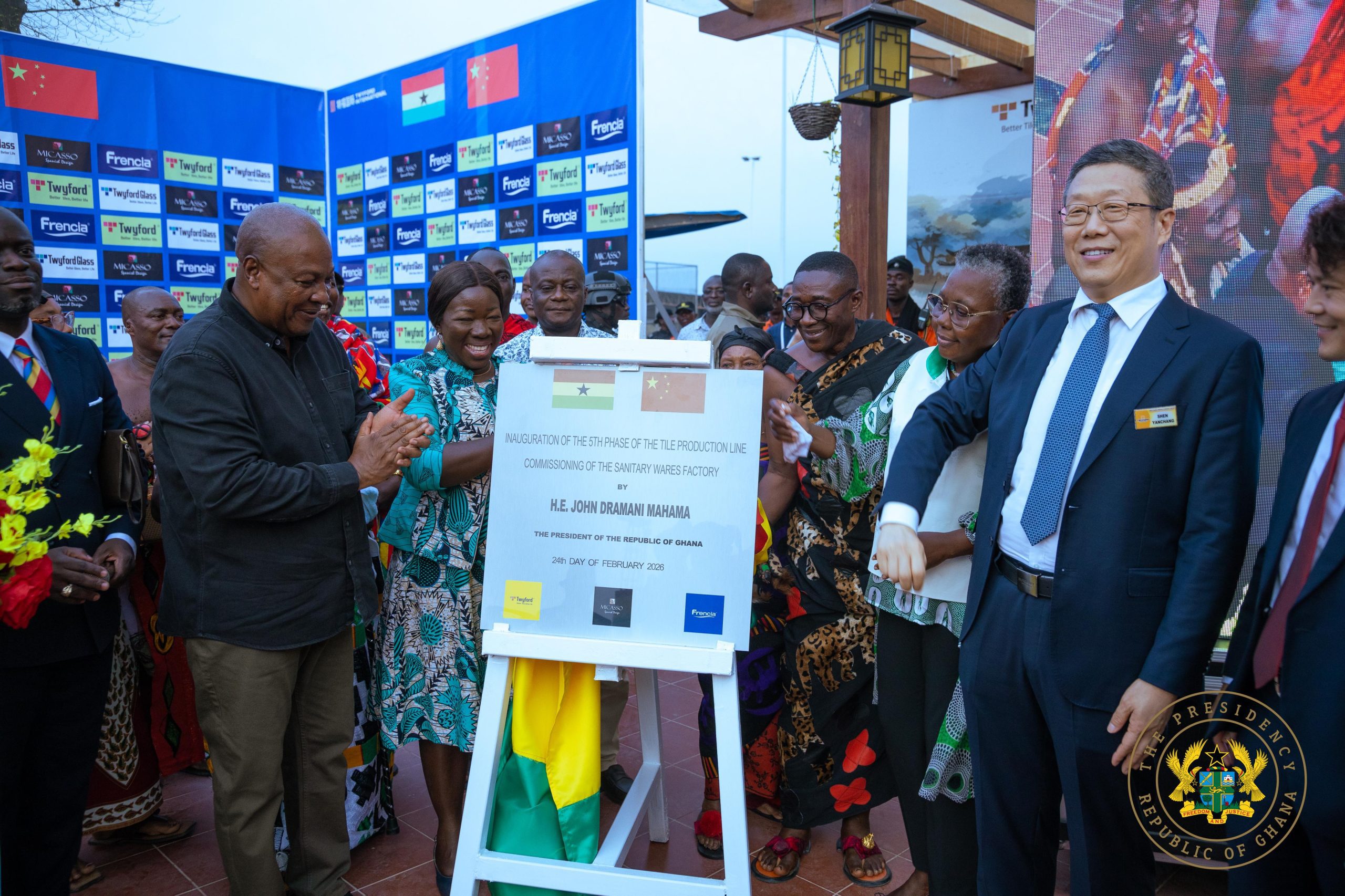
Speaking at the sod-cutting ceremony for a new US$250 million float glass manufacturing facility, alongside the commissioning of a modern sanitary ware factory and the inauguration of Phase Five of KEDA’s ceramic tile production line, President Mahama said the investment symbolised Ghana’s renewed commitment to production, value addition, and exports.
“This is not merely the expansion of factories. It is a statement to the world that Ghana is determined to produce, to process, to manufacture, and to export,” the President said.
Reflecting on KEDA’s journey in Ghana, President Mahama recalled that when the company first conducted feasibility studies in 2015, there was widespread scepticism.
“When they said they were coming to build a brand new ceramic tile factory, I doubted it,” he admitted.
“But today, many years later, we can all see what that partnership has produced.”
He noted that KEDA’s decision to establish a float glass factory fulfils a promise made less than a year ago during an investment engagement in China.
“The last time I heard about a glass factory in Ghana was the Aboso Glass Factory,” he said. “So when I was told this would be a brand new glass factory, I was curious.
Today, here we are, cutting sod for a 250-million-dollar float glass factory. This is a game changer.”
According to President Mahama, Ghana currently imports virtually all its glass products, from bottles to windows, a situation the new factory is expected to reverse. He explained that the facility will have a total production capacity of 1,400 tonnes per day when completed, ranking among the largest float glass factories in Africa.
“At full capacity, export earnings alone are projected to be nearly 100 million dollars annually,” he said. “This is how you build a strong economy and a strong currency not by speculation, but by production and exports.”
The President also highlighted the broader economic impact of KEDA’s operations, revealing that the company paid about GHS 740 million in taxes in 2025 alone, with projections exceeding GHS 1 billion annually once the new facilities are fully operational.
“That is the revenue we use to build schools, hospitals, and roads,” he said.
Beyond exports and revenue, President Mahama underscored job creation as a key benefit of the expansion.
He disclosed that the project will generate more than 2,100 direct jobs, with thousands of additional indirect jobs through logistics, raw materials, and support services.
“This investment includes skills transfer and localisation. Ghanaian engineers, technicians, and managers will be trained to take leadership roles,” he noted.
President Mahama linked the investment to his government’s broader RESET agenda and the recently operationalised 24-hour economy programme, announcing proposed incentives for industries operating under the initiative.
“Factories registered under the 24-hour economy will be able to import capital equipment duty and tax-free,” he said, assuring investors that “the incentives are coming.”
He commended KEDA’s Chairman, Shen Yanchang, Managing Director Li Wei, traditional authorities in Shama, and the workforce for their collective role in the project’s success.
“As I stand here today, I see more than structures rising from the ground,” President Mahama said. “I see reduced imports, increased exports, jobs for our youth, and Ghana emerging as a giant of West African manufacturing.”
He concluded by urging workers to treat the factories as their own and called the sod-cutting ceremony a symbol of Ghana’s industrial resurgence and renewed belief in its productive power.
Story: Patrick Asford Boadu