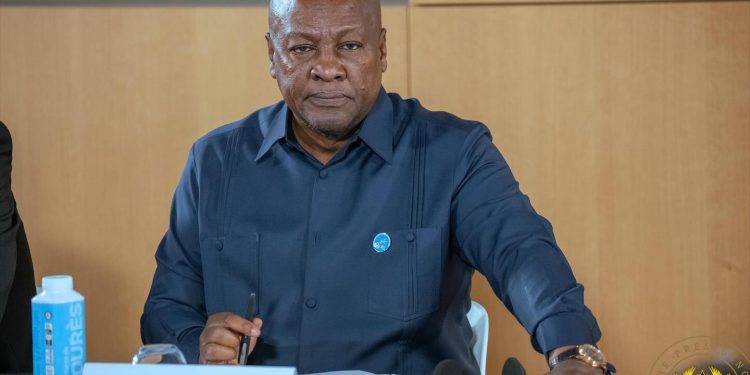
President John Dramani Mahama has called on the international community to transform recognition of the transatlantic slave trade into meaningful action, unveiling a comprehensive framework to advance reparatory justice at the High-Level Consultative Conference on the Next Steps to the Landmark United Nations Resolution on the Trafficking of Enslaved Africans.
Welcoming heads of state, scholars, activists, faith leaders, and international delegates to Accra, President Mahama described the gathering as a historic moment aimed not only at examining the past but determining how the world responds to one of humanity’s greatest injustices.
“This conference has been convened not merely to discuss the past, but to determine how humanity responds to one of the greatest crises of our time,” he stated.
The President reflected on his address to the United Nations General Assembly on September 25, 2025, when Ghana announced its intention to introduce a resolution recognizing the trafficking of enslaved Africans as a grievous crime against humanity. Six months later, on March 25, 2026, the UN General Assembly adopted Resolution A/RES/80/250 with the support of 123 member states.
Mahama expressed gratitude to governments, civil society organizations, scholars, and faith leaders whose efforts contributed to the landmark adoption, emphasizing that the resolution marked the beginning—not the conclusion—of a broader process of truth-telling, dialogue, and justice.
Centering the Experiences of Enslaved Women
Addressing delegates in a country that bears some of the most visible physical reminders of the transatlantic slave trade, including Elmina Castle, Cape Coast Castle, Assin Manso, and Christiansborg Castle, the President stressed the need for a gender-responsive approach to reparatory justice.
He noted that while millions endured the horrors of enslavement, women and girls experienced distinct forms of violence and exploitation that have often been overlooked in historical narratives.
Mahama observed that history frequently remembers the merchants and ships involved in the trade while failing to adequately acknowledge the women whose bodies became instruments of economic exploitation and systems of bondage.
He paid tribute to iconic figures such as Nanny of the Maroons, Harriet Tubman, and Sojourner Truth, arguing that any meaningful framework for reparatory justice must fully recognize and address the unique experiences of women.
Responsibility for History’s Legacy
The President underscored that the current generation should not inherit guilt for past atrocities but must accept responsibility for confronting their enduring consequences.
“History does not ask us to inherit guilt, but it asks us to inherit responsibility,” he declared.
Mahama argued that societies today continue to grapple with inequalities and structures rooted in slavery and colonialism, making it imperative to pursue solutions that address those historical legacies.
He welcomed recent acknowledgements by international religious and political leaders, including Pope Francis, the Church of Scotland, the Church of England, and French President Emmanuel Macron, describing such actions as important steps toward honest engagement with history.
New Global Structures for Reparatory Justice
To ensure that momentum generated by the UN resolution results in lasting outcomes, President Mahama endorsed the African Union’s decision to establish an African-Caribbean Joint Mechanism on Reparative Justice.
He also announced the creation of three global panels that will guide the next phase of implementation, drawing inspiration from the CARICOM 10-Point Plan for Reparatory Justice.
The Global Advisory Panel on Reparatory Justice will bring together heads of state, government leaders, and eminent personalities to provide strategic direction for international engagement.
The Expert Panel on the Restitution of Cultural Artifacts will focus on facilitating the return of looted cultural treasures, sacred objects, archives, and heritage items to their communities of origin.
Meanwhile, the Global Legal Panel on Reparatory Justice will assemble leading jurists and legal scholars to develop pathways for advancing reparatory claims within the framework of international law and human rights.
The President emphasized that these bodies are intended to complement, rather than replace, the efforts of governments, regional organizations, and existing institutions by providing technical expertise and policy guidance.
A Historic Moment for Action
As part of the conference, delegates were scheduled to participate in a commemorative event and traditional dinner at Christiansborg Castle in Osu, symbolizing the enduring bonds between Africa and its diaspora and honoring the resilience of people of African descent across the world.
In his closing remarks, Mahama reminded participants that future generations will assess their legacy not by declarations and resolutions alone, but by the concrete actions taken to achieve justice.
He urged the global community to embrace truth over denial, cooperation over indifference, and justice over division.
“When history calls upon our generations to act, let us say that we stood up and we answered with courage,” the President said.
Mahama expressed confidence that the Accra conference would help shape a practical and enduring framework for reparatory justice and strengthen international efforts to confront the lasting consequences of slavery, colonialism, and racial inequality.
Story By: Eugenia Ewoenam Osei