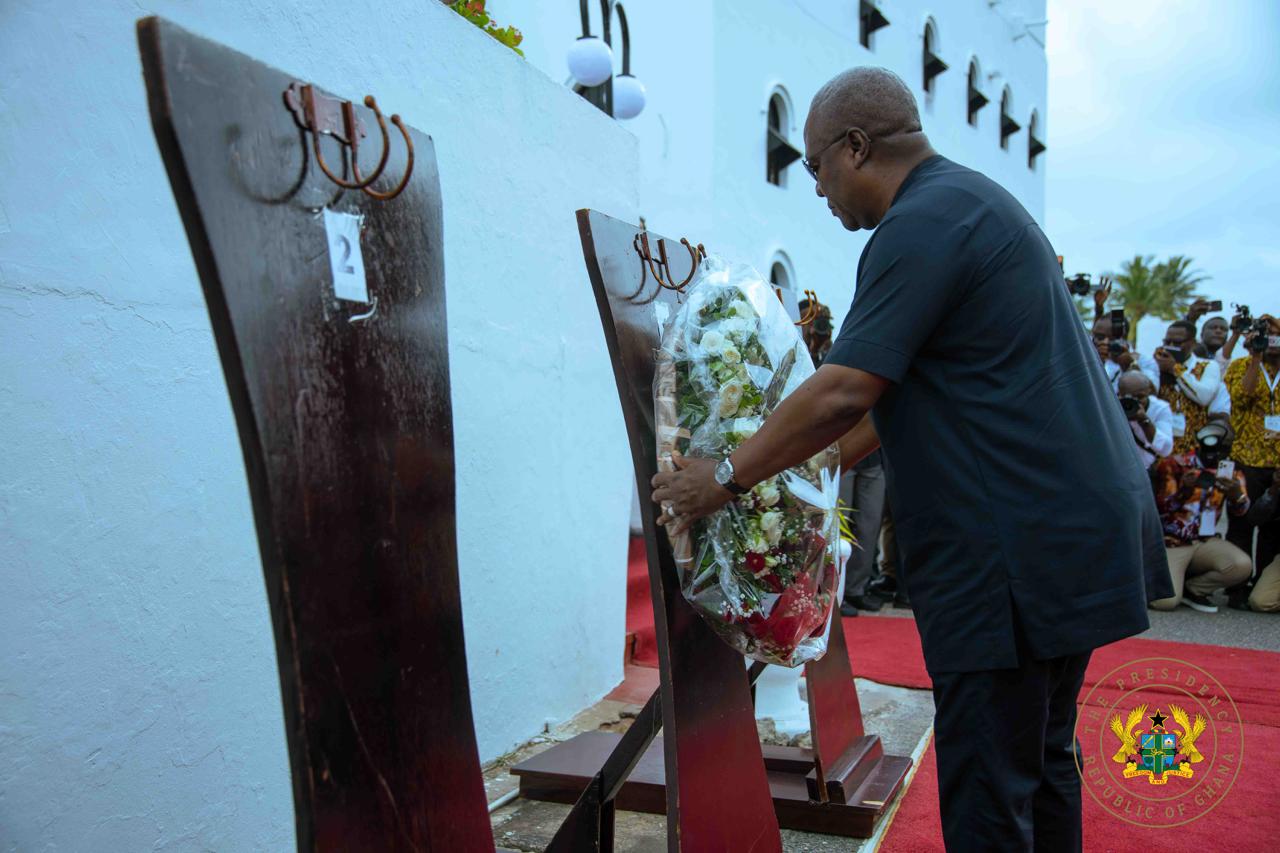
President John Dramani Mahama has called for greater unity among Africans and people of African descent across the globe in the pursuit of reparatory justice, equality, and historical recognition for the enduring consequences of slavery and colonialism.
Speaking at the Juneteenth Commemoration and the closing session of the High-Level Consultative Conference on the Next Steps following the landmark United Nations resolution on the trafficking of enslaved Africans, President Mahama said the conference had demonstrated an unprecedented level of commitment to the cause.
“Unlike many international conferences where chairs empty by day two, this conference was different.
The full attendance over three days shows the value and importance of what we discussed,” he said, commending participants and the technical team for their dedication throughout the event.
The President announced the adoption of the conference’s outcome document, describing it as a roadmap for collective action.
“The outcome document has been adopted. It will serve as the platform for forging ahead together in unity,” he stated.
Reflecting on a dramatic re-enactment of the transatlantic slave trade presented during the conference, President Mahama recounted the horrors endured by millions of Africans who were forcibly removed from their homelands.
“We walked through a powerful re-enactment showing the stages of the slave trade: the raiders taking sons and daughters, families fractured, loved ones crying out names like Ayanda, never to be seen again,” he said.
He described how enslaved Africans were marched hundreds of kilometres under brutal conditions before being confined in coastal dungeons and eventually transported across the Atlantic.
“The Middle Passage was the most torturous journey. People were chained and shackled, given little food, and some chose death over continued suffering,” he noted.
President Mahama explained that Juneteenth serves as a reminder of the resilience of enslaved Africans and their descendants, particularly those in the United States who remained enslaved for two years after emancipation had legally been proclaimed.
“Juneteenth commemorates our comrades in the United States who remained enslaved for two years after the Emancipation Act was signed. They only learned of their freedom two years later,” he said.
He described this year’s observance as historic, noting that it marked the first joint commemoration of Juneteenth by Africa and the United States.
“For the first time, Africa and the United States are jointly observing Juneteenth. We celebrate our brothers and sisters for their resilience, survival, strength, and faith,” he added.
The President emphasized that the struggle for reparatory justice extends beyond financial compensation and the return of looted cultural artefacts.
“Our work goes beyond reparations and the return of artifacts. It is advocacy for a more equal world, a world that offers opportunity to everyone, a fair and just world,” he said.
Referencing remarks by Mia Mottley, President Mahama argued that the structural inequalities created by slavery continue to disadvantage descendants of enslaved Africans.
“As Mia Mottley said, the iniquities of the slave trade still remain. The demographic affected is still the poorest part of the world because the system is rigged against descendants of slaves,” he stated.
The President also highlighted Ghana’s efforts to strengthen ties with the African diaspora, citing legislation that allows people of African descent to seek permanent residence in the country.
“Ghana has passed an Act allowing people of African descent to seek abode in Ghana. If you want to come home to the motherland, Ghana is one of the countries that has a law allowing you to stay,” he said.
He further noted Ghana’s visa-free policy for African citizens and ongoing efforts to expand similar arrangements to countries within the Caribbean Community.
“For all Africans, we have introduced visa-free travel to Ghana. We are working to extend the same to CARICOM countries, and already have visa waivers with most CARICOM nations,” he said.
President Mahama concluded with a message of solidarity to Africans and the global African diaspora, declaring: “Ghana is your home. You are all free to visit whenever you want.”
The conference brought together African leaders, representatives of the diaspora, traditional authorities, academics, and international partners to chart a common path toward implementing the landmark UN resolution and advancing the global campaign for historical justice, reparations, and equitable development.
Story: Patrick Asford Boadu