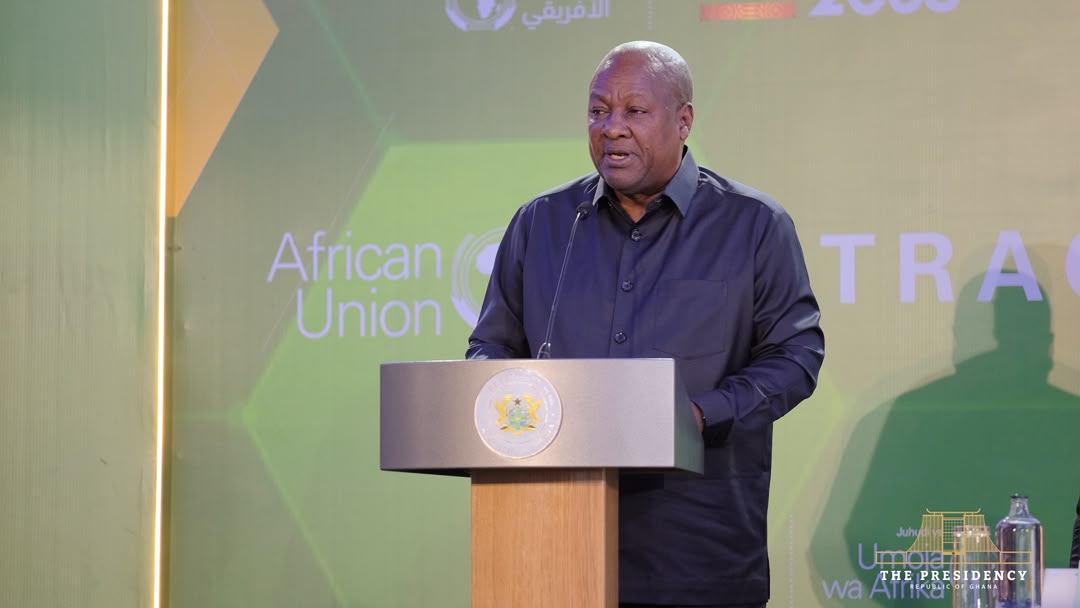
President John Dramani Mahama has called on African leaders to seize what he described as a defining moment in the continent’s history by building self-reliant health systems capable of delivering quality healthcare without excessive dependence on external support.
Delivering the keynote address at the opening of the African Union Extraordinary Summit on Health in Accra, President Mahama said Africa’s new struggle was no longer against colonialism but against inequality, preventable diseases, weak health systems and dependence on foreign healthcare systems.
Drawing parallels with Ghana’s historic role in Africa’s liberation movement, the President recalled that it was in Accra in 1958 that Osagyefo Dr. Kwame Nkrumah convened the All-African Peoples Conference to champion the continent’s political freedom.
“Today, sixty-eight years later, Africa gathers once again in Accra to confront a different struggle. The liberation we seek today is not from colonial rule but from inequality, preventable disease, maternal deaths, weak health systems and dependence on others for our healthcare.”
He said the success of Africa’s new liberation struggle would be measured by resilient health systems, locally manufactured medicines, healthy mothers and children, and governments financing their own healthcare priorities.
President Mahama expressed appreciation to the African Union for selecting Ghana to host the landmark summit and noted that the gathering was taking place at a critical moment when global health financing was rapidly declining.
He observed that international development assistance for health had fallen sharply from nearly US$50 billion to just over US$39 billion within a year, while many African countries still depended on external partners to finance almost half of their health budgets.
“This is not the time to speak the language of hopelessness but the language of determination, resilience and action.
The system that is weakening today was never meant to become our permanent foundation. It was only the scaffolding that helped us build.
Our responsibility now is to complete the building itself a strong, self-reliant African health system that can stand on its own.”
The President acknowledged the progress Africa has made in reducing HIV/AIDS and tuberculosis-related deaths but warned that the continent continues to face major public health challenges, including malaria, hepatitis, neglected tropical diseases and the growing burden of non-communicable diseases such as heart disease, diabetes, cancer and mental health conditions.
He noted that more than two million Africans die annually from non-communicable diseases before reaching the age of 70, stressing that Africa needed an entirely new approach to healthcare delivery.
“Africa can no longer afford to remain a passive beneficiary of global health systems designed elsewhere. We must become the architects of our own health destiny.”
President Mahama highlighted Ghana’s Accra Reset Initiative as a bold continental agenda aimed at advancing African health sovereignty through stronger institutions, innovative financing and local manufacturing.
He explained that the initiative includes the establishment of a High-Level Panel on Global Health Architecture and Governance to develop practical solutions that place Africa firmly in control of its healthcare future.
According to him, complementary initiatives such as the Health Investment National Gateway Enablers (HINGE) and the Reform Interlock Observatory are designed to connect public health priorities with private investment while transforming healthcare into a driver of economic growth.
The President also outlined Ghana’s domestic health reforms, including the Ghana Medical Trust Fund (Mahama Cares), which he said is helping protect families from the financial burden of chronic diseases.
He expressed Ghana’s full support for Tanzanian President Samia Suluhu Hassan in her role as the African Union Champion for Maternal and Child Health and pledged Ghana’s commitment to advancing the Mother Africa Call to Action.
President Mahama stressed that health sovereignty must also extend to conflict-affected and displaced populations across the continent.
“Health sovereignty means little if healthcare cannot reach those who need it most. We cannot allow war and instability to destroy our health gains or deny vulnerable populations access to essential care.”
Turning to pharmaceutical manufacturing, President Mahama noted that Africa currently imports approximately 70 percent of its medicines, more than 90 percent of its medical devices and almost all of its vaccines, describing the COVID-19 pandemic as a painful reminder of the risks associated with overdependence on external suppliers.
He welcomed the expansion of vaccine manufacturing across Africa and highlighted Ghana’s investment in the Ghana Vaccine Institute, describing it as a major contribution to strengthening continental manufacturing capacity.
He also praised the steady implementation of the Pharmaceutical Manufacturing Plan for Africa and the operationalisation of the African Medicines Agency, which he said would improve pharmaceutical regulation and create opportunities for African manufacturers.
“Building strong health value chains will create industries, laboratories, factories and quality jobs for millions of African youth. Through the African Continental Free Trade Area, health sovereignty also becomes a strategy for industrialisation, economic transformation and sustainable development.”
President Mahama further urged African governments to honour the Abuja Declaration commitment of allocating 15 percent of national budgets to health, emphasizing the need for stronger domestic financing, innovative funding mechanisms and greater collaboration with finance ministries.
He stressed that investment in disease prevention remains one of the highest-return investments any nation can make.
The President said the summit would deliberate on financing, governance, local manufacturing and leadership before adopting the Accra Declaration, which he urged leaders to treat as a practical roadmap rather than another symbolic document.
“My appeal is that the Accra Declaration should become a living commitment rather than another well-written document. We must hold ourselves accountable through regular monitoring, peer review and measurable progress.”
Concluding his address, President Mahama called on African leaders to remain united in shaping the continent’s healthcare future.
Quoting a popular Ghanaian proverb, “Ti koro nko agyina” meaning one head does not hold counsel alone he said collective action remained essential to overcoming Africa’s shared health challenges.
He ended with a powerful reflection on the significance of the moment.
“Let history record that when the old systems began to fail, African leaders gathered once again in Accra and charted a new path towards health sovereignty and total liberation.”
President Mahama welcomed delegates to Ghana and concluded by recalling the enduring words of Osagyefo Dr. Kwame Nkrumah: “Think like people of action and act like people of thought.”
Story: Patrick Asford Boadu