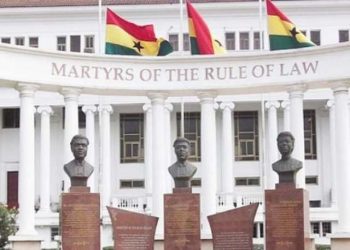
The Supreme Court has ruled that the Office of the Special Prosecutor (OSP) has the legal authority to prosecute criminal cases, holding that its prosecutorial powers do not violate Article 88 of the 1992 Constitution, which grants the Attorney-General (A-G) exclusive authority to initiate criminal proceedings in the name of the Republic.
In a unanimous judgment delivered on Wednesday, July 29, 2026, the apex court held that the OSP’s prosecutorial mandate is valid because it operates under the authority delegated by the Attorney-General through the Office of the Special Prosecutor (Operations) Regulations, 2018 (L.I. 2374).
According to the court, the Legislative Instrument provides the legal basis for the OSP to initiate and conduct prosecutions, and that authorization remains in force unless Parliament amends or revokes it.
The court affirmed that while the Attorney-General retains exclusive constitutional prosecutorial authority, the OSP is lawfully empowered to prosecute cases on the Attorney-General’s delegated authority. It further ruled that the Attorney-General retains the constitutional power to discontinue any prosecution initiated by the OSP by entering a nolle prosequi.
The judgment also confirmed the validity of all prosecutions, convictions, and freezing orders secured by the OSP under its existing mandate, stating that none of those actions are affected by the court’s decision.
The Supreme Court further declared that Sections 3 and 4 of the Office of the Special Prosecutor Act, 2017 (Act 959), are consistent with the 1992 Constitution and are therefore valid. This rejected arguments by legal officer Noah E. Adamtey, who had contended that the provisions were unconstitutional.
The justices reiterated that although the Attorney-General alone holds the constitutional authority to prosecute on behalf of the Republic, any individual or institution prosecuting criminal matters does so lawfully when authorized by the Attorney-General in accordance with the law.
The ruling overturns uncertainty created by an April 2026 decision of the Accra High Court, which held that the OSP lacked the constitutional authority to independently prosecute criminal cases.
In that earlier judgment, delivered on April 15, 2026, Justice John Eugene Nyadu Nyante ruled that while the OSP could investigate corruption-related offences, it could not initiate prosecutions without the Attorney-General’s involvement. The decision effectively placed several ongoing OSP prosecutions on hold pending legal clarification.
The Supreme Court’s latest decision settles the constitutional question, confirming that the OSP can continue prosecuting corruption and corruption-related offences under the Attorney-General’s delegated authority while preserving the Attorney-General’s ultimate constitutional oversight over all criminal prosecutions.