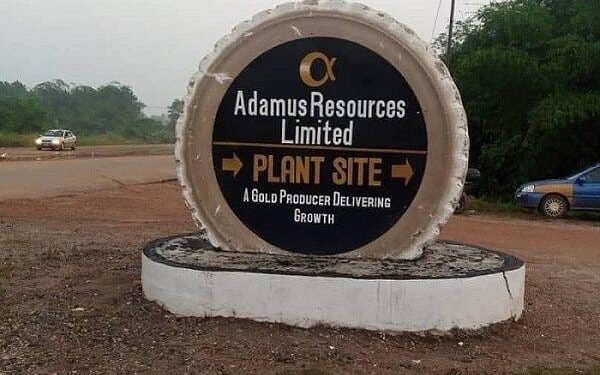
Adamus Resources Limited has welcomed a new government initiative giving the company a 12-month window to revive and stabilise its mining operations following months of regulatory disputes over its mining leases.
The new arrangement, announced by the Presidency on Friday, August 21, requires the Ministry of Lands and Natural Resources, the Minerals Commission and Adamus Resources to jointly develop a 12-month roadmap aimed at restoring the mine to full and sustainable operations.
Under the arrangement, a six-member management team comprising three representatives from Adamus and three from the government will be established to oversee the turnaround process.
The Presidency said the agreement was reached following discussions between the government and the company aimed at resolving their differences and safeguarding “one of the few operating indigenous large-scale mines” in the country.
The development comes shortly after Lands and Natural Resources Minister Emmanuel Armah-Kofi Buah upheld the revocation of Adamus Resources’ Akango, Salman and Nkroful mining leases.
The leases were initially revoked in April 2026 after investigations by the Inspectorate Division of the Minerals Commission allegedly identified what the government described as sustained and material breaches of the Minerals and Mining Act, 2006 (Act 703), and related regulations.
The alleged violations included the unauthorised assignment of mineral rights, mining beyond approved areas without the necessary permits, failure to secure some environmental and forestry approvals, and the alleged involvement of foreign nationals in mining activities within the concessions.
Adamus Resources, however, rejected the allegations and challenged the revocation, arguing that the government had not followed the required legal and administrative procedures. The company maintained that the allegations against it were unfounded.
Following Adamus’ petition, the Lands Minister established an Inter-Ministerial Committee to review the revocation. After considering the committee’s final report, Mr Buah announced on August 10 that he had upheld the decision to revoke the leases.
The Minister subsequently directed the Minerals Commission to assume administrative control of the mine, while assuring that the interests and livelihoods of workers would be protected.
The decision attracted criticism from some civil society groups and commentators. IMANI Africa Vice President Kofi Bentil, for instance, accused the government of what he described as a “calculated effort” to strip the Ghanaian owner of Adamus Resources of her mining assets.
The latest agreement now offers the two parties an opportunity to move beyond the dispute and focus on restoring the mine’s operations.
As part of the 12-month roadmap, Adamus will be required to prepare a comprehensive plan to settle outstanding liabilities owed to the Ghana Revenue Authority, the Minerals Income Investment Fund, financial institutions and suppliers.
The government and the company will also explore options for raising additional capital to support the mine’s operations, including the possibility of bringing in new investors to acquire equity in the business.
According to the Presidency, the roadmap will specifically examine “means to inject fresh capital by inviting additional partners to take up equity in the mining operation.”
The government, Adamus Resources and the Minerals Commission are expected to submit the completed roadmap to the Presidency within two weeks.
The agreement marks a significant shift in the government’s approach to the Adamus dispute—from the earlier decision to assume administrative control of the mine to a joint effort to restructure, recapitalise and restore the operation.
For Adamus Resources, the 12-month reprieve provides a fresh opportunity to address its financial and operational challenges while working with government authorities to secure the future of one of Ghana’s indigenous large-scale mining operations.
Story By: Eric Boateng