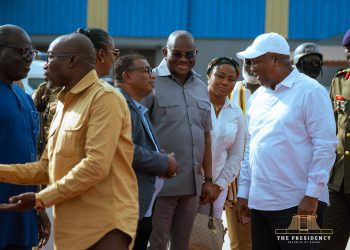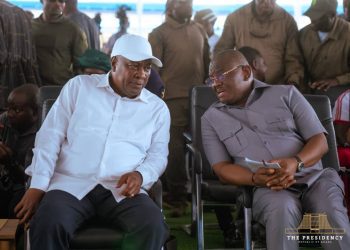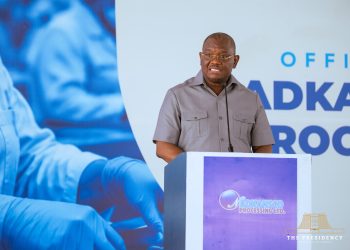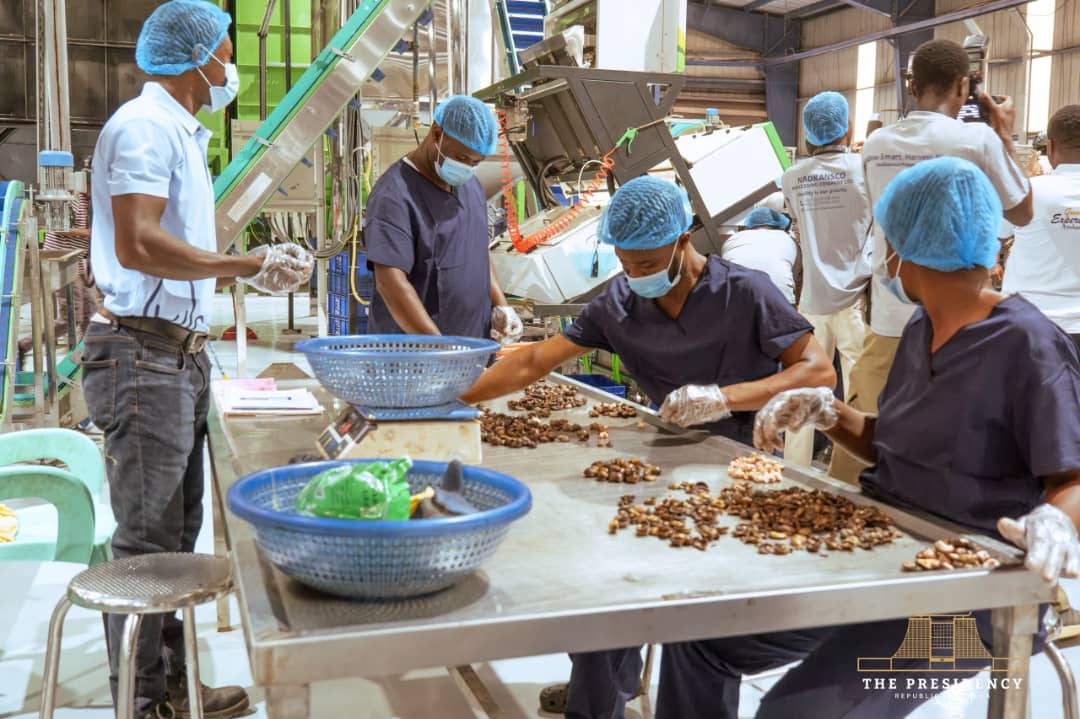
President John Dramani Mahama has commissioned the GH¢148.4 million Nadkansco Cashew Processing Factory at Tuobodom in the Techiman North District of the Bono East Region, pledging additional government support to ensure the facility operates throughout the year.
The factory, which has an annual processing capacity of approximately 30,000 to 31,000 metric tonnes of raw cashew nuts, is expected to create up to 1,500 direct jobs, particularly for young people, while strengthening Ghana’s agro-processing and manufacturing industries.
Speaking at the commissioning ceremony, President Mahama said the establishment of the facility represented a significant step towards transforming Ghana’s agricultural sector from the export of raw materials to value addition, industrialisation and job creation.
He explained that the creation of the Ministry of Trade, Agribusiness and Industry was part of government’s efforts to bridge the gap between agricultural production and industrial processing.
According to the President, successive agricultural interventions had focused largely on increasing food production without paying sufficient attention to processing, packaging and marketing the produce.
“We decided that we would continue the value chain, not only in respect of producing more food but also in respect of processing the food, packaging it for the market and for export,” he said.
President Mahama observed that Ghana had over the years exported substantial quantities of raw cashew nuts, thereby missing opportunities to generate additional income, create employment and retain more economic value locally.
He recalled his commitment during the 2024 election campaign to establish cashew processing factories across the country, describing the commissioning of the Nadkansco facility as the fulfilment of that promise.
“Promise made, promise fulfilled,” he declared.
The President disclosed that Ghana currently produces approximately 262,000 metric tonnes of cashew nuts annually, noting that the Nadkansco factory’s capacity of about 31,000 metric tonnes was insufficient to process the country’s entire production.
He estimated that Ghana would require between four and five additional factories of similar capacity to significantly increase local processing and reduce dependence on raw cashew exports.
Government to support year-round operations
President Mahama assured the management of Nadkansco that government would provide additional financial support through the Ghana Export-Import Bank (Ghana EXIM Bank) to enable the company to purchase and stockpile enough raw cashew nuts to sustain operations throughout the year.
He explained that although Ghana EXIM Bank had provided financing for the factory’s machinery and working capital, the available funding could only sustain operations for approximately 60 to 80 days.
“We do not want a factory that will run for 80 days and shut down for the rest of the year until the next cashew season,” he stated.
He consequently announced that government would make additional funds available to Ghana EXIM Bank for on-lending to Nadkansco to facilitate the purchase and storage of sufficient raw materials.
“We will unlend money to Ghana EXIM to unlend to Nadkansco so that Nadkansco can acquire enough cashew nuts to process throughout the year,” he said.
The President stressed that ensuring a consistent supply of raw materials was critical to the sustainability of local processing factories and the protection of jobs.
Raw cashew exports to face restrictions
President Mahama also announced plans to introduce measures to protect local cashew processing companies, including a temporary restriction on the export of raw cashew nuts during the first three months of the harvesting season.
He explained that the proposed policy would give domestic processors priority access to locally produced cashew nuts before exporters could purchase and ship the remaining quantities outside the country.
“We are going to implement the same conditions that Ivory Coast is implementing.
So, when the season opens, for the first three months of the season, nobody will be allowed to export cashew nuts from Ghana until our local processors have bought enough,” he announced.
He further disclosed that government intended to introduce a levy on exported raw cashew nuts, with proceeds channelled into a dedicated fund to support local processors in purchasing additional raw materials.
The measures, he said, were intended to strengthen domestic processing capacity and ensure that factories established in the country did not struggle to secure the raw materials required for production.
Mahama urges entrepreneurs to invest in manufacturing
The President also challenged Ghanaian entrepreneurs to move beyond traditional trading activities and invest in manufacturing and agro-processing businesses capable of transforming the country’s agricultural economy.
He urged local investors to explore opportunities in processing maize, rice, mangoes and other agricultural commodities instead of concentrating on businesses with limited industrial impact.
“We must change that mindset. We are not a country of traders. We are a country of manufacturers, so let us invest,” he said.
He argued that Ghana could generate more employment and economic opportunities by processing its agricultural produce locally rather than exporting raw materials and importing finished products.
“We should not only open a pure water factory. We have enough pure water factories. We need factories that will process our raw materials for export,” he stressed.
Referencing comments by Nigerian industrialist Aliko Dangote, President Mahama said exporting raw materials amounted to exporting jobs and income, while importing finished products meant transferring economic opportunities to other countries.
24-hour economy incentives for manufacturers
President Mahama further encouraged Nadkansco and other manufacturing companies to take advantage of incentives under the government’s 24-hour economy initiative.
He explained that companies operating multiple shifts under the programme would benefit from accelerated depreciation of plants and equipment over two years, enabling them to free up resources for reinvestment.
He added that businesses seeking to expand existing operations or establish additional factories would enjoy deferred payment of duties and levies on imported equipment for one year.
The incentives, he said, were designed to reduce the financial burden on manufacturers, encourage private-sector investment and promote continuous industrial production.
The President also disclosed that government was committing 10 billion dollars of its own resources to eight strategic sectors of the economy to stimulate growth and create employment, with agriculture and agribusiness among the priority areas.
He maintained that economic stability, declining inflation and currency appreciation must translate into tangible opportunities for Ghanaians, particularly the country’s youth.
“It is good to have a stable economy. It is good to have a growing economy. It is good to have low inflation. It is good to have a strong currency, but what matters for us today is that we’re creating jobs and opportunities for our young people,” he said.
Factory jobs to benefit young people and women
President Mahama commended Nadkansco for investing in the cashew processing industry, describing its projected employment of up to 1,500 people as a significant contribution to addressing youth unemployment.
He also praised Ghana EXIM Bank for supporting local industrial projects, citing a factory in Savelugu which, following additional financial intervention, had expanded its operations and employed more than 2,000 workers.
According to him, women account for approximately 80 per cent of the workforce at the Savelugu facility, demonstrating the potential of industrialisation to create employment opportunities for women.
President Mahama reaffirmed government’s commitment to supporting the establishment and expansion of factories as part of its broader 24-hour economy and industrialisation agenda.
He congratulated the Minister of Trade, Agribusiness and Industry and the management of Nadkansco for the investment, urging other Ghanaian entrepreneurs to emulate the company’s initiative.
He expressed confidence that increased investment in agro-processing and manufacturing would help retain more value within the domestic economy, expand employment opportunities and provide sustainable livelihoods for the country’s growing youth population.
“Factory by factory, factory by factory, we are creating the jobs for our young people,” he said.
Story: Patrick Asford Boadu