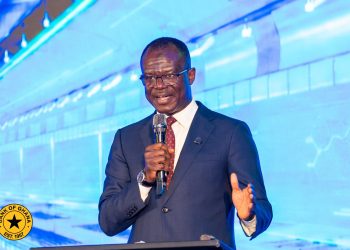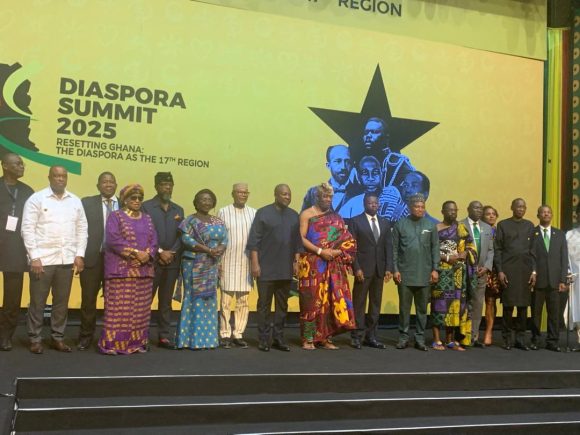
In a keynote address at the 2025 Diaspora Summit, President John Dramani Mahama called for an end to the “conspiracy of silence” surrounding Africa’s history, announcing that Ghana will formally move a motion at the United Nations next year to recognize the Transatlantic Slave Trade as the greatest crime against humanity.
Speaking to a global audience of leaders, traditional rulers, and members of the “17th Region”, the African Diaspora, President Mahama argued that the story of Ghana does not end at its shores but extends across the Atlantic to every descendant of the thirteen million Africans captured and transported during the Middle Passage. He challenged the traditional colonial framing of West African history, noting that the collective identity of Ghana’s ethnic groups predates the existence of any colony. He urged the diaspora to view their journey as an integral part of the Ghanaian story, asking where the ancestors went and asserting that they remain the “blood and bone” of the nation today.
The President highlighted the “cruel irony” of the River Volta, which was named by Portuguese explorers. While Volta translates to “return,” he noted that for centuries, the name symbolized the safe return of the captors, who had memorialized their own navigation routes even as they forced captives through the “Door of No Return.” This history, he argued, must be reclaimed by Africans to truly understand themselves and write their own future.
Delivering a scathing critique of the artificial borders created by colonialism, President Mahama discussed the “systemic war of images” used to divide people of African descent. He noted that these divisions were intentionally manufactured to foster self-hatred and justify subjugation by labeling some ethnicities as “intellectual” and others as “martial.” He called for an end to these lines of demarcation, stating that he sees himself in the faces of the diaspora and recognizes that all people of African descent are inextricably linked.
Despite centuries of separation, the President pointed to the “unbroken cord” of culture that continues to link Africa to the Americas. He noted how the African spirit survived through the Gullah Geechee people in the United States, who still use Fulani words, and the persistence of the Yoruba language in Brazil, Cuba, and Trinidad. He also observed that the culinary heritage of the continent remains at the heart of the diaspora, citing the clear lineage between Ghanaian okro stew and the gumbo and caruru of the New World.
Drawing inspiration from Dr. Kwame Nkrumah, who famously declared that Ghana’s independence is meaningless unless linked to the total liberation of the continent, President Mahama asserted that reparative justice is the next frontier of that liberation. He warned against a “modern-day amnesia” regarding the sacrifices made for freedom, particularly at a time when derogatory rhetoric is still used by some global leaders to describe African nations.
He concluded by stating that this is the moment for Africa to speak loudly and clearly about what has been lost and what is to be gained. He called on the global African community to be more intentional about its unity than oppressors were about its division, declaring that the process of reclamation has begun in earnest.
Story by: Eugenia Ewoenam Osei