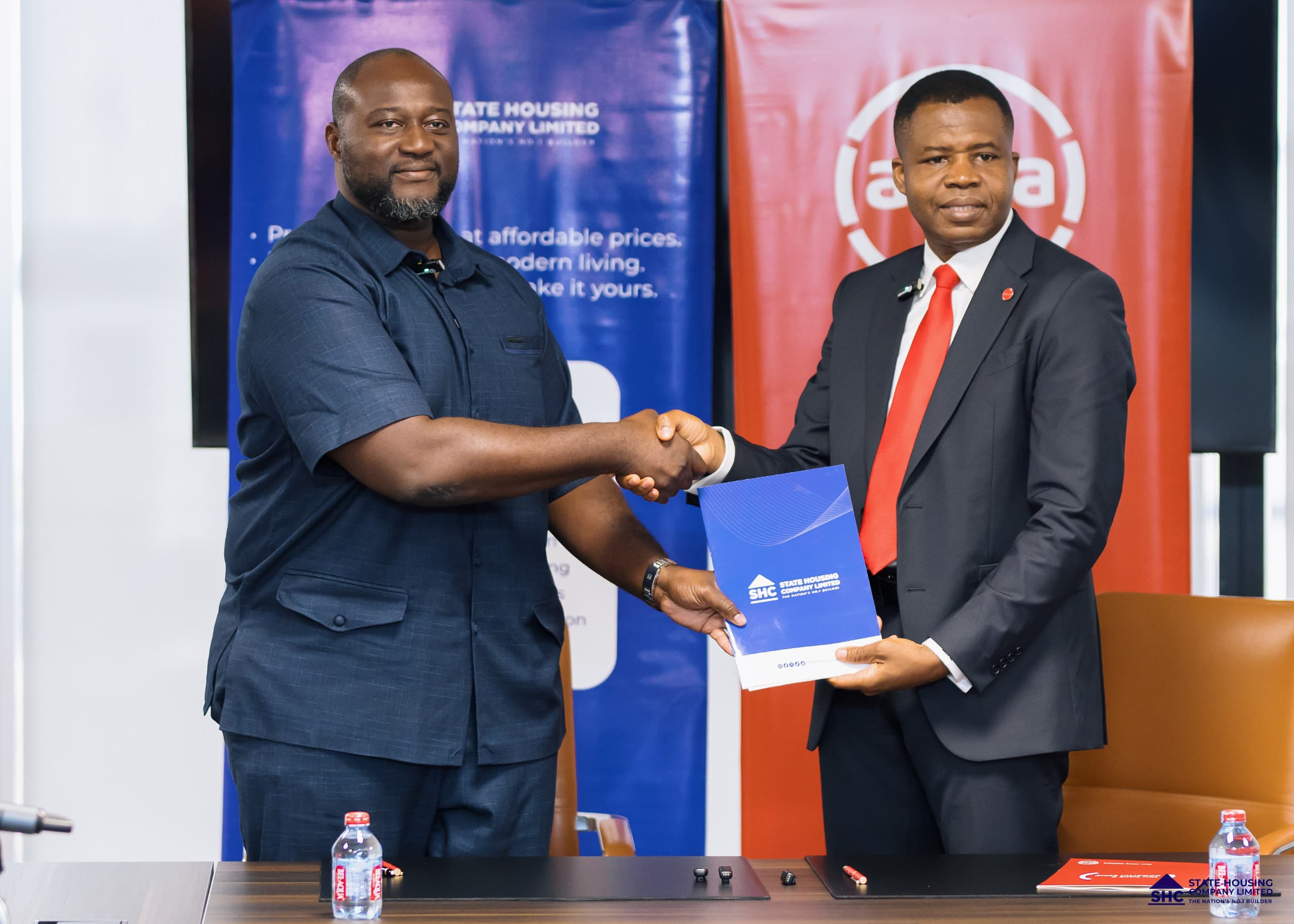
Absa Bank Ghana and the State Housing Company (SHC) Limited have signed a Memorandum of Understanding (MoU) aimed at bridging the nation’s estimated 1.8 million housing deficit by expanding affordable homeownership solutions.
The strategic partnership, marked at Absa Bank’s headquarters, leverages Absa’s balance sheet alongside SHC’s footprint as the country’s primary state housing developer.
Speaking at the signing ceremony, the Managing Director of Absa Bank Ghana, Dr. Edward Nartey Botchway, described the agreement as a concrete commitment to reducing Ghana’s growing housing gap.
Dr. Botchway noted that recent reductions in interest rates present an opportunistic macroeconomic environment for home buyers to access affordable mortgage financing.
”Today, we are not just signing a document; we are making a commitment to ensure that we address the housing gap in Ghana,” Dr. Botchway stated. “With interest rates coming down, it makes it more possible for customers to access mortgages to build and buy. As of June, our loan portfolio stood at GH¢12 billion, a testament to our belief in the Ghanaian economy.”
He added that addressing the housing deficit requires sustained, long-term collaboration, expressing confidence that pairing Absa’s financial capability with SHC’s track record will yield measurable results.
For his part, the Managing Director of the State Housing Company Limited, John S. Bawah, emphasized that the collaboration will target low- to middle-income earners, where the bulk of the housing shortfall exists.
He pointed out that while market demand remains high, accessibility to long-term mortgage financing has historically constrained potential homebuyers.
”The majority of the 1.8 million deficit lies at the bottom end of the pyramid, yet over 95 percent of private developers cater exclusively to the top five percent of the market,” Bawah noted. “Our policy is to deliver homes at a 25 to 40 percent price differential below market competition without compromising on quality.”
Highlighting SHC’s history having delivered over 30,000 housing units across Ghana as it marks its 70th anniversary this year, Bawah expressed optimism that flexible, tailor-made financing structures from Absa will unlock homeownership for thousands of Ghanaians.
Both institutions reaffirmed that joint technical teams are finalizing product frameworks and deployment timelines to ensure immediate implementation following the execution of the agreement.
Eugenia Ewoenam Osei