President John Dramani Mahama has announced that the government’s Free Primary Healthcare Programme will be extended to all 261 districts across Ghana by the end of 2028.
According to the President, the programme, which was launched earlier this year in Dodowa in the Greater Accra Region, is designed to remove geographical and financial barriers that prevent many Ghanaians from accessing basic healthcare.
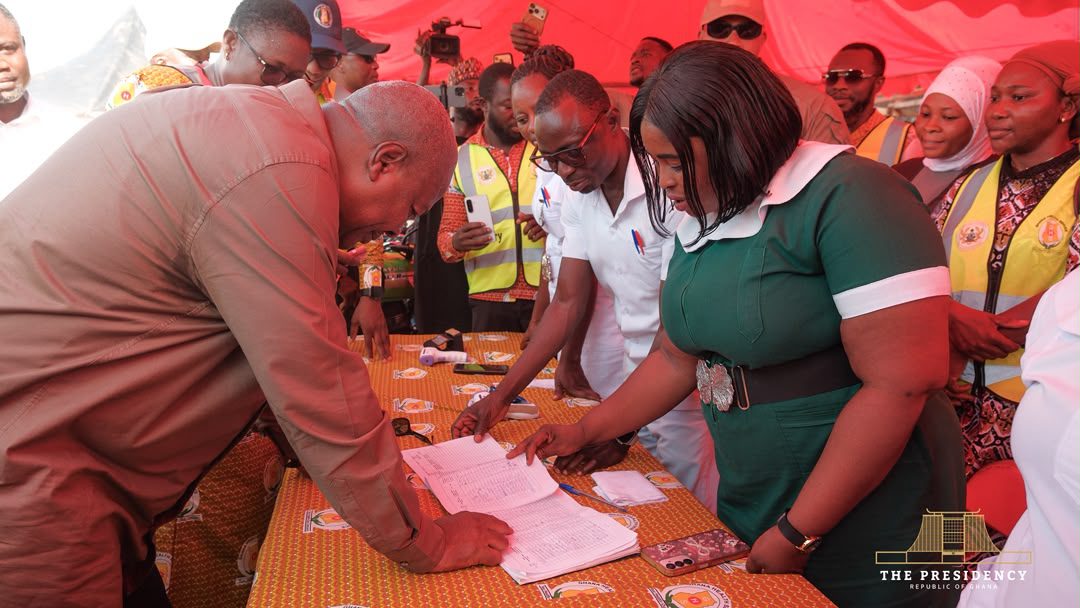
President Mahama made the announcement during a Free Primary Healthcare Durbar in the Daffiama-Bussie-Issa District as part of his Resetting Ghana Tour of the Upper West Region.
He said the programme had initially targeted 150 districts, adding that 135 districts had already been brought onto the programme.
“By the end of this year, the remaining 15 districts will be onboarded, completing the first phase,” he said.
President Mahama explained that although health insurance coverage under the National Health Insurance Scheme (NHIS) had increased from about 60 percent when his administration assumed office to 76 percent, physical access to healthcare remained a major challenge for many communities.
He said, “The question then is: who are the remaining 24 percent, and why do they still lack access?”
“In many cases, the problem is not money alone. The problem is the long distance people must travel to reach a health facility. When people cannot come to the health facility, government must take the health facility to the people.”
Free treatment at primary level
President Mahama said under the Free Primary Healthcare Programme, services at CHPS compounds, health centres and polyclinics would be provided without direct payment.
He listed basic diagnosis and treatment, antenatal and postnatal care, and treatment for common illnesses including malaria, typhoid and diarrhoeal diseases among the services covered.
“If you visit your CHPS compound, health centre, or polyclinic, you are not supposed to pay a single cedi,” the President stated.
He further clarified that patients would not need an NHIS card to access treatment at the primary healthcare level.
“You will be examined, treated, and given medicines free of charge, bringing healthcare directly to the doorstep of our people,” he said.
President Mahama stressed that the initiative was not limited to curative services, but would place significant emphasis on preventive healthcare and early detection.
He said community health professionals would undertake home visits to screen families and identify people who might otherwise never visit a health facility.
20% incentive for health workers in deprived areas
The President also announced plans to introduce an incentive package for health and education professionals who accept postings to deprived and underserved districts.
He said he had directed the Fair Wages Commission to identify deprived and underserved districts across the country.
“Health workers and educational workers who accept postings to those districts will receive an additional 20 percent of their basic salary as an incentive,” he announced.
President Mahama commended young health professionals who had accepted postings to the Daffiama-Bussie-Issa District, describing their decision as an act of patriotism.
“All the young people you see here are health professionals who have accepted postings to the Daffiama-Bussie-Issa District,” he said.
“I want to commend them for their patriotism and for accepting to serve in an underserved part of Ghana.”
He appealed to residents to make the professionals feel welcome and comfortable in their communities.
“If you harvest yam, share some with them. If you have a guinea fowl, give them one, so they will know they are welcome in your community,” he said.
The President said government was simultaneously working to improve roads, water, electricity and other public services in underserved communities to make such postings more attractive.
Focus on maternal and preventive healthcare
President Mahama said the Free Primary Healthcare Programme would also contribute to reducing maternal and infant mortality by ensuring that pregnant women receive regular antenatal care.
He said mothers would have access to antenatal services, basic scans, medical advice and referrals to district hospitals when specialised care was required.
He explained that mothers with anticipated complications would be referred early enough to district hospitals for specialised interventions, including caesarean sections where necessary.
Postnatal services, he added, would ensure that newborn babies were weighed, monitored and given the necessary support to grow healthily.
Health Kiosks for markets and lorry stations
The President further announced the introduction of Health Kiosks at busy commercial centres, including markets and transport terminals.
According to him, the kiosks would operate as small outpatient facilities with consultation rooms and digital links to district hospitals.
Through telemedicine, health workers would be able to consult doctors remotely when specialist advice was required.
He said government was also partnering the Ghana Private Road Transport Union (GPRTU) to establish Health Kiosks at lorry stations, particularly to screen commercial drivers for hypertension and other health conditions.
“A driver who suffers a stroke while transporting passengers could cause a fatal road crash,” President Mahama cautioned.
He therefore urged Ghanaians to undergo health screening at least once every year, stressing that early detection could save lives.
Warning over undiagnosed hypertension
President Mahama raised concern over the prevalence of undiagnosed hypertension in Ghana, saying a statistic he had seen suggested that 37 percent of Ghanaians were living with the condition without knowing it.
“That means more than one-third of our population is walking around with high blood pressure unknowingly,” he said.
“Knowledge is power. Once you know your health status, you can receive treatment and protect your future.”
He encouraged citizens to have their blood pressure and blood sugar levels checked regularly.
25,000 medical equipment delivered
The President also announced that government was distributing medical equipment to primary healthcare facilities across the country.
He said 25,000 items had already been delivered, with an additional 12,000 expected.
The equipment includes diagnostic kits for home visits, motorcycles and tricycles to enable health workers to reach people in remote communities.
President Mahama said the equipment would strengthen the capacity of health professionals to provide services beyond health facilities and directly in communities.
Ghana Medical Trust Fund
Beyond primary
healthcare, the President highlighted government’s intervention for patients suffering from serious and expensive medical conditions.
He said diseases such as cancer, kidney failure, stroke and congenital heart disease could impose severe financial burdens on families.
“That is why we established the Ghana Medical Trust Fund,” he said.
President Mahama recounted the case of a child born with three holes in the heart whose father, a teacher, had been presented with a GH¢154,000 bill for surgery.
He said the family applied to the Ghana Medical Trust Fund, which paid the full cost of the operation.
“Today, that child is healthy, active, and even playing football,” he said, describing the intervention as another important layer of healthcare protection for Ghanaians.
Mahama urges NHIS registration
Despite the introduction of free primary healthcare, President Mahama urged all Ghanaians to register for and maintain their NHIS membership.
He explained that patients requiring treatment beyond the primary healthcare level would be referred to district hospitals, where NHIS coverage would become important.
“Keep your NHIS card because you never know when you may need it,” he advised.
The President also said the NHIS had improved significantly under his administration, noting that arrears owed to health facilities had been cleared, claims were being paid promptly and reimbursement rates had been increased after remaining unchanged for more than 15 years.
“No hospital should now refuse treatment because NHIS claims have not been paid,” he stated.
President Mahama expressed satisfaction with the rollout of the Free Primary Healthcare Programme and said the intervention represented a major step towards achieving universal health coverage.
“I am delighted to be here in the Daffiama-Bussie-Issa District to present these medical equipment to your primary healthcare facilities and help improve the health outcomes of your people,” he said.
Story: Patrick Asford Boadu