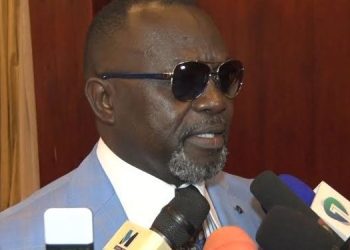
Security and fraud consultant Richard Kumadoe has criticised the public handling of Attorney-General Dr Dominic Akuritinga Ayine’s directive on criminal investigations and prosecutions, warning that its presentation has created room for political misinterpretation and unnecessary attacks on Ghana’s security and law enforcement agencies.
Speaking on Radio Gold, the former National Investigations Bureau (NIB) operative argued that although the directive reinforces important constitutional safeguards, the concerns raised could have been addressed through direct institutional engagement rather than a public intervention that appeared to rebuke the agencies.
The Attorney-General and Minister for Justice, Dr Dominic Akuritinga Ayine, issued the directive on November 2, 2026, following the identification of five recurring problems in criminal investigations.
These include the detention of suspects beyond the constitutional 48-hour limit without bringing them before a court, arrests to recover civil debts, coerced or improperly recorded statements, searches conducted without legal authority and the mistreatment of suspects before charge.
The directive seeks to protect constitutional rights, ensure that prosecutors receive legally admissible evidence, reduce the state’s exposure to compensation claims and strengthen public confidence in criminal investigations.
However, Mr Kumadoe questioned the circumstances surrounding its public issuance, particularly after what he described as assurances from the Attorney-General’s spokesperson that ongoing prosecutions had not been adversely affected by the conduct of investigative agencies.
He maintained that the constitutional requirements outlined in the directive were fundamental principles already taught to law enforcement personnel during their professional training.
According to him, where specific operational failures have been identified, those incidents should form the basis for corrective action, professional training and institutional accountability.
Mr Kumadoe argued that publicly highlighting shortcomings without identifying particular cases could create the impression that security agencies had collectively failed in their responsibilities.
Using the analogy of a father publicly reprimanding his children, he suggested that the Attorney-General could have engaged the leadership of the relevant institutions privately to assess their operations and address any concerns.
He stressed that his criticism was directed at the approach adopted rather than the constitutional protections contained in the directive.
The security consultant also expressed concern that the public debate had become increasingly politicised, with competing interpretations being used to question the conduct of particular investigative institutions and their leadership.
He specifically warned that the controversy could be exploited by individuals seeking to discredit the leadership of the Economic and Organised Crime Office (EOCO).
According to him, the public presentation had provided an opportunity for people to “misinterpret, misinform and miscommunicate” the issues raised.
Mr Kumadoe nevertheless acknowledged that abuses could occur within security institutions and that corrective measures remained necessary.
He cited recent disciplinary actions against officers as examples of efforts by security agencies to address misconduct through established internal accountability mechanisms.
The former intelligence operative urged the Attorney-General to prioritise structured engagement with investigative agencies, using documented cases and established oversight procedures to address operational weaknesses.
He maintained that such an approach would strengthen accountability while limiting misinformation and political controversy surrounding the work of security institutions.