Pressure group Arise Ghana has commended the government’s ongoing agricultural transformation agenda, describing recent interventions by the Ministry of Food and Agriculture as promising steps toward strengthening food security, creating jobs and boosting agro-industrial growth across the country.
Speaking at a press conference on the organization’s independent mid-year assessment, leading member of Arise Ghana, Dramani Selorm Dzramado, praised the ministry’s flagship Feed Ghana Programme and related initiatives, saying they demonstrate a comprehensive approach to addressing longstanding challenges in the agricultural sector.
According to him, the ministry’s strategy of integrating crop production, livestock development, irrigation, mechanization, extension services, agro-processing and market access has the potential to significantly improve agricultural productivity and livelihoods if sustained over the long term.
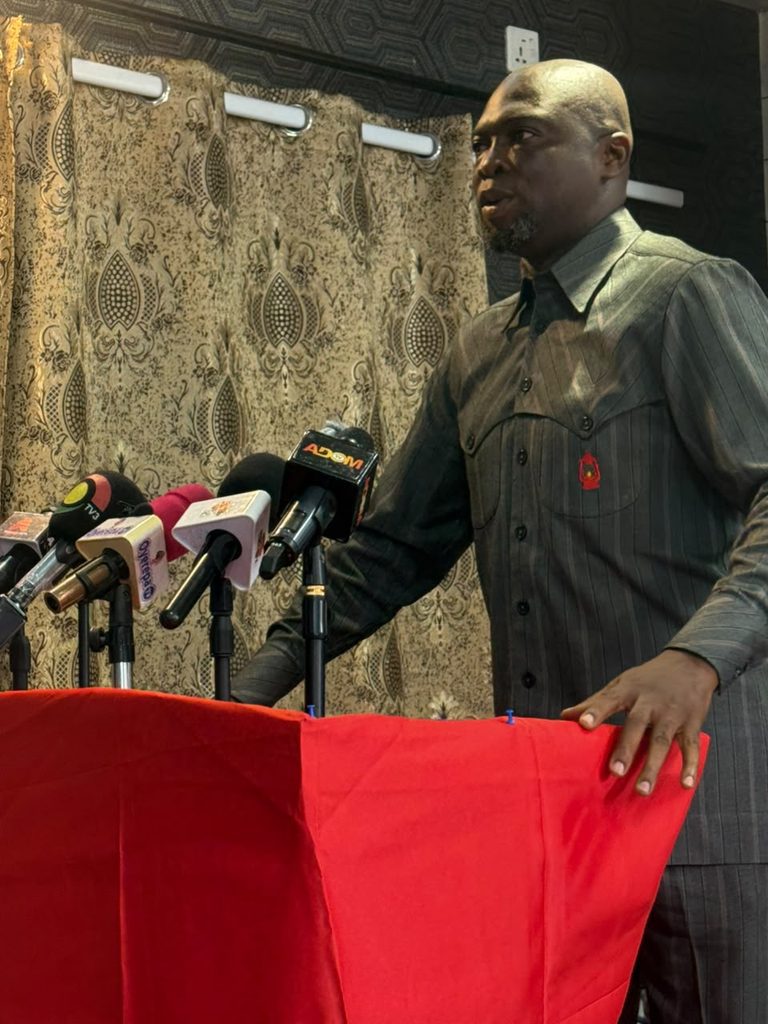
Dzramado highlighted several achievements recorded so far, including the distribution of fertilizers to farmers, the deployment of agricultural drones to improve farming efficiency, and the commissioning of Feed Ghana Brigadiers to strengthen agricultural extension services across the country.
He also pointed to ongoing investments in seed testing facilities, soil laboratories and nationwide soil sampling exercises, describing them as critical interventions to improve productivity and enhance the quality of agricultural outputs. He further welcomed the Japan-supported rice seed initiative, which aims to help Ghana attain local seed sufficiency by 2027.

On irrigation and mechanization, Dzramado noted that government efforts to reduce dependence on rain-fed agriculture through the construction and rehabilitation of dams, as well as the installation of solar-powered boreholes, are expected to improve year-round farming. He also lauded the procurement of mechanization equipment and the establishment of farmer service centres to reduce labour constraints and increase efficiency.
The Arise Ghana representative further commended measures aimed at reducing post-harvest losses, including the local fabrication of threshers, efforts to strengthen the National Food Buffer Stock Company, and reforms in rice import quotas designed to encourage partnerships between importers and local producers.
He also welcomed initiatives targeting women, youth and vulnerable groups, particularly backyard poultry and vegetable production projects, which he said would help improve household nutrition while creating additional income opportunities.

While acknowledging the progress made, Dzramado stressed the need for stronger accountability mechanisms and institutional reforms to ensure the sustainability of the programmes.
He called on government to publish measurable annual targets for major agricultural interventions and establish a transparent public monitoring platform that would allow citizens to track implementation and assess performance.
Among other recommendations, he urged authorities to strengthen and clean up farmer databases to eliminate ghost beneficiaries, expand irrigation infrastructure with clear maintenance plans, improve access to affordable agricultural financing for smallholder farmers and agribusinesses, and provide better logistics and staffing support for extension services.
He also advocated increased investment in storage facilities and agro-processing to reduce post-harvest losses, while calling for successful agricultural programmes to be backed by legislation and sustainable financing mechanisms to guarantee continuity across successive administrations.
“The true measure of success will be what happens on farms, in markets and in the homes of ordinary Ghanaians — whether farmers earn better incomes, food becomes more affordable, and young people find decent jobs in agriculture,” Dzramado stated.
Arise Ghana concluded by urging Parliament, the private sector, development partners, civil society organisations, the media and citizens to support a non-partisan and nationally owned agricultural transformation agenda that prioritises accountability, investment and long-term development.
The group maintained that with sustained commitment and effective implementation, Ghana’s agricultural reforms could serve as a catalyst for economic growth, job creation and improved food security nationwide.
Story by Osman Issah Abadoo