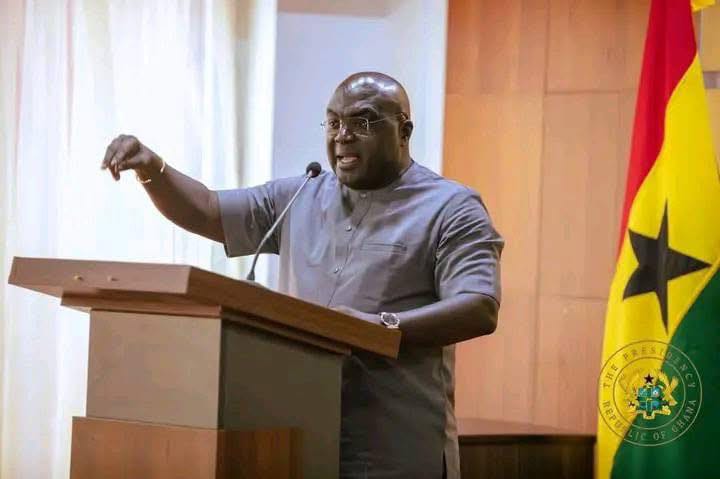
Chief of Staff Dr. Julius Debrah has called for greater responsibility and accountability in Ghana’s mining sector, saying the country’s emergence as Africa’s leading gold producer and the world’s sixth-largest gold-producing nation comes with a corresponding duty to protect the environment and ensure that mineral wealth translates into broad-based development.
Speaking at the National Mining Dialogue 2026 at the Kempinski Hotel in Accra, Dr. Debrah said Ghana’s global position in gold production must be matched by exemplary standards in environmental protection, host-community development and economic transformation.
The high-level dialogue brought together government officials, foreign investors, traditional authorities, including His Royal Majesty the Ga Mantse, King Tackie Teiko Tsuru II, and key stakeholders in the mining industry to deliberate on the future of the sector.
Dr. Debrah stressed that Ghana could no longer afford to export its mineral wealth without creating sufficient value domestically.
“Ghana’s position as the 6th largest gold-producing nation in the world places a huge responsibility on us. It is a responsibility to mine responsibly, to safeguard our rivers and forest reserves, and to ensure that the wealth beneath our soil translates into tangible prosperity, jobs for our youth, roads for our communities, and opportunities for generations yet unborn.”
He said the government was committed to ending what he described as an era of extraction without transformation, insisting that mining must contribute significantly to Ghana’s industrial development.
“We will not preside over an industry that enriches a few while impoverishing the many. The time has come for mining that respects our land, empowers our people, and expands our economy beyond the pit. Let us convert the gold in our ground into the factories, schools, and hospitals of tomorrow.”
The Chief of Staff also called for collective responsibility among traditional leaders, the media and civil society organisations in protecting Ghana’s natural resources and demanding accountability from all actors in the mining value chain.
“Our chiefs must guard the land. Our media must inform the people. Our civil society must hold us all to account. This is a national project,” he said.
GoldBod Pushes for Greater Community Participation
The call for responsible mining was reinforced by the Chief Executive Officer of the Ghana Gold Board (GoldBod), who delivered a keynote address on the theme, “Rethinking the Social Licence to Operate.”
The GoldBod CEO disclosed that gold generated $20.2 billion, representing 63.1 percent of Ghana’s $32 billion total exports in 2025, with small-scale mining contributing 52.4 percent of total gold output.
He, however, raised concerns about the limited benefits reaching young people in mining communities.
“A social license cannot survive where the youth believe mining has no place for them except as casual laborers, Mining communities must no longer be treated as land donors.
They are custodians of the resource hence must be treated as development partners and economic shareholders.”
To address these challenges, GoldBod unveiled an IPE Framework — Involve, Protect and Expand — aimed at strengthening community participation, environmental protection and domestic value addition.
Under the Involve component, GoldBod proposes giving host communities a formal stake in licensing decisions, increasing local royalty retention, enforcing mandatory corporate social responsibility contracts and promoting indigenous ownership of mining operations.
The Protect component focuses on stricter enforcement of environmental laws, reclamation of degraded forest reserves, formalisation of small-scale mining and the rehabilitation of critical water-treatment facilities.
Under Expand, the framework seeks to accelerate domestic gold refining, establish the proposed Ghana Gold Village for jewellery manufacturing, set up an ISO-certified National Assay Laboratory at the Accra Airport by late 2026 and introduce a gold tokenisation initiative in 2027 to broaden Ghanaian participation in gold ownership.
Government Targets Greater Local Value Creation
GoldBod also announced that more than 170 tonnes of gold had been exported through formal channels since 2025, generating over $17 billion in foreign exchange, which it said had contributed to stabilising the cedi and strengthening national reserves.
Beginning July 2026, 30 percent of gold produced by large-scale mining companies is expected to be acquired locally to supply domestic refineries and support Ghana’s efforts to achieve LBMA certification.
A groundbreaking ceremony for an ISO-certified Fire Assay National Laboratory at the Accra Airport is scheduled for November 2026. The laboratory is expected to provide standardised testing for gold exports.
GoldBod also outlined environmental restoration measures, including the reclamation of 150 hectares of degraded land in the Tano Nimri Forest Reserve and support for the rehabilitation of six Ghana Water Limited treatment plants.
The National Mining Dialogue ended with a broad consensus that the future sustainability and commercial viability of Ghana’s gold industry will depend on greater local value creation, meaningful participation of mining communities, increased opportunities for young people and deliberate restoration of degraded environments.
Story: Patrick Asford Boadu