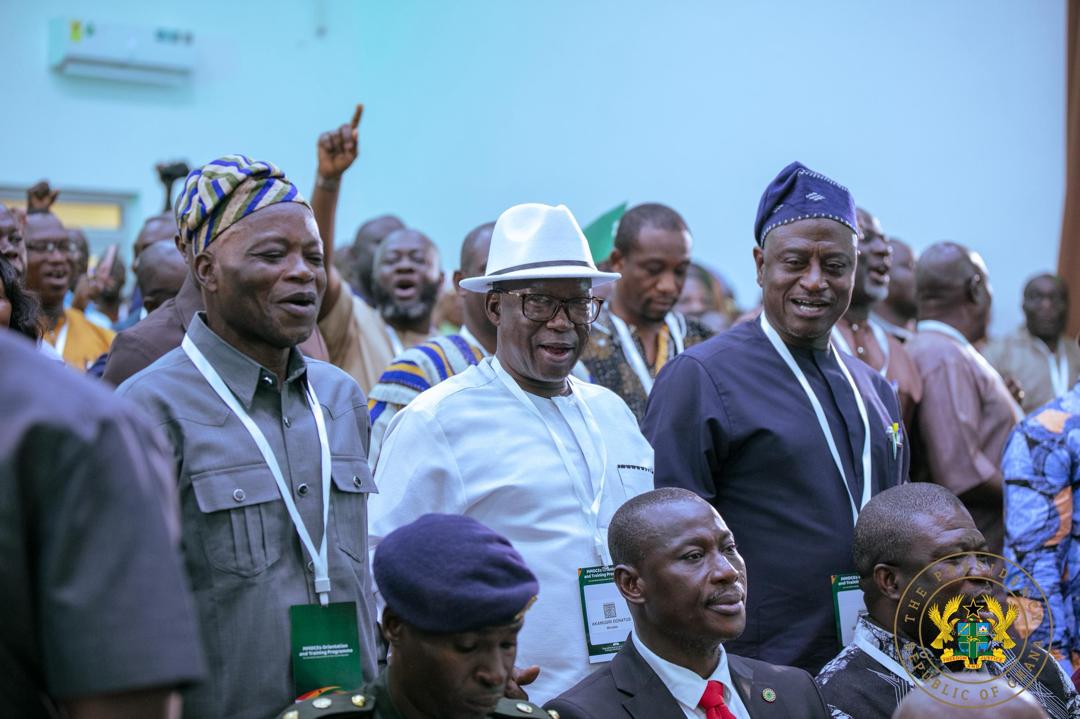
President John Dramani Mahama has called on Metropolitan, Municipal, and District Chief Executives (MMDCEs) to actively engage with traditional rulers, religious leaders, and civil society organizations to help rebuild the fractured social contract between the government and the citizenry.
Speaking at the opening session of the MMDCEs orientation and training programme in Accra, under the theme “Strengthening Local Governance through the Reset Agenda”, President Mahama emphasized the urgent need for renewed legitimacy and connection between the state and the people.
“The legitimacy and authority of the state must be felt not only in law but in the lived experiences of our people,” he stated.
“I therefore urge you to work with the chiefs and religious bodies in your districts and with civil society to restore the social contract with our people.”
This call aligns with ongoing structural reforms that have merged the Ministry of Chieftaincy and Religious Affairs with the Ministry of Local Government. President Mahama described the new alignment as a “governance tripod”, which integrates political, cultural, and spiritual forces to reflect Ghana’s traditional foundations.
According to him, the model is designed to foster synergy, coordination, and collective action at the grassroots level.
He charged MMDCEs to take bold steps in reforming local governance structures by reviving weak area councils, defunct zonal committees, and addressing the partisan nature of assembly operations.
“You must correct the dysfunction in our local government structures. If you do not fix this, governance at the local level cannot deliver for the people,” President Mahama emphasized.
In a strong appeal for political cooperation, President Mahama urged the MMDCEs to work closely with their respective Members of Parliament and prioritize development over political rivalry.
“You must work closely with your respective Members of Parliament. Leave behind political turf wars, and focus on delivering development. Together, you must work to make the lives of your people better,” he advised.
He further cautioned government appointees with future political ambitions to focus on their current responsibilities, warning against any efforts to undermine sitting MPs.
“When government officials fight among themselves, it is the people who suffer. Remember, you are part of one government,” he warned.
As part of the Reset Agenda, President Mahama announced deeper decentralization reforms. Key among these is the devolution of basic services such as education, health, and local roads to district authorities.
Under this new framework, agencies like the Ghana Education Service, Ghana Health Service, and the Departments of Urban and Feeder Roads will be brought under district control.
He added that funding from the Road Fund, National Health Insurance Scheme, and education sector budgets will be directly tied to local performance and priorities.
“Decentralization must not be mere rhetoric,” President Mahama concluded. “It must mean controlled resources and results that transform lives at the grassroots.”
The orientation programme marks a pivotal moment for local governance under the Mahama administration, signaling a strategic shift toward deeper citizen engagement, accountability, and structural reform.