The Minister for Trade, Agribusiness and Industry, Elizabeth Ofosu-Adjare, says Ghana must move beyond celebrating the volume of investment attracted into the country and focus on whether those investments are expanding production, strengthening local businesses, creating jobs and building value chains that leave lasting economic benefits.
Delivering the keynote address at the launch of the 2025 Annual Investment Report at the Bank of Ghana on Friday, the Minister said the true value of investment should be measured by its contribution to transforming the structure of the Ghanaian economy.
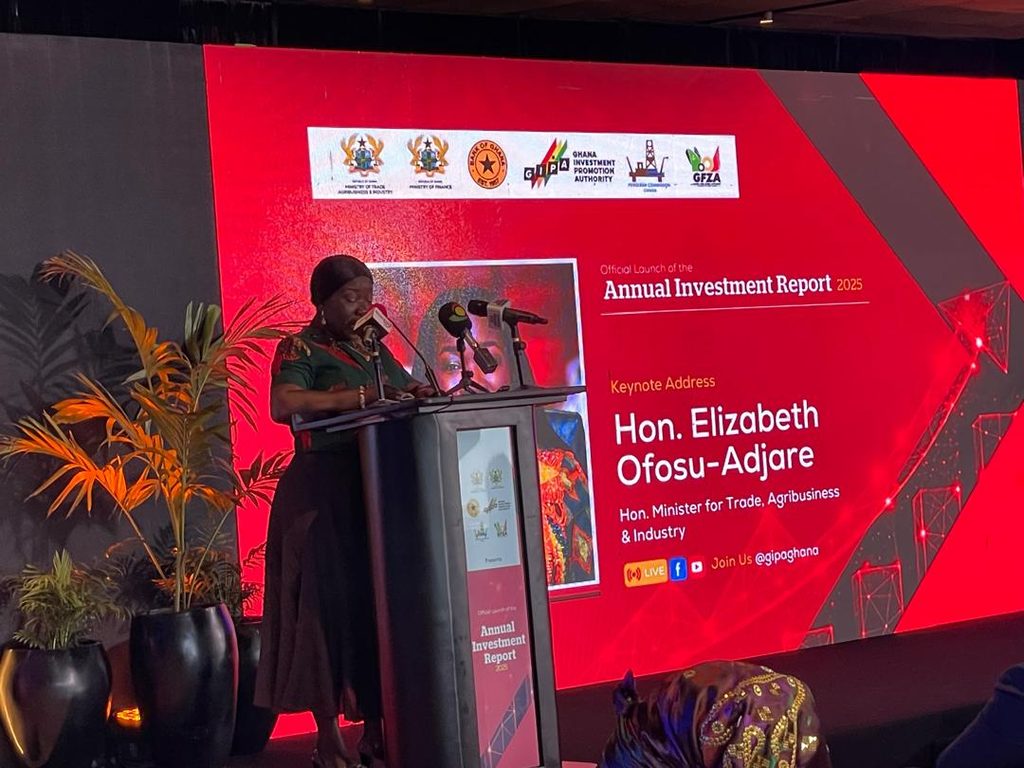
“While the figures in the 2025 Annual Investment Report are encouraging, the more important question for me is what those investments are leaving behind in Ghana,” she said.
She argued that investment becomes meaningful when it translates into increased domestic production, opportunities for Ghanaian suppliers, local processing, skills development and access to larger markets.
According to the Minister, the investment figures captured in the report may significantly understate the actual level of activity in the economy because some major investments, including machinery and other capital expenditure, are not fully reflected in the available data.
She therefore called for improvements in investment-data collection to ensure that future reports provide a more comprehensive account of capital being deployed in Ghana.
Mrs. Ofosu-Adjare said government’s industrial strategy is increasingly focused on sectors where Ghana can develop competitive domestic production and stronger value chains, including textiles and garments, pharmaceuticals, automotive and component manufacturing, agribusiness and agro-processing.

She disclosed that Cabinet had approved policies covering key areas of the government’s industrialisation agenda, providing clearer direction for investment and production.
Agribusiness, she said, demonstrates the wider economic impact Ghana wants from investment. Processing agricultural produce locally allows more value to remain in the country while generating additional opportunities in packaging, transportation, warehousing, distribution and exports.
Government targets business bottlenecks
The Minister acknowledged that attracting investment also requires a more efficient regulatory environment, warning that delayed approvals and prolonged administrative procedures increase the cost of doing business and can discourage investors from expanding.

She said the Ministry is consequently prioritising reforms aimed at simplifying business processes, eliminating duplication and providing investors with greater certainty over regulatory requirements and compliance costs.
The recent move to establish the Ghana Investment Promotion Authority, she added, forms part of efforts to modernise investment facilitation and make the country more responsive in an increasingly competitive global investment environment.
US$12bn pipeline must become real businesses
Mrs. Ofosu-Adjare said the Annual Investment Report identifies approximately US$12 billion in announced and pipeline investments, but stressed that announcements alone would not transform the economy.
“Our task now is to convert as much of that interest as possible into enterprises that are operating, producing and creating value within Ghana,” she said.
She urged investors to regard Ghana not simply as a location for their operations, but as a production base where they can develop relationships with Ghanaian suppliers, source local inputs, employ and train young people, and serve markets across Africa.
With Ghana hosting the AfCFTA Secretariat, she said investors have an opportunity to establish operations in the country and use it as a platform to reach consumers across West Africa and the wider continental market.

The Minister said government would continue working to improve the ease of doing business, strengthen coordination among public institutions and eliminate avoidable delays between investment decisions and actual production.
She concluded that future investment reports should ultimately be judged by whether Ghana records deeper local processing, stronger Ghanaian suppliers, increased productive employment and greater penetration of regional and international markets.
“Investment should lead to visible economic transformation in Ghana through expanded production, stronger local enterprises, productive jobs and greater access to regional and international markets,” she said.