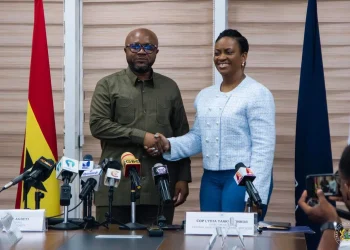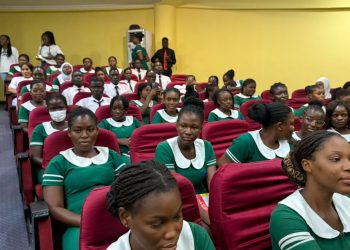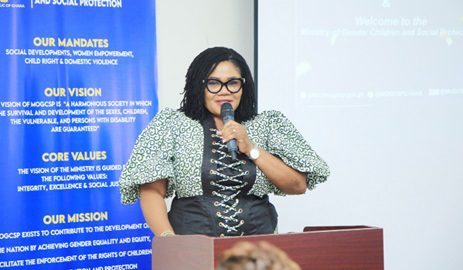
Ghana today renewed its steadfast commitment to combating human trafficking, marking the 20th anniversary of its pivotal Human Trafficking Act (Act 694). Delivering the keynote address at a media launch ahead of the World Day Against Human Trafficking (Blue Day) on July 30, Dr. Afisah Zakaria, Chief Director for the Ministry of Gender, Children and Social Protection (MoGCSP), underscored the nation’s journey and future resolve in eradicating this modern-day slavery.
Dr. Zakaria spoke on behalf of the Minister, Hon. Dr. Agnes Naa Momo Lartey.
The event focused on the critical importance of raising awareness about the dangers associated with human trafficking. Dr. Zakaria emphasized that each year, Ghana joins global efforts to commemorate this day, which stems from the 2010 United Nations General Assembly’s adoption of the Global Plan of Action to Combat Trafficking in Persons (TIP).
This initiative led to July 30 being designated a day to remember victims and spur policy interventions. This year’s global theme, “Reach every victim of trafficking, leave no one behind,” she revealed, serves as a powerful call to action, demanding intentional and inclusive efforts to uncover, protect, and support every individual affected by trafficking, regardless of background, gender, age, or migration status.
“The Human Trafficking Act of 2005, Act 694, is 20 years old this year,” Dr. Zakaria highlighted. According to her, Ghana’s local theme for the commemoration, “The Human Trafficking Law @ 20; The Journey So Far in Ghana,” aims to underscore the significant work of partners in policy planning, institutional capacity building, law enforcement, and educational programs. It also provides an opportunity to take stock of challenges and chart future policy directions.
Despite notable progress, including Ghana’s Tier 2 ranking in the 2023 U.S. Department of State’s Trafficking in Persons Report, Dr. Zakaria acknowledged that much more remains to be done.
She painted a grim picture of the realities faced by victims.
“Ghanaian women and men are recruited by unscrupulous agencies with promises of good-paying jobs in domestic service or hospitality in the Middle East, only to be abused, raped, tortured, disgraced, and reduced to nothing. Many suffer mental health issues, losing their dignity, respect, and everything they worked for.” She stated.
The Chief Director also addressed the perilous irregular migration routes, where individuals attempting to reach Europe endure harsh desert conditions or overcrowd boats without life jackets, often resulting in tragic deaths. She referenced Professor Leander’s observations on a renewed global interest in human trafficking, largely influenced by migration flows and sexual exploitation. Human trafficking, she noted, is now the second-largest trade after firearms trafficking and before drug trafficking, estimated to be worth over $30 billion annually.
Dr. Zakaria stressed the crucial role of gender in counter-trafficking activities, emphasizing that while real-life data is hard to obtain, poverty and the pursuit of “greener pastures” remain significant root causes, pushing vulnerable young men and women into dangerous migration.
She lauded successes, including the operationalization of adult and child shelters, as well as transit shelters, which are vital as victims often serve as key witnesses in prosecutions. However, she called for the establishment of adult male shelters to provide similar trauma-informed care.
“Human trafficking is real. Report it and defend the vulnerable,” Dr. Zakaria urged. “As we raise awareness today, we must also raise our ambition. Let this be more than a commemoration; let this be a recommitment to reach every victim, to strengthen international cooperation, and to hold perpetrators accountable.”
She called for concerted efforts to educate, legislate, and activate, emphasizing the need to strengthen border protection without criminalizing victims. She concluded by advocating for collaboration across governments, civil society, communities, and survivors, not in silos, but in solidarity.
“Let us reset and reassess our efforts. Together, we can break the chains of trafficking. Together, we can build a world where no one is exploited, no one is invisible, and no one is left behind.”
Ghana’s legislative framework against human trafficking dates back to the Palermo Protocol, adopted by the UN General Assembly in November 2000. Five years later, Ghana enacted its Human Trafficking Act 2005 (Act 694), followed by the Human Trafficking Prohibition Regulations 2015 (L.I. 2219). The Ministry has also developed a comprehensive Human Trafficking National Plan of Action (NPA) (2022-2026), covering prevention, protection, prosecution, and partnership.