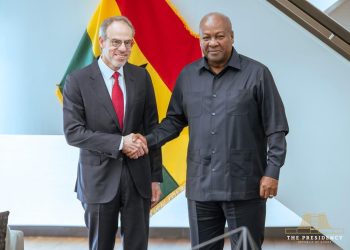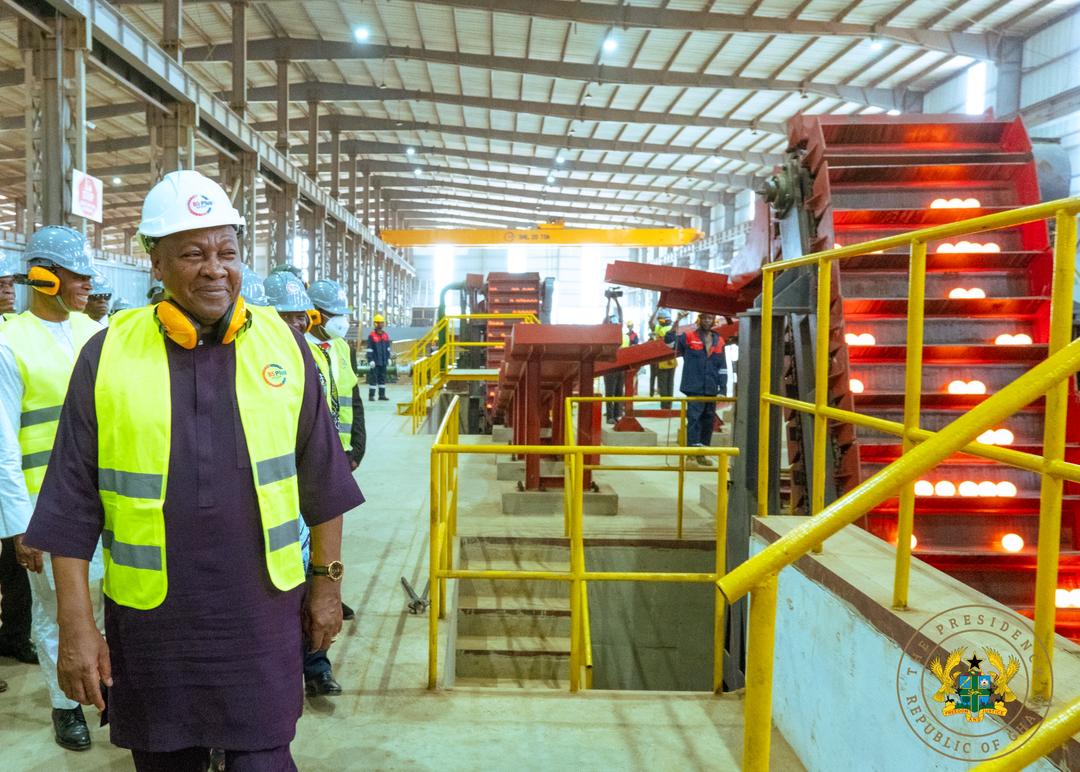
President John Dramani Mahama has described the Phase Two expansion of the B5 Plus steel Ball Mill and Sector Mill manufacturing facility as a defining milestone in Ghana’s industrial transformation, declaring that the project represents not just the growth of a factory, but the expansion of the nation’s industrial ambition.
Speaking at the commissioning ceremony, President Mahama said the expansion forms part of a broader structural shift in Ghana’s economy away from dependence on raw material exports toward value-added industrial production.
“Today marks more than the expansion of a factory. It marks the expansion of Ghana’s industrial ambition,” the President stated.
Steel as a Measure of Industrial Growth
President Mahama noted that steel consumption is a key indicator of industrial development, rising in tandem with infrastructure growth, urbanization, and manufacturing expansion.
He revealed that Ghana’s annual steel demand exceeds 1.2 million metric tons, driven largely by construction, energy infrastructure, mining, and manufacturing.
Historically, he said, a significant portion of this demand has been met through imports, exerting sustained pressure on Ghana’s foreign exchange reserves.
“The expansion of this facility strengthens domestic capacity to substitute imports, save foreign exchange, improve our trade balance, stabilize supply chains, and reduce exposure to global price volatility,” he emphasized.
According to the President, reducing steel imports by just 20 to 30 percent annually could translate into hundreds of millions of dollars in foreign exchange savings.
Ghana’s Strategic Position Under AfCFTA
President Mahama highlighted Ghana’s unique strategic position in West Africa, citing political stability, expanding energy infrastructure, deep-water ports at Tema and Takoradi, and the country’s role as host of the Secretariat of the African Continental Free Trade Area (AfCFTA).
He noted that AfCFTA is opening access to a continental market of 1.4 billion people with a combined GDP exceeding US$3 trillion, creating opportunities for Ghana-manufactured steel to serve construction, mining, and infrastructure projects across West Africa and the Sahel.
“Instead of importing steel from Asia or Europe, West Africa can source competitively from Ghana,” President Mahama said, describing the development as “regional value chain integration in real practice.”
Scrap Metal Policy and Industrial Jobs
Touching on raw material security, the President explained that Ghana generates substantial volumes of scrap metal annually through construction, demolition, vehicle imports, and industrial activity.
He said government restrictions on non-ferrous scrap exports are intended to give local processors priority access to raw materials.The policy, he said, is expected to boost processed metal exports by US$250–300 million annually, create between 5,000 and 10,000 jobs, and increase tax revenues through VAT, corporate taxes, and PAYE.
President Mahama praised B5 Plus Group as one of the Ghana Revenue Authority’s most compliant taxpayers, noting that the company has paid over US$300 million in taxes and is projected to exceed US$500 million in contributions in the near future.
Infrastructure, 24-Hour Economy and Manufacturing
The President linked the steel expansion to the government’s Big Push Infrastructure Programme, which includes investments in roads, highways, railways, bridges, energy transmission lines, affordable housing, and industrial parks all heavily dependent on steel.
He also highlighted the relevance of the 24-Hour Economy policy to energy-intensive industries such as steel manufacturing, announcing that he had signed the 24-Hour Economy Authority Bill into law a day earlier.
“Steel production benefits from continuous operation to reduce energy wastage, improve furnace efficiency, lower unit production costs, and maximize asset utilization,” he said.
President Mahama disclosed that GH¢110 million has been allocated in the 2026 Budget to operationalize the 24-Hour Economy initiative, alongside industrial tariff reforms, improved grid stability, and expanded domestic gas supply.
Fiscal Reforms to Support Industry
He outlined several fiscal reforms introduced in the 2026 Budget to support manufacturing, including the abolition of the COVID-19 Health Recovery Levy, a reduction in the effective VAT rate from 21.9 percent to 20 percent, and the introduction of digital VAT monitoring systems.
Reviews of income tax, customs, and excise regimes are also underway to improve predictability, reduce compliance costs, and eliminate unfair competition.“Industrial investors must compete on productivity, not on navigating unpredictability,” the President stressed.
Mining, Skills and Industrial Transformation
President Mahama said Ghana’s mining sector spanning gold, bauxite, manganese, and lithium requires significant steel inputs for equipment, processing, and infrastructure. As mineral processing and local content policies expand, domestic steel manufacturing will become increasingly strategic.
He noted that at full capacity, facilities like B5 Plus will create factory jobs, engineering and technical roles, logistics employment, SME supply-chain opportunities, and vocational training placements.
“Industrialization deepens skills development. It creates engineers, technicians, quality control specialists, and plant managers the competence that transforms a nation from an importer to a producer,” he said.
Commitment to Continued Expansion
President Mahama commended the board, management, and staff of B5 Plus for their confidence in Ghana’s economy and praised the traditional authorities and people of La Pleku for supporting industrial development in their community.
He urged parties involved in land litigation around the facility to resolve the matter swiftly to allow further expansion.
“On behalf of the Government and people of Ghana, it is my honor to declare the second-phase expansion of the B5 Plus steel manufacturing facility duly commissioned,” the President declared, expressing confidence that the project will strengthen Ghana’s economy, deepen regional trade, and contribute to Africa’s industrial renaissance.
Story: Patrick Asford Boadu