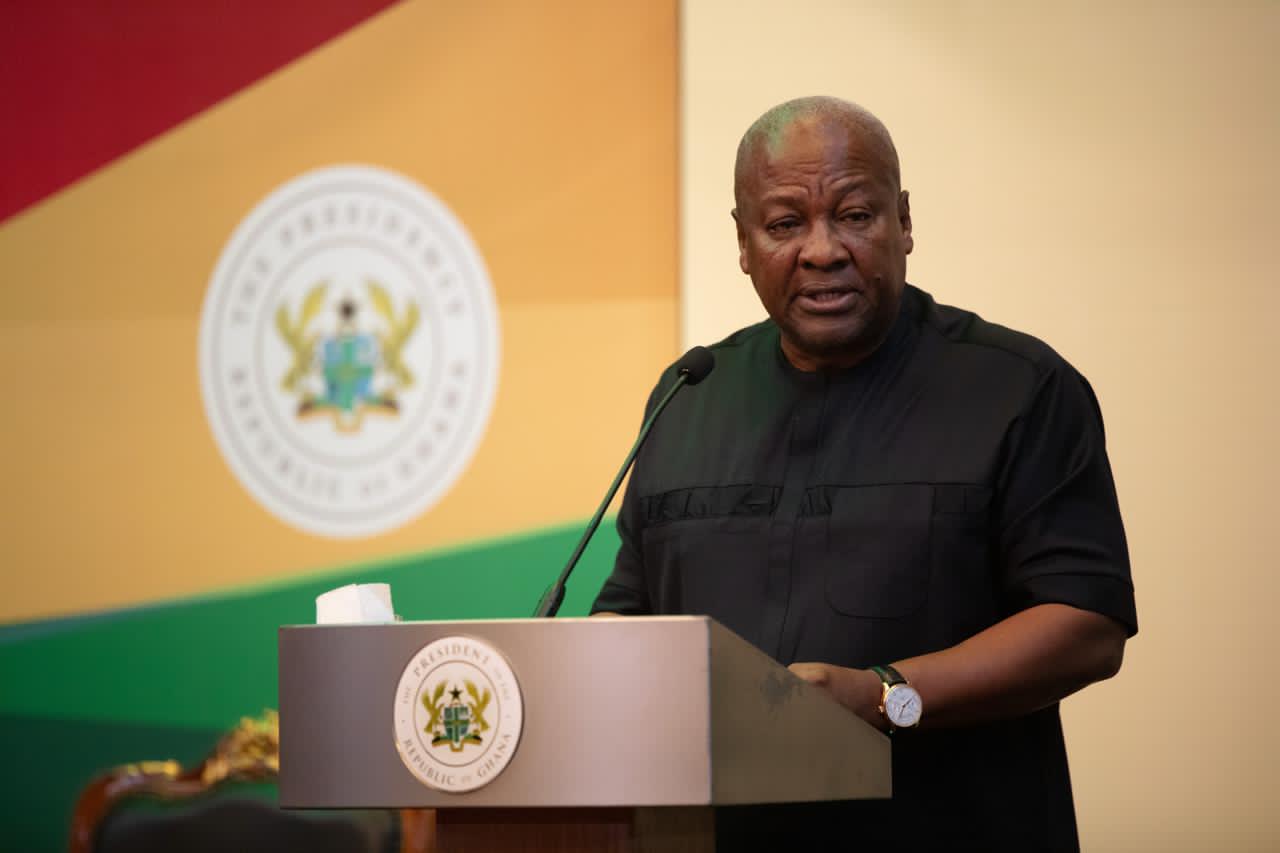
President John Dramani Mahama says Ghana’s economic recovery is not just about improved macroeconomic figures but about tangible relief for households across the country.
Addressing journalists at the Jubilee House, the President emphasized that the real measure of progress lies in the lives of ordinary Ghanaians.
“Our approach to economic management goes beyond improving the macroeconomic indicators. It’s about making the Ghanaian household feel the impact in their everyday lives. As the saying goes, the real economy is not in statistics but in the pockets of the people,” he said.
Inflation Falls, Prices Drop
Mahama noted that inflation had dropped from 23.8% in December 2024 to 11.5% in July 2025—the lowest since December 2021. He added that this progress was being felt in markets across the country.
“The prices of key commodities are falling, and for the first time in years, brands and businesses are actively advertising their price reductions. Recovery is not only real but tangible,” he said.
According to official trade associations, up to 4,500 items on the market have recorded price reductions.
Ghana has also kept up with its bond repayment obligations, earning international recognition.
Global credit rating agency S&P Global Ratings recently upgraded Ghana’s country risk from junk to B- with a stable outlook, a development Mahama described as a “significant endorsement of Ghana’s recovery efforts.”
24-Hour Economy Takes Shape
The President outlined ongoing initiatives to sustain momentum, with a special focus on his government’s flagship 24-hour economy policy, designed to modernize agriculture, support SMEs, and expand job opportunities.
“This initiative is not just about keeping the lights on longer. It is about unlocking new shifts of productivity, widening access to jobs, and building a resilient, inclusive economy that works for all,” Mahama explained.
Cabinet has already approved the 24-Hour Authority Bill for submission to Parliament, alongside amendments to the GIPC Act and Labour Act to regulate and encourage round-the-clock economic activity.
Institutions such as the Ghana Publishing Company, the Passport Office, Ghana’s foreign missions, and the country’s two major ports, Tema and Takoradi have already begun operating on a 24-hour basis. A dedicated 24-hour Economy Policing Secretariat has also been set up under the Ministry of Interior to provide continuous security.
Youth Employment and Digital Skills
Mahama said the 24-hour economy was being complemented by youth-centered programs such as the Adwumawura Program and the National Apprenticeship Program, which are equipping artisans and young people with tools and skills to secure jobs.
He further pointed to the One Million Coders Program as a bold step in preparing the country’s youth for the digital economy.
“Thousands of young Ghanaians are undergoing training to access digital jobs, create sustainable employment opportunities, and build Ghana’s competitiveness in the global ICT space,” the President added.