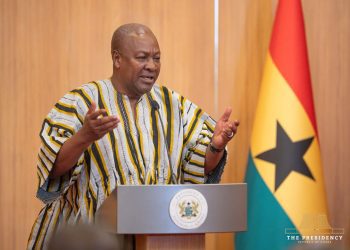
President John Dramani Mahama has reaffirmed his long-term vision for Ghana’s development with the official launch of the Ghana Infrastructure Plan (GIP), describing it as a renewed national commitment to sustainable, inclusive, and balanced infrastructure growth.
Speaking at the event, Mr. Mahama said the Ghana Infrastructure Plan (GIP) is not a new idea but a continuation of a vision that began more than a decade ago during his tenure as President.
“Today we gather not just for a launch but to rekindle a vision, a journey that started over a decade ago when I had the honor as President to initiate the development of a long-term infrastructure plan for our beloved country,” he stated.
The Ghana Infrastructure Plan, according to Mr. Mahama, serves as a 30-year national blueprint designed to guide how Ghana designs, funds, and implements infrastructure projects to support economic growth and improve quality of life.
“The Ghana Infrastructure Plan stands as a bold, forward-looking national blueprint, one that lays the foundation for building a resilient, inclusive, and future-ready Ghana,” he said.
Reflecting on Ghana’s development history, Mr. Mahama recalled the Seven-Year Development Plan launched by Dr. Kwame Nkrumah in 1963, emphasizing that infrastructure had always been the cornerstone of national progress.
“Nkrumah recognized that infrastructure was the foundation of a modern, industrialized, and self-reliant nation. He built roads, railways, schools, and energy systems to connect our people and unlock Ghana’s productive potential,” he noted.
“Yet 60 years on, we must humbly ask ourselves: how far have we progressed in fulfilling that promise?”
Citing findings from the 2024 National Annual Progress Report by the National Development Planning Commission (NDPC), Mr. Mahama revealed that Ghana recorded over GH¢70 billion in cost overruns across 18,000 capital projects, describing the figure as “a painful reflection of inefficiency and fragmentation” in infrastructure delivery.
“Despite our ambition, our infrastructure delivery has often been fragmented, politicized, and inefficient. We inherited Nkrumah’s dream, but we have yet to fulfill its promise,” he said.
President John Dramani Mahama explained that the Ghana Infrastructure Plan would realign the country’s development strategy with the government’s Big Push Agenda, the African Union’s Agenda 2063, and the United Nations Sustainable Development Goals (SDGs).
He lamented the persistent regional imbalance in national development and the lack of continuity between successive governments.
“You cannot progress as a nation when you have geographical imbalance in economic development,” he said.
“Unfortunately, new governments come, shut down initiatives like SADA, and replace them with new authorities that have made absolutely no impact.”
Mr. Mahama proposed the creation of an agro-industrial park in northern Ghana to attract investors and create jobs for young people in the region.
“We must redirect foreign investors who want to invest and give them the necessary incentives to move up north to create jobs so that our young people can have opportunities there and not drift to the south,” he emphasized.
He further assured that his administration would prioritize completing abandoned projects, in line with Article 35(7) of the 1992 Constitution, which mandates successive governments to continue projects started by their predecessors.
“Our goal is to move from scattered, politically motivated projects to unified, long-term investments that generate jobs, unlock value, and foster prosperity,” he said.
“The Big Push is not about spending more, it is about spending wisely.”
Highlighting specific projects under the plan, Mr. Mahama mentioned the Green Digital City, a 20-year sustainable innovation hub spanning parts of Greater Accra and the Eastern Region, the expansion of major water systems in Ho, Tamale, Sogakope, and Hohoe, and new strategic road and transport corridors to boost trade and ease congestion.
“These projects are not isolated interventions; they are interconnected investments within a unified national framework,” he explained.
“Each of them helps to achieve spatial equity, support industrial growth, and encourage climate-smart development.”
President John Dramani Mahama also announced a national competition, in collaboration with the NDPC, for the best artistic cover design for the Ghana Vision 2057 — a roadmap for economic transformation and shared prosperity.
“This competition encourages our youth to envision the Ghana of the future, a nation of innovation, dignity, and shared prosperity,” he said, adding that the top prizes include GH¢100,000, GH¢75,000, and GH¢50,000.
In closing, President John Dramani Mahama called for broad national cooperation to ensure the success of the Ghana Infrastructure Plan.
“The Ghana Infrastructure Plan is more than a policy document; it is a national covenant,” he declared.
“Let us not just build roads and bridges, but a Ghana that works for everyone — a Ghana where vision meets discipline, and where continuity, transparency, and innovation illuminate the path to a shared future.”
Story: Patrick Asford Boadu