President John Dramani Mahama has stated that the Power Distribution Services (PDS) initiative was not a bad policy, but failed because of poor management and the involvement of personal interests.
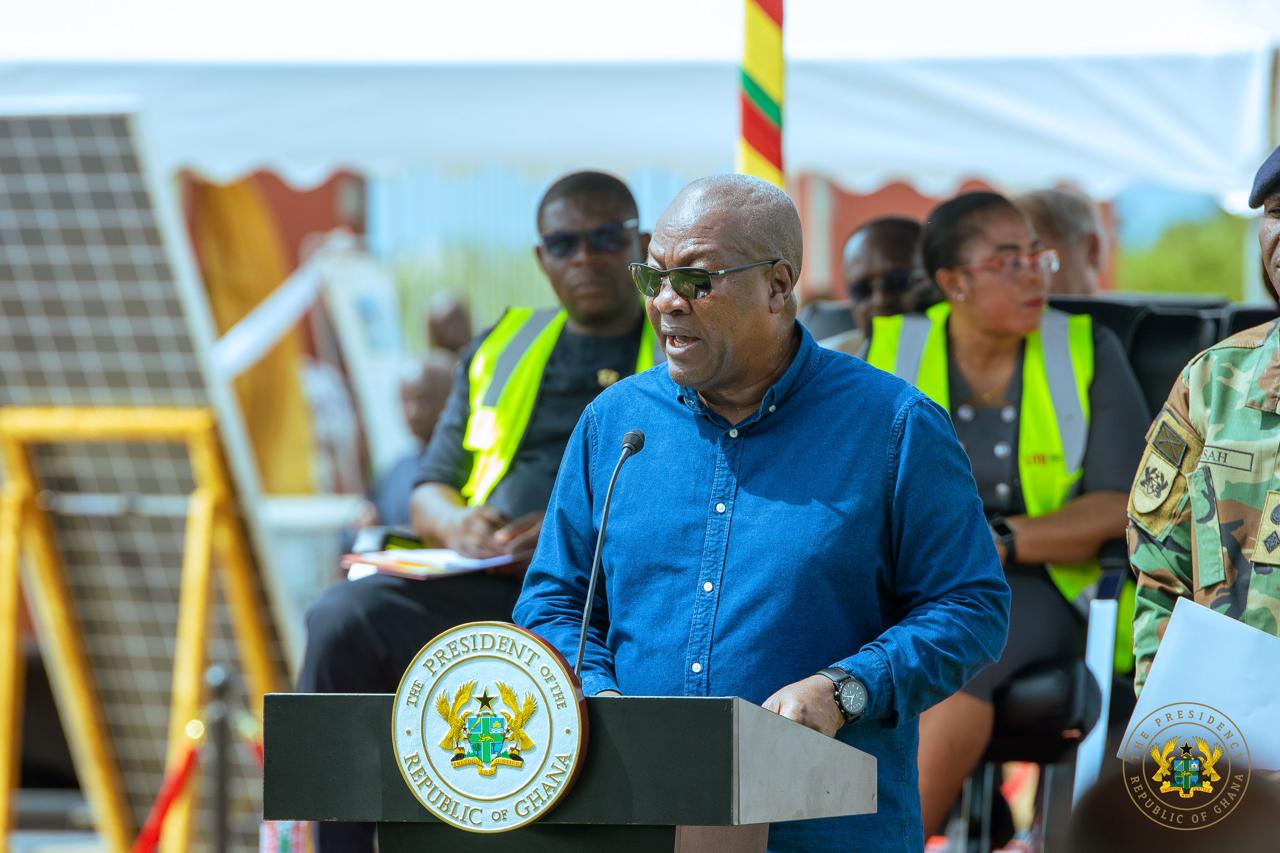
Speaking at the sod-cutting ceremony for the Solar For Industries project, President Mahama highlighted the importance of public-private partnerships in improving energy efficiency and expanding access to reliable power across the country.
“PDS was not a bad thing. It is just that it was handled wrongly, and many people had personal interests in PDS—and that is why it failed,” President Mahama said.
He noted that his administration is taking lessons from that experience and will reintroduce private sector participation in a more transparent and accountable manner, especially in the areas of water and electricity distribution.
According to the President, the government will soon begin a pilot programme that allows private companies to rehabilitate and manage small-town water systems, many of which have broken down due to weak public maintenance.
“We are going to involve private sector companies to repair those small-town water systems, distribute the water, and be responsible for bill collection,” he explained.
“After all, PURC is the one that sets the tariffs, so these companies are not going to charge beyond what Ghanaians can afford.”
He said similar private sector involvement would be introduced in electricity billing and last-mile distribution to improve revenue collection and ensure timely payment to power producers, including independent power producers (IPPs).
“We will inject efficiency in bill collection so we can pay the power generators who are producing the electricity,” he added.
Turning to the Solar for Industries project, President Mahama said it reflects his government’s vision of an energy-secure and environmentally responsible industrial future for Ghana.
“The future we are creating requires partnership rooted in trust between government, investors, community, and the environment—and this project embodies that spirit,” he said.
He outlined three pillars guiding Ghana’s long-term energy policy: Sovereignty, Sustainability, and Security of Supply. This includes expanding local renewable energy production through solar, wind, and hydro resources.
“This is how development should work—one project generating many opportunities,” he noted.
President Mahama stressed that as Ghana industrializes, it must also restore its natural environment.
“Our rivers must run clear, our forests must regenerate, and our communities must breathe clean and fresh air,” he said.
He added that the Solar for Industries project aligns with national environmental programmes such as Blue Water Guards, Tree for Life afforestation, and the Clean Ghana Campaign.
“Every megawatt of clean energy we generate is a promise fulfilled a pledge to our children that we will leave them a healthier planet than the one we inherited,” he stated.
President Mahama described the project as a defining step in Ghana’s transition toward a clean energy industrial economy.
“The Solar for Industries is not just a solar plant. It is a message that Ghana is prepared to lead Africa’s next industrial renaissance, energized by the sun, propelled by innovation, and upheld by our collective determination,” he said.
He urged all project partners to work with integrity and urgency.
“Let us build this project with integrity, speed, and purpose so that when we return to commission it, we can proudly say that this is the dawn of Ghana’s clean industrial revolution.”
Story: Patrick Asford Boadu