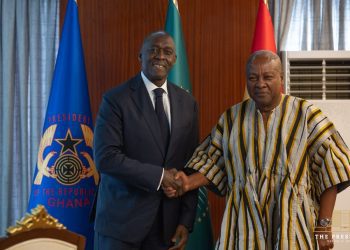
President John Dramani Mahama has called on African Union member states to renew and deepen their commitment to human rights, judicial independence, and the rule of law as the African Court on Human and Peoples’ Rights officially opened its 2026 Judicial Year and launched activities to commemorate its 20th anniversary in Arusha, Tanzania.
Delivering the keynote address as Guest of Honour under the theme “20 Years of Service in Protecting Human and Peoples’ Rights in Africa,” President Mahama described the Court as a vital continental institution that must be empowered to serve all Africans without fear or favour.
“This is why Africa needs an institution that serves all but is beholden to none,” he said. “The African Court represents our collective conscience and our shared responsibility to ensure that justice prevails over power and law over impunity.”
Personal History Shapes Commitment to Justice
In a deeply personal reflection, President Mahama recounted his childhood experiences shaped by political repression following the 1966 overthrow of Ghana’s first President, Kwame Nkrumah, during which his father, then a Minister of State, was detained without trial.
“Although I stand before you today as a Head of State, I remain the child whose father was detained for serving his country and for advising its leaders,” he said. “I learned early how dangerous it can be to challenge those in power when they act with impunity.”
He said these experiences formed the foundation of his lifelong respect for due process, judicial independence, and human dignity.
Africa’s Shared Responsibility
President Mahama noted that while Africa comprises 55 sovereign states, the continent’s history demonstrates a shared destiny, where injustice in one country often reverberates across borders.
“No one suffers injustice alone,” he said. “Human rights violations affect families, communities, and entire nations. We are, indeed, each other’s keepers.”
He commended the African Court for two decades of courage and resilience in upholding the African Charter on Human and Peoples’ Rights (Banjul Charter), describing the institution as central to Africa’s moral and legal architecture.
Call for Ratification and Respect for Judgments
President Mahama urged African Union member states that have not yet ratified the Protocol establishing the Court to do so without delay.
He also called on states to respect and implement the Court’s judgments and to allow individuals and civil society organisations direct access to the Court.
“You have nothing to fear from this Court,” he assured his fellow leaders. “Its work strengthens justice, accountability, and public trust in governance.”
Africa’s Greatest Wealth Is Its People
Marking the 20th anniversary of the Court, President Mahama reflected on Africa’s lost potential due to repression, exile, and the silencing of visionary leaders across the continent.
“Imagine an Africa that measures its wealth not by minerals, but by people assured of dignity, liberty, and self-determination,” he said.
With Africa’s population projected to reach 2.5 billion by 2050, he described the continent’s youthful population as both a powerful asset and a solemn responsibility.
Ghana’s Contribution to the Court
President Mahama reaffirmed Ghana’s commitment to the African Court, highlighting the service of Ghanaian jurists including former Court President Justice Sophia Akuffo and current judge Justice Dennis Adjei.
“Ghana remains firmly committed to strengthening justice systems at home and across Africa,” he said.
Looking Ahead
As the Court enters its third decade, President Mahama challenged African leaders to honour the aspirations of past generations by strengthening continental institutions and safeguarding human rights for the future.
“Now is the time to deepen our commitment to this Court,” he declared. “So that when we celebrate its 40th anniversary, it will stand as a model international judicial body and a beacon of justice for Africa.”
He concluded by formally declaring the 2026 Judicial Year of the African Court on Human and Peoples’ Rights officially open, drawing sustained applause from judges, diplomats, and invited guests gathered in Arusha.
Story: Patrick Asford Boadu