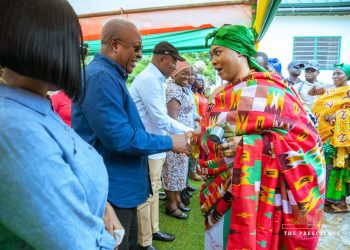
President John Dramani Mahama has praised Tanzania’s hospitality and the serene beauty of Arusha, describing the city as a fitting home for peace, diplomacy, and justice, as he arrived ahead of the opening of the 2026 Judicial Year of the African Court on Human and Peoples’ Rights and the court’s 20th anniversary celebrations.
“It was a smooth flight, five hours forty minutes. It’s not so far,” President Mahama said. “We arrived safely in the beautiful city of Arusha.
It’s my first visit, even though I’ve heard so much about it. All the attributes you gave a city of peace, diplomacy, and justice are very fitting.”
The Ghanaian leader recounted being struck by the city’s greenery and scenic views, noting with a smile that he had shared a video of Arusha with his wife. “I told her this is our next vacation destination. She said, ‘Wow, it’s so beautiful,’” he added.
President Mahama underscored the deep historical ties between Ghana and Tanzania, rooted in the friendship between Ghana’s first President Osagyefo Dr. Kwame Nkrumah and Tanzania’s founding leader Julius Nyerere. “We have a joint history that has metamorphosed into shared values, making it easier to build an even closer relationship,” he said.
He revealed that discussions are underway to establish a Permanent Joint Commission for Cooperation (PJCC) between the two countries ahead of a proposed state visit.
“It’s an issue we want to deal with as quickly as possible so that by the time of the state visit, we can sign MOUs that structure our cooperation,” he noted.
Mining, Agriculture, and Value Addition
Touching on shared economic priorities, President Mahama highlighted mining as a significant contributor to both economies.
He said Ghana has recently tightened its gold export regime to exercise greater sovereignty over natural resources. “Within nine months of the new regulation, we increased small-scale gold exports from 63 tons to 104 tons, bringing about $10 billion into the economy,” he said.
On agriculture, he pointed to the cocoa sector and the vulnerabilities of exporting raw commodities.
“We produce a crop, but we don’t control the price,” he said, citing a sharp fall in cocoa prices. Ghana, he announced, will begin financing cocoa purchases domestically in cedis and prioritize local processing.
“From next season, we aim to process at least 400,000 tons locally so we can add value before export.”
He also identified fintech and cybersecurity as areas where Ghana can share expertise, noting the rapid adoption of digital solutions among Ghanaian youth.
Democracy, Reconciliation, and Justice
President Mahama congratulated Tanzania’s leadership on its recent elections and commended the establishment of an independent commission to investigate post-election events.
“These commissions help us learn lessons so such incidents do not recur,” he said, adding that reconciliation is vital in multiparty democracies.
At the continental level, he called on African states that have not ratified the protocol establishing the African Court to do so. “It is a court we can be proud of as Africans,” he said.
Reparations and Global Stability
As the African Union’s Champion on Reparations, President Mahama said Africa is making decisive moves on reparative justice.
He recalled that the AU declared 2025 the Year of Reparative Justice and extended it into a decade. Ghana, he said, will table a motion at the UN to recognize the transatlantic slave trade as the gravest crime against humanity.
“This is an urgent first step in the call for reparations,” he stressed, thanking Tanzania for its support and leadership in the process.
He concluded by expressing concern over escalating geopolitical tensions in the Middle East, warning of their impact on global oil supplies. “We call for the cessation of conflict and a return to dialogue so that peace can return to that region and our people can be protected,” President Mahama said.
Story: Patrick Asford Boadu