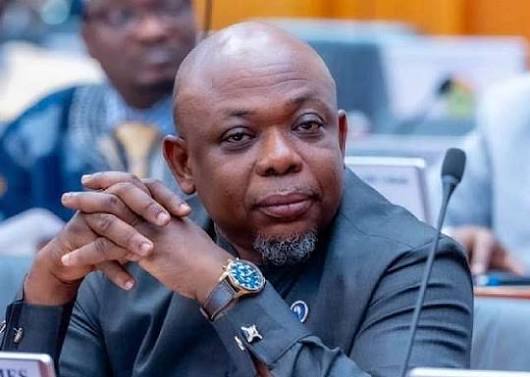
In a detailed press statement delivered today, Thursday September 24, Majority Leader James Agalga outlined the state of Ghana’s counter-narcotics efforts, revealing a sweeping restructuring of the Narcotics Control Commission (NACOC) under the administration of President John Dramani Mahama.
Addressing journalists, Agalga framed the recent policy shift as a transition away from an era of severe institutional neglect toward an aggressive, data-driven national defense against organized drug syndicates.
Agalga stated that prior to 2025, NACOC operated under severe structural limitations that exposed the nation’s borders to transnational cartels. The agency was tasked with securing a country of over 30 million people with fewer than 1,500 personnel nationwide, leaving vast communities completely unmonitored.
This vulnerability, according to him was compounded by a 2018 policy change that removed NACOC from mandatory joint cargo inspections at the Tema Port, stripping the agency of oversight at Ghana’s busiest entry point. Furthermore, without dedicated courts, drug cases were forced onto standard criminal dockets, creating judicial bottlenecks that favored trafficking networks. Deprived of operational vehicles, modern digital tools, and in-house forensic labs, the commission was left trying to fight 21st-century networks with outdated methods.
He revealed that since March 2025, targeted investments, policy realignments, and structural expansions have fundamentally altered the agency’s operational capacity. NACOC recorded 217 arrests across 165 cases in 2025, representing a 197 percent increase compared to the 73 arrests made in 2024. Out of these suspects, 95 were referred to court, 120 remain under active investigation, and six convictions have been secured to date.
These enforcement efforts led to the seizure of nearly 1,500 kilograms of narcotics valued at over $5.2 million, alongside tens of thousands of units of controlled pharmaceuticals. Crucially, the administration shifted focus toward financial disruption, restraining over GH₵ 6.9 million, $140,000 USD, and nearly 20 kilograms of gold linked to money laundering operations.
The Majority Leader explained that to tackle structural delays and improve coverage, the government established special delegated courts dedicated exclusively to narcotics offenses to clear long-standing case backlogs. Human capacity was significantly expanded through the training of 495 new officers in 2025, the largest cohort in the agency’s history with executive approval granted to recruit an additional 1,200 personnel.
NACOC also expanded its presence from under 10 district commands to 77 across all 16 regions, backed by 35 new operational vehicles, advanced digital forensic software such as i2 Analyst Notebook and Cellebrite Insight PRO, and an ongoing project to build an in-house forensic laboratory.
While highlighting these advances, Agalga acknowledged that the transformation is an ongoing process. Moving forward, the government’s strategic focus centers on restoring full end-to-end oversight for NACOC across maritime ports, including direct integration into ICUMS and mandatory joint inspections.
The Majority Leader called for enhanced operational coordination between NACOC, the Ghana Police Service, Ghana Immigration Service, EOCO, and the National Intelligence Bureau. He concluded by urging the public, media, and Parliament to evaluate the administration’s counter-narcotics progress based on verified evidence while holding security institutions to these expanded standards.
Eugenia Ewoenam Osei