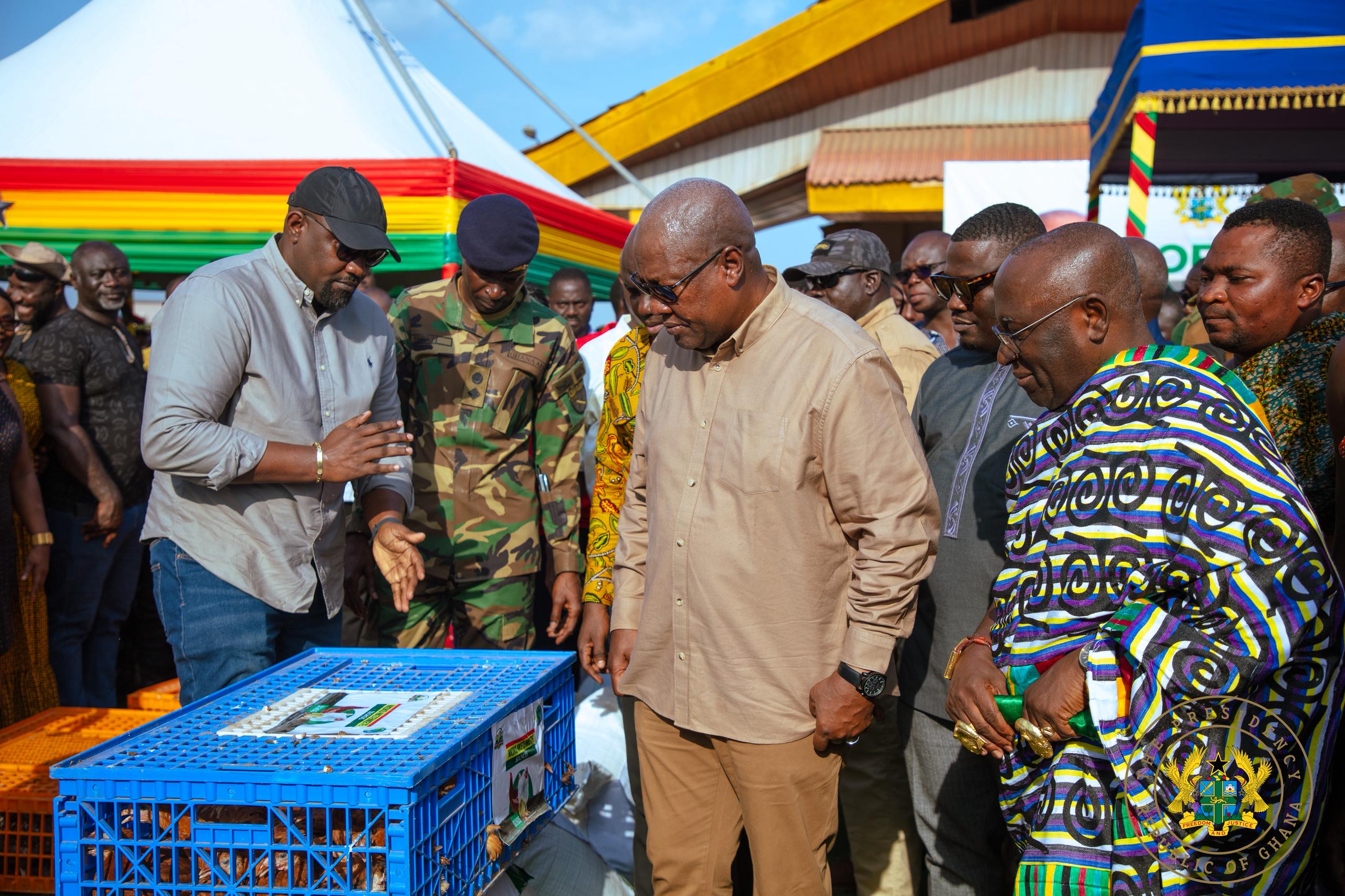
President John Dramani Mahama has officially launched the Nkoko Nkitinkiti Household and Backyard Poultry Production Initiative, describing it as a national movement aimed at restoring food self-sufficiency, strengthening household resilience, and fostering sustainable livelihoods for tens of thousands of Ghanaians.
Speaking at Jubilee Park in Kumasi, President Mahama said the initiative is part of the Poultry Industry Revitalization Program, a flagship component of the government’s broader Feed Ghana Program, which seeks agricultural transformation, food sovereignty, and inclusive growth.
“This initiative is more than just a government intervention; it is a courageous step towards ensuring sustainable livelihoods, especially for women, youth, and vulnerable families across our country,” he said.
The President outlined challenges facing Ghana’s poultry sector, including high feed costs, limited access to improved breeds, inadequate processing capacity, and over-reliance on imports. He noted that in 2023 alone, Ghana spent over $350 million on imported poultry products, draining foreign exchange and limiting opportunities for local farmers.
“We must and we will reverse this trend. The time has come for Ghana to reclaim the pride of producing, processing, and consuming what we ourselves grow,” he said.
Under the Feed Ghana Program, the government is executing a three-pronged strategy to restore the poultry value chain:
Poultry Farm-to-Table Project – Anchor farmers: 50 carefully selected large-scale poultry producers across the country, each equipped with 80,000 beds, housing, logistics, and technical support, expected to produce 4 million beds collectively.
Food Systems Resilience Program – Supporting 500 small and medium-scale poultry farmers nationwide to produce 3 million beds.
Nkoko Nkitinkiti Backyard Poultry for Nutrition and Livelihoods – Bringing poultry production directly to homes, schools, and communities. Vulnerable households will receive pullets, starter packs, feed support, and technical guidance.
In this phase, 3 million beds will be distributed across all 276 constituencies, benefiting approximately 60,000 households, with each household receiving 50 beds.
“The breeds, pullets, and cockerels have been selected for their resilience, adaptability, and high productivity under local conditions,” President Mahama explained.
The initiative has already been piloted in 13 districts, benefiting 13,000 farmers. The pilot demonstrated that backyard poultry production is not a marginal activity but a transformative route to better nutrition, job creation, and local agribusiness development.
“Every household poultry enterprise must develop into a sustainable micro-enterprise capable of generating income, creating jobs, and contributing to the nation’s food security,” the President said.
To complement increased production, the government is establishing a modern poultry processing factory in Bechem, Bono Region, which will provide a ready market for small- and medium-scale producers in Bono, Ashanti, and Bono East regions.
President Mahama concluded by outlining the long-term ambition of the program:
“Our target is to increase Ghana’s poultry self-sufficiency from 12% today to over 75% by 2028.
The Nkoko Nkitinkiti Initiative represents not only poultry production but a spirit of renewal and self-belief. Let us take pride in producing what we eat and eating what we make.”
The Nkoko Nkitinkiti Initiative is expected to create sustainable livelihoods, strengthen household food security, and reduce Ghana’s dependence on imported poultry products.
Story: Patrick Asford Boadu