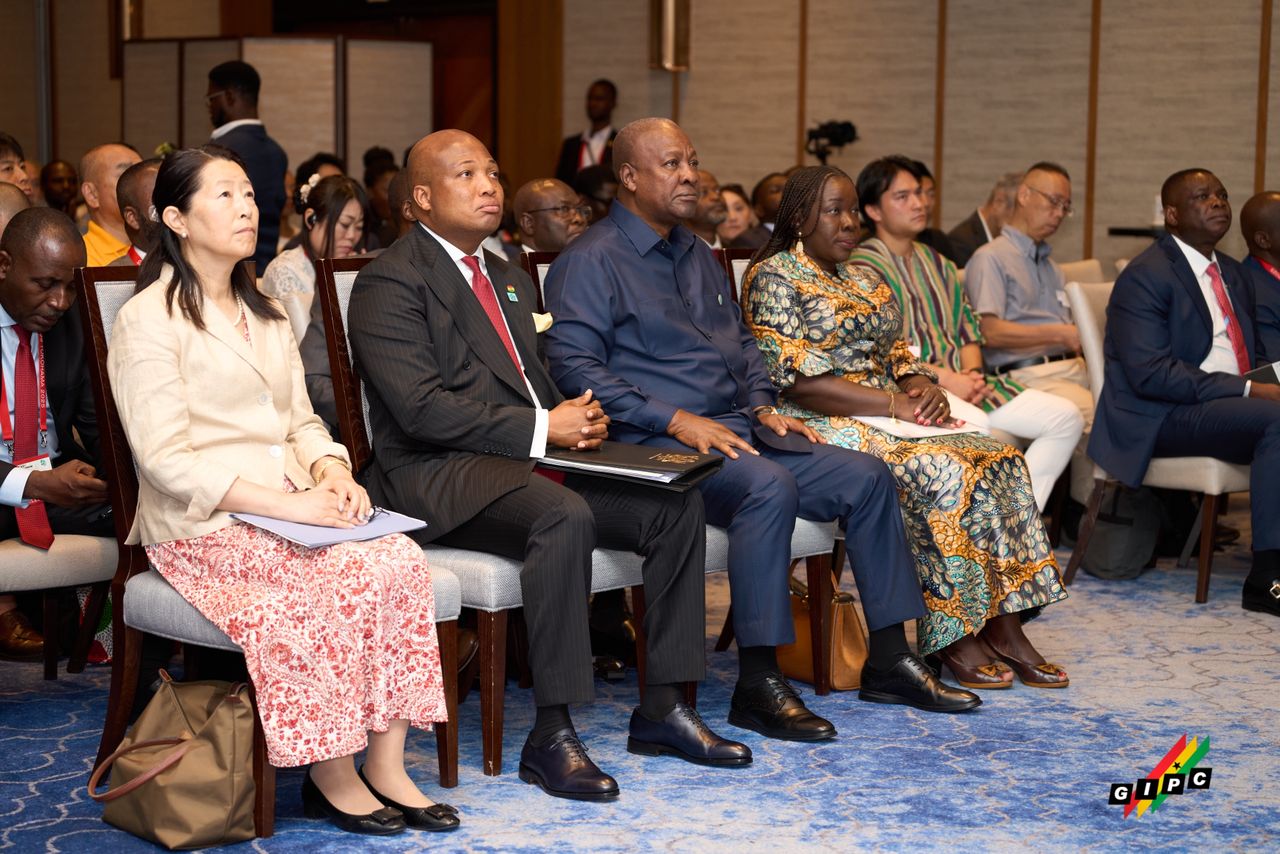
More than 100 Japanese companies gathered in Yokohama, Japan, to explore investment opportunities in Ghana at a Presidential Investment Forum organised by the Ghana Investment Promotion Centre (GIPC). The forum was held on the sidelines of the ninth Tokyo International Conference on African Development (TICAD-9). This was disclosed in a statement issued by the Ghana Investment Promotion Centre (GIPC).
The event, themed “Ghana is Open for Business – Unleashing Investment Opportunities for Shared Prosperity”, was organised in partnership with Ghana’s Ministry of Foreign Affairs, the Ghana Export Promotion Authority (GEPA), the Ministry of Trade, Agribusiness and Industry (MOTAI), and the Japan External Trade Organisation (JETRO).
According to the statement, President John Dramani Mahama delivered the keynote address, urging Japanese investors to see Ghana as their preferred entry point into Africa. “Ghana is a stable, democratic, business-friendly gateway to West Africa,” he said, stressing the country’s strategic location, macroeconomic stability, and reforms aimed at improving the ease of doing business.
The statement said President Mahama also announced specific commitments to facilitate Japanese investment, including “fast-track approvals, ready industrial sites, sovereign guarantees, and blended financing frameworks.” He further appealed to firms to commit to technology transfer and training agreements for Ghanaian workers. “My three requests are simple. Pilot with us, partner to scale, and invest in people,” he told participants.
Delivering a strategic investment pitch, the CEO of GIPC, Mr Simon Madjie, outlined Ghana’s 24-Hour Economy and Accelerated Export Development Programme (24H+). He explained that the initiative is designed to extend business operations “beyond traditional hours, boosting productivity, job creation, and market access.”
“Investors were assured of financial incentives such as tax rebates, duty waivers, and export bonuses to support businesses operating under this model,” Mr Madjie stated in the release.
The statement also tied Ghana’s investment drive to the Big Push Agenda, a US$10 billion infrastructure plan targeting transport, logistics, water systems, agriculture, and energy. It further listed a wide range of incentives for investors, including “corporate tax holidays for agro-processing, manufacturing, and renewable energy, location-based tax reductions for businesses outside Accra and Tema, customs duty exemptions on machinery and equipment, free zone benefits, export incentives and guarantees against expropriation, and full repatriation of profits.”
Among the strategic projects highlighted were the Volta Economic Corridor, the Legon Pharmaceutical Innovation Park, and the Kumasi Machinery & Technology Park, which were described as ready investment destinations.
Japanese companies were also encouraged to explore opportunities in “automotive and electric vehicle assembly, agro-industrial parks and food processing, renewable energy and grid infrastructure, pharmaceuticals and healthcare, digital economy and smart manufacturing, as well as tourism, arts, and heritage development.”
The release noted that the presentation “was widely acknowledged by participants for its clarity, strategic alignment, and actionable insights.” Several Japanese firms expressed interest in undertaking feasibility studies and pilot projects in Ghana, signalling what officials described as a renewed momentum in Ghana–Japan economic cooperation.
By: Victor Lavor